Personalized accelerated pacing was associated with fewer clinical events in patients with heart failure
Clinical Outcomes With Personalized Accelerated Physiologic Pacing in Heart Failure With Preserved Ejection Fraction: Follow-up of the myPACE Trial
Observational extension of a randomized clinical trialMixed results
Does personalized accelerated physiologic pacing reduce adverse clinical events in heart failure with preserved ejection fraction?
Who
100
100 patients with stage B or C heart failure with preserved ejection fraction · University of Vermont Medical Center
Compared
personalized accelerated pacing: 15 vs 33 events
usual care: 33 events
Main outcome
accrual of first and recurrent adverse clinical events
Result: hazard ratio 0.63 (95% CI 0.31-1.29)
Bottom line: Intention-to-treat analysis showed no significant difference, but per-protocol analysis suggested personalized pacing reduces adverse clinical events.
Limitation: results are hypothesis generating and warrant confirmation in larger multicenter trials
JAMA Cardiol · 2025-08-29Download image
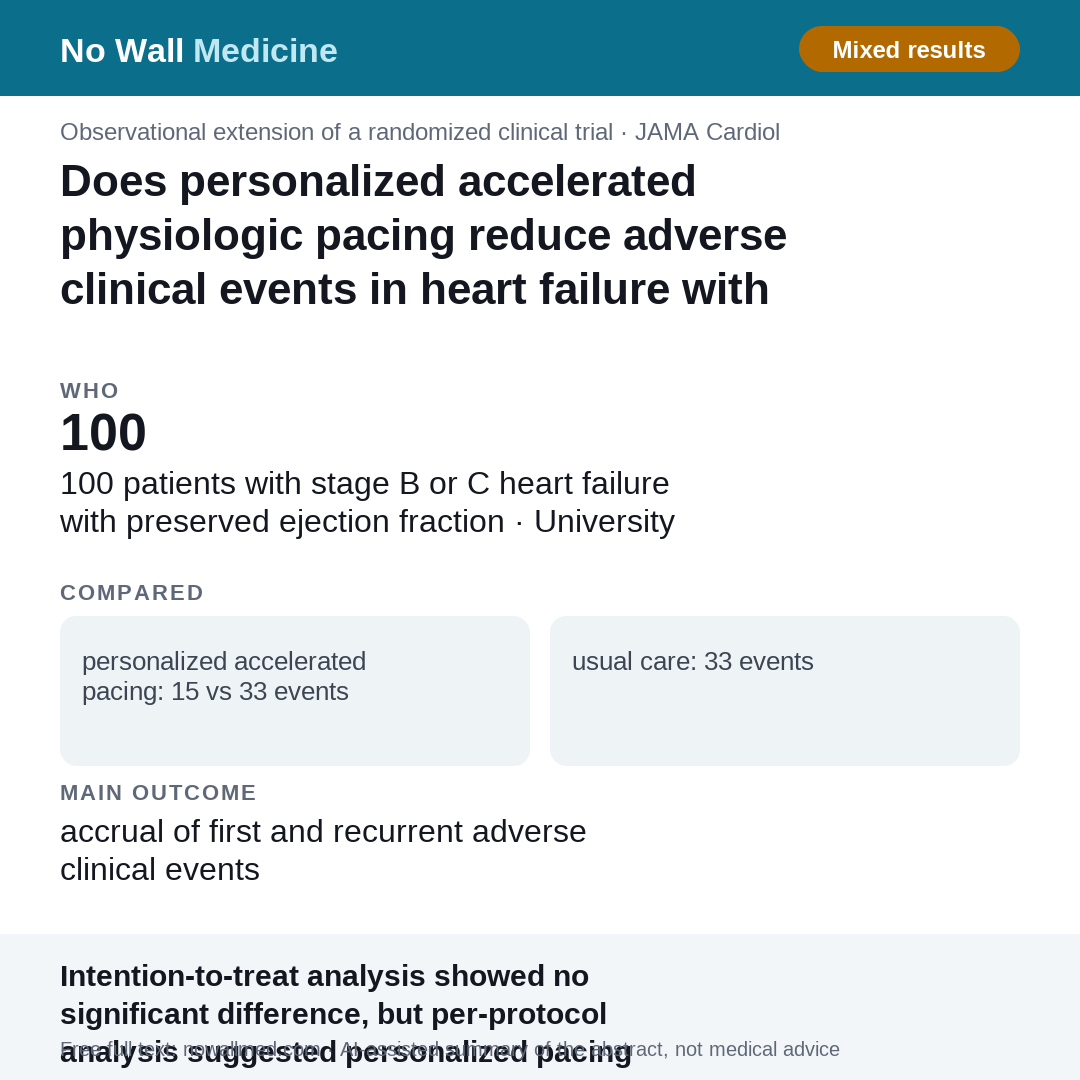
Clinical question: Does personalized accelerated physiologic pacing reduce adverse clinical events in heart failure with preserved ejection fraction?
Why it matters: It is unclear if pacing rates above the standard 60 beats per minute benefit patients with heart failure and preserved ejection fraction.
Key points
- Researchers followed 100 patients with heart failure and preserved ejection fraction who had preexisting pacemakers for up to 4 years.
- In the per-protocol analysis of 87 patients, personalized accelerated pacing was associated with 5 events compared to 31 events in usual care.
- The intention-to-treat analysis of all 100 participants did not reach statistical significance for event accrual or event-free survival.
Limitation the authors note: This was an observational extension of a randomized clinical trial and the results are hypothesis generating.
Headline and key points written with AI from the paper’s abstract, with every number checked against it. Read the paper before relying on them.
Topics
Cite this article
Infeld M, Cyr J, Novelli AE, Rawlings R, Wahlberg K, Plante TB. Clinical Outcomes With Personalized Accelerated Physiologic Pacing in Heart Failure With Preserved Ejection Fraction: Follow-up of the myPACE Trial. JAMA Cardiol. 2025. doi:10.1001/jamacardio.2025.2827
Spotted a mistake? Suggest a correction
Top studies every Monday
The week’s key trials and guidelines in your specialties, plus any topics you follow. By email, free.
Get the weekly digest