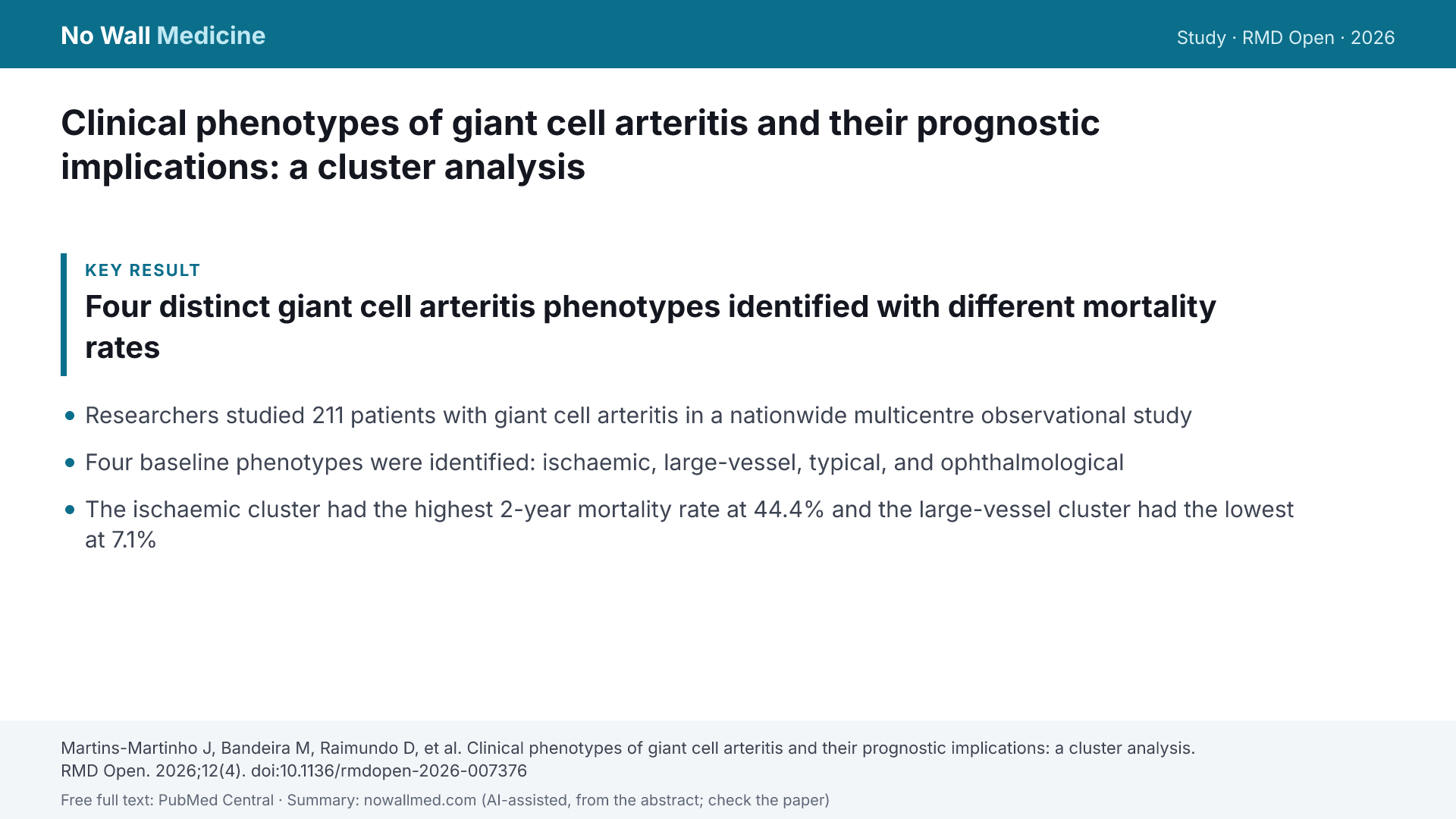
Four distinct giant cell arteritis phenotypes identified with different mortality rates
Clinical phenotypes of giant cell arteritis and their prognostic implications: a cluster analysis
Why it matters: Doctors have had limited understanding of clinical heterogeneity in giant cell arteritis and its implications for treatment
Key points
- Researchers studied 211 patients with giant cell arteritis in a nationwide multicentre observational study.
- Four baseline phenotypes were identified: ischaemic, large-vessel, typical, and ophthalmological.
- The ischaemic cluster had the highest 2-year mortality rate at 44.4% and the large-vessel cluster had the lowest at 7.1%.
Limitation the authors note: The study was observational, which may limit the ability to establish cause-and-effect relationships
Study type: Observational study: it can show a link, but not prove that one thing causes another.
Headline and key points written with AI from the paper’s abstract, with every number checked against it. Read the paper before relying on them.
Was this summary helpful?
Headline, design, result, key points, caveat and citation as plain text.
Cite this article
Martins-Martinho J, Bandeira M, Raimundo D, et al. Clinical phenotypes of giant cell arteritis and their prognostic implications: a cluster analysis. RMD Open. 2026;12(4). doi:10.1136/rmdopen-2026-007376
Spotted a mistake? Suggest a correction