McLernon's post-treatment model performed best at predicting live births in IVF and ICSI
Clinical prediction models for in vitro fertilization outcomes: a systematic review, meta-analysis, and external validation
Systematic review and meta-analysisBenefit found
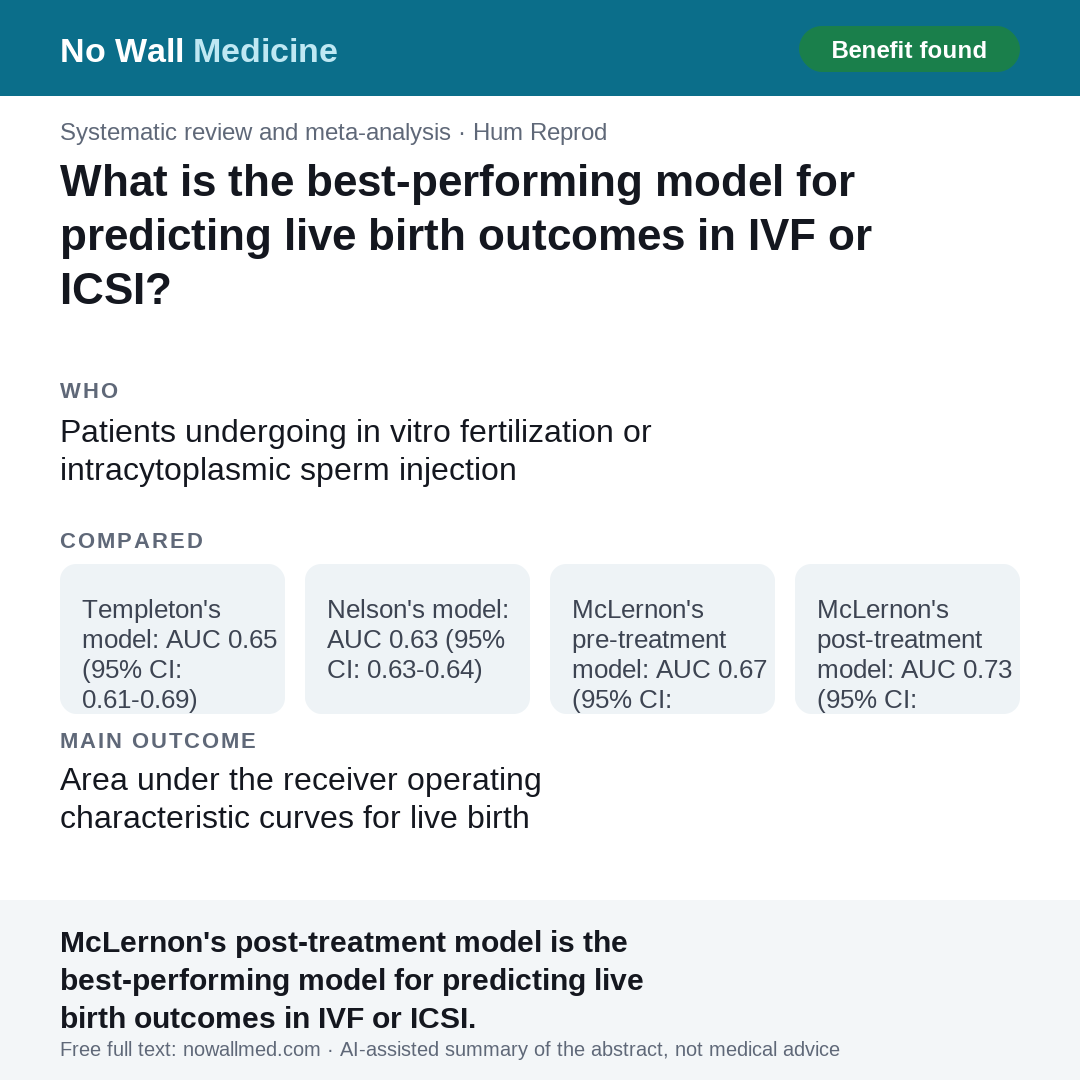
What is the best-performing model for predicting live birth outcomes in IVF or ICSI?
Who
Patients undergoing in vitro fertilization or intracytoplasmic sperm injection
Compared
Templeton's model: AUC 0.65 (95% CI: 0.61-0.69)
Nelson's model: AUC 0.63 (95% CI: 0.63-0.64)
McLernon's pre-treatment model: AUC 0.67 (95% CI: 0.62-0.71)
McLernon's post-treatment model: AUC 0.73 (95% CI: 0.71-0.75)
Main outcome
Area under the receiver operating characteristic curves for live birth
Result: McLernon's post-treatment model AUC 0.73 (95% CI 0.71-0.75)
Bottom line: McLernon's post-treatment model is the best-performing model for predicting live birth outcomes in IVF or ICSI.
Limitation: Focus on English-language studies and live birth outcomes may constrain generalizability to diverse populations.
Funded by: National Natural Science Foundation of China
Hum Reprod · 2025-02-22Download image
Clinical question: What is the best-performing model for predicting live birth outcomes in IVF or ICSI?
Why it matters: There is a lack of validated evidence to distinguish high-quality from low-quality prediction tools for live birth outcomes in in vitro fertilization.
Key points
- Researchers conducted a meta-analysis of 72 studies containing 86 prognostic models and 132 predictors to evaluate their ability to predict live births.
- McLernon's post-treatment model showed the highest area under the receiver operating characteristic curve (a measure of predictive accuracy) of 0.73 (95% CI: 0.71-0.75).
- Other models analyzed included Templeton's at 0.65 (95% CI: 0.61-0.69), Nelson's at 0.63 (95% CI: 0.63-0.64), and the intelligent data analysis score (iDASScore) at 0.66 (95% CI: 0.63-0.68).
Limitation the authors note: The focus on English-language studies and live birth outcomes may constrain the generalizability of the findings to diverse populations.
Headline and key points written with AI from the paper’s abstract, with every number checked against it. Read the paper before relying on them.
Topics
Cite this article
Tian CH, Liu LY, Huang YF, Yang HJ, Lai YY, Li CL. Clinical prediction models for in vitro fertilization outcomes: a systematic review, meta-analysis, and external validation. Hum Reprod. 2025. doi:10.1093/humrep/deaf013
Spotted a mistake? Suggest a correction
Top studies every Monday
The week’s key trials and guidelines in your specialties, by email. Free.
Get the weekly digest