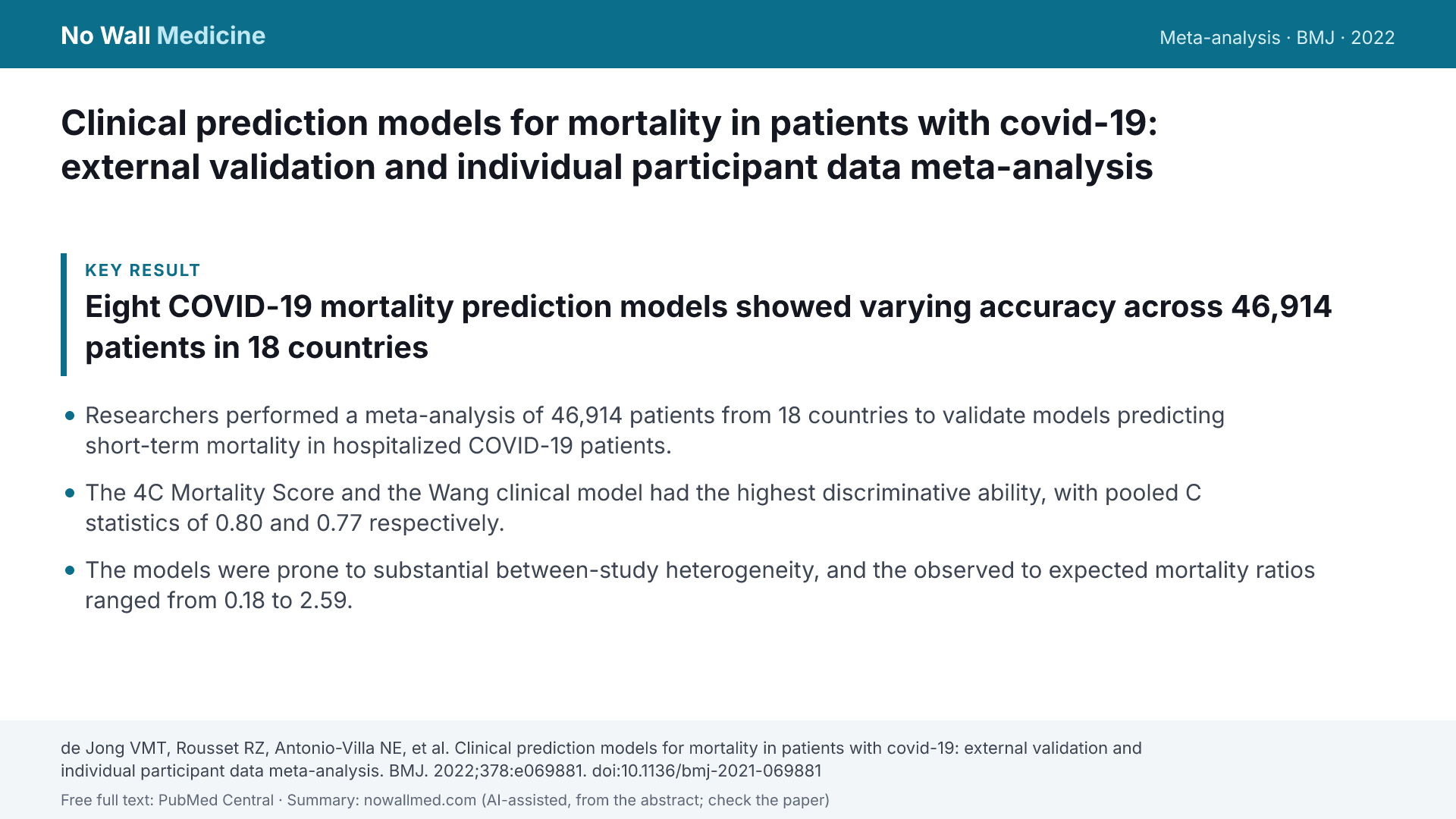
Eight COVID-19 mortality prediction models showed varying accuracy across 46,914 patients in 18 countries
Clinical prediction models for mortality in patients with covid-19: external validation and individual participant data meta-analysis
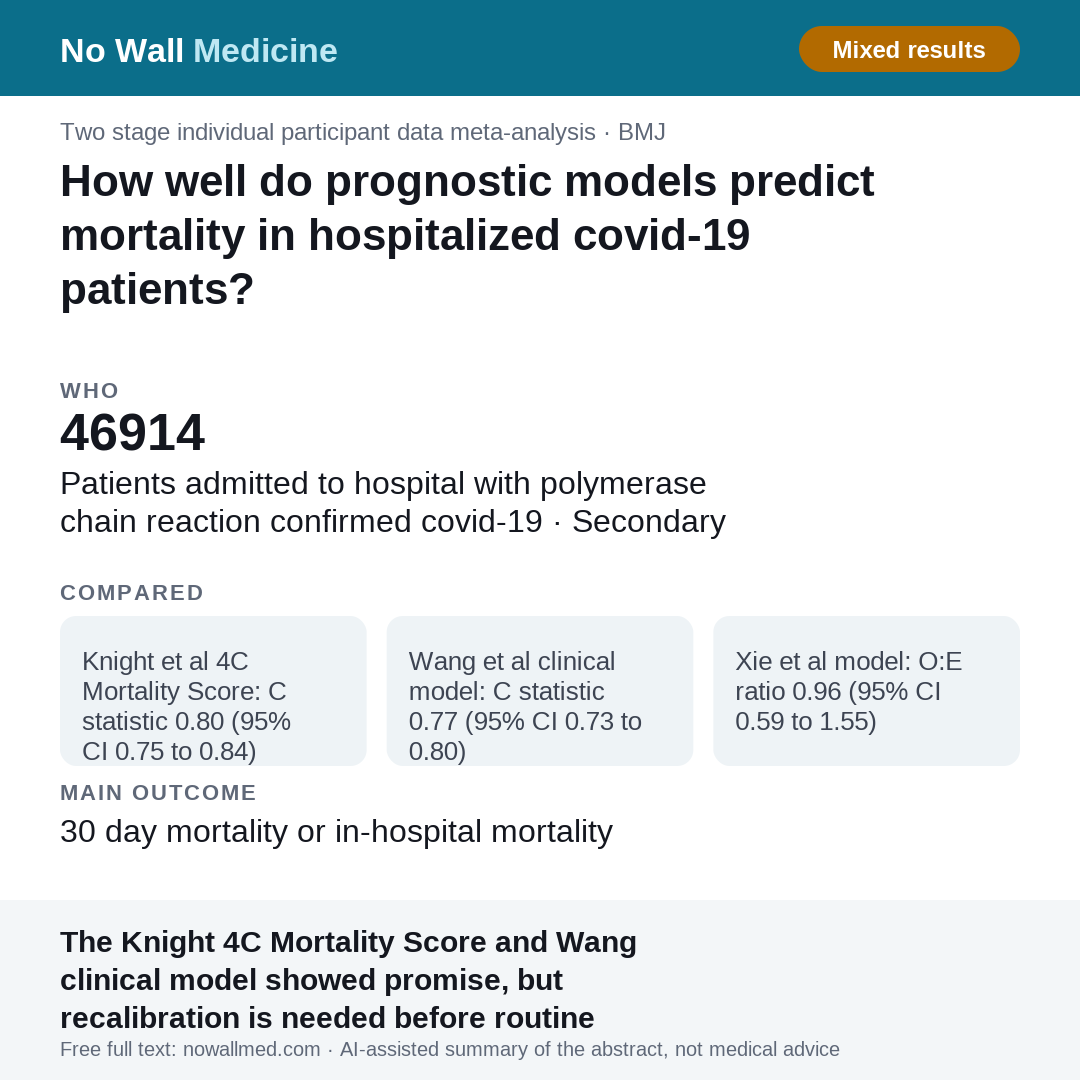
Two stage individual participant data meta-analysisMixed results
How well do prognostic models predict mortality in hospitalized covid-19 patients?
Who
46914
Patients admitted to hospital with polymerase chain reaction confirmed covid-19 · Secondary and tertiary care in 18 countries
Compared
Knight et al 4C Mortality Score: C statistic 0.80 (95% CI 0.75 to 0.84)
Wang et al clinical model: C statistic 0.77 (95% CI 0.73 to 0.80)
Xie et al model: O:E ratio 0.96 (95% CI 0.59 to 1.55)
Main outcome
30 day mortality or in-hospital mortality
Bottom line: The Knight 4C Mortality Score and Wang clinical model showed promise, but recalibration is needed before routine clinical implementation.
Limitation: The prognostic value of the included models varied greatly between the data sources.
BMJ · 2022-07-12Download image
Clinical question: How well do prognostic models predict mortality in hospitalized covid-19 patients?
Why it matters: It was unknown how accurately existing prognostic models could predict short-term mortality for patients hospitalized with COVID-19 across different global settings.
Key points
- Researchers performed a meta-analysis of 46,914 patients from 18 countries to validate models predicting short-term mortality in hospitalized COVID-19 patients.
- The 4C Mortality Score and the Wang clinical model had the highest discriminative ability, with pooled C statistics of 0.80 and 0.77 respectively.
- The models were prone to substantial between-study heterogeneity, and the observed to expected mortality ratios ranged from 0.18 to 2.59.
Limitation the authors note: The prognostic value of the included models varied greatly between the data sources.
Headline and key points written with AI from the paper’s abstract, with every number checked against it. Read the paper before relying on them.
Was this summary helpful?
Abstract
Objective
To externally validate various prognostic models and scoring rules for predicting short term mortality in patients admitted to hospital for covid-19. Design
Two stage individual participant data meta-analysis. Setting
Secondary and tertiary care. Participants
46 914 patients across 18 countries, admitted to a hospital with polymerase chain reaction confirmed covid-19 from November 2019 to April 2021. Data sources
Multiple (clustered) cohorts in Brazil, Belgium, China, Czech Republic, Egypt, France, Iran, Israel, Italy, Mexico, Netherlands, Portugal, Russia, Saudi Arabia, Spain, Sweden, United Kingdom, and United States previously identified by a living systematic review of covid-19 prediction models published in The BMJ, and through PROSPERO, reference checking, and expert knowledge. Model selection and eligibility criteria
Prognostic models identified by the living systematic review and through contacting experts. A priori models were excluded that had a high risk of bias in the participant domain of PROBAST (prediction model study risk of bias assessment tool) or for which the applicability was deemed poor. Methods
Eight prognostic models with diverse predictors were identified and validated. A two stage individual participant data meta-analysis was performed of the estimated model concordance (C) statistic, calibration slope, calibration-in-the-large, and observed to expected ratio (O:E) across the included clusters. Main outcome measures
30 day mortality or in-hospital mortality. Results
Datasets included 27 clusters from 18 different countries and contained data on 46 914patients. The pooled estimates ranged from 0.67 to 0.80 (C statistic), 0.22 to 1.22 (calibration slope), and 0.18 to 2.59 (O:E ratio) and were prone to substantial between study heterogeneity. The 4C Mortality Score by Knight et al (pooled C statistic 0.80, 95% confidence interval 0.75 to 0.84, 95% prediction interval 0.72 to 0.86) and clinical model by Wang et al (0.77, 0.73 to 0.80, 0.63 to 0.87) had the highest discriminative ability. On average, 29% fewer deaths were observed than predicted by the 4C Mortality Score (pooled O:E 0.71, 95% confidence interval 0.45 to 1.11, 95% prediction interval 0.21 to 2.39), 35% fewer than predicted by the Wang clinical model (0.65, 0.52 to 0.82, 0.23 to 1.89), and 4% fewer than predicted by Xie et al's model (0.96, 0.59 to 1.55, 0.21 to 4.28). Conclusion
The prognostic value of the included models varied greatly between the data sources. Although the Knight 4C Mortality Score and Wang clinical model appeared most promising, recalibration (intercept and slope updates) is needed before implementation in routine care.
Abstract reproduced under the article’s CC BY licence.
Subject terms
Cite this article
de Jong VMT, Rousset RZ, Antonio-Villa NE, Buenen AG, Van Calster B, Bello-Chavolla OY. Clinical prediction models for mortality in patients with covid-19: external validation and individual participant data meta-analysis. BMJ. 2022. doi:10.1136/bmj-2021-069881
Spotted a mistake? Suggest a correction