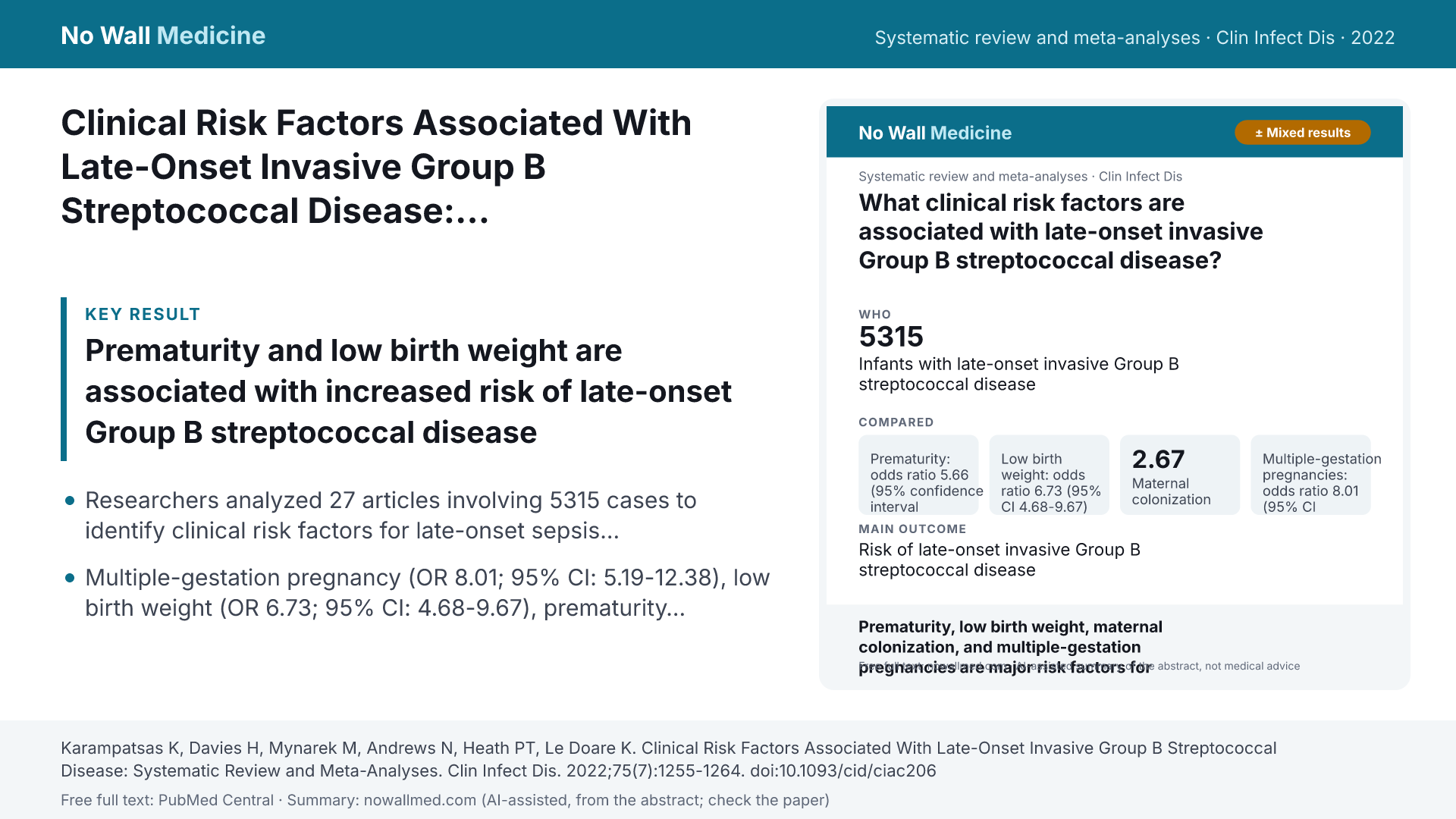
Prematurity and low birth weight are associated with increased risk of late-onset Group B streptococcal disease
Clinical Risk Factors Associated With Late-Onset Invasive Group B Streptococcal Disease: Systematic Review and Meta-Analyses
Systematic review and meta-analysesMixed results
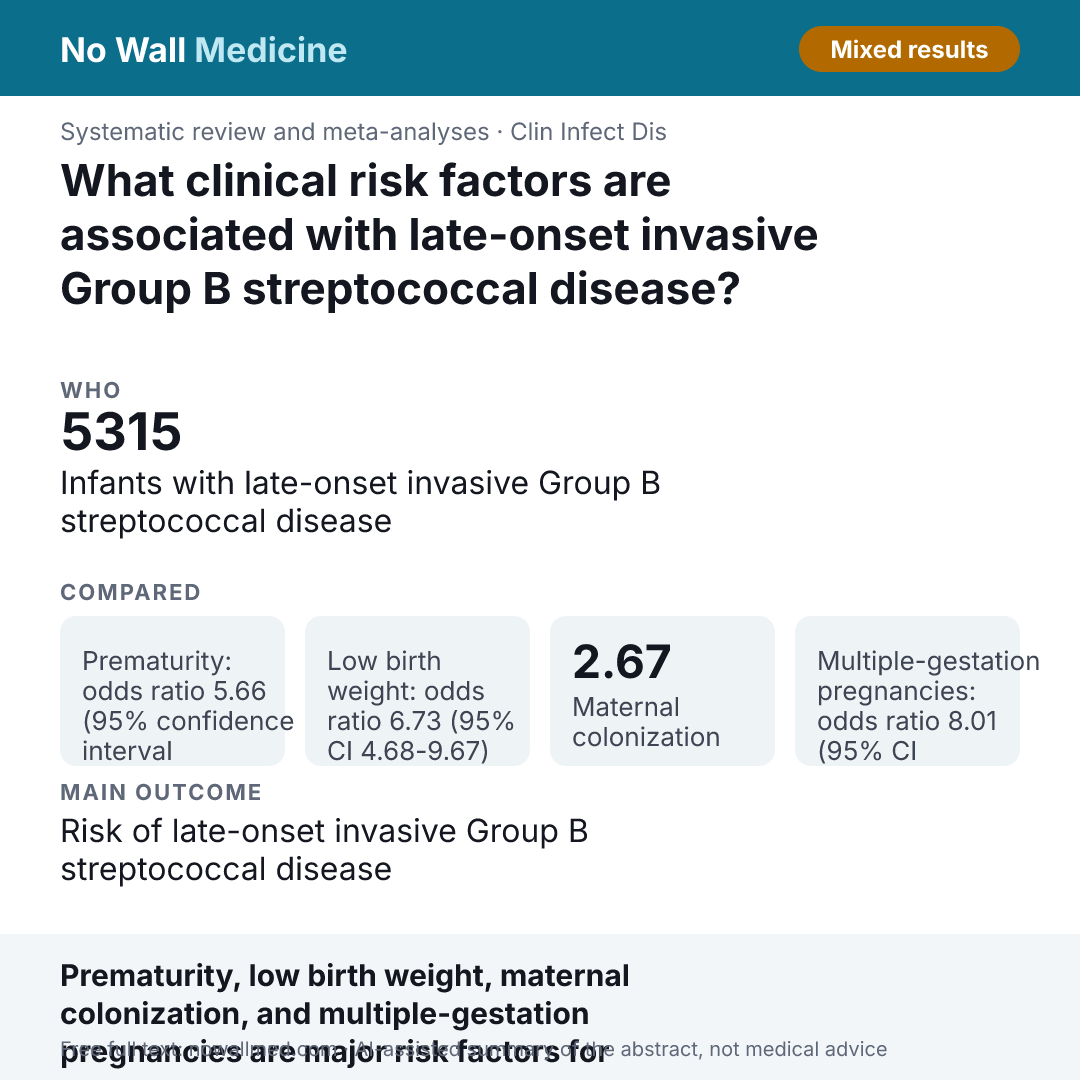
What clinical risk factors are associated with late-onset invasive Group B streptococcal disease?
Who
5315
Infants with late-onset invasive Group B streptococcal disease
Compared
Prematurity: odds ratio 5.66 (95% confidence interval 4.43-7.22)
Low birth weight: odds ratio 6.73 (95% CI 4.68-9.67)
2.67Maternal colonization (2.07-3.45)
Multiple-gestation pregnancies: odds ratio 8.01 (95% CI 5.19-12.38)
Main outcome
Risk of late-onset invasive Group B streptococcal disease
Bottom line: Prematurity, low birth weight, maternal colonization, and multiple-gestation pregnancies are major risk factors for late-onset Group B streptococcal disease.
Clin Infect Dis · 2022-03-12 · Save PNG
Clinical question: What clinical risk factors are associated with late-onset invasive Group B streptococcal disease?
Key points
- Researchers analyzed 27 articles involving 5315 cases to identify clinical risk factors for late-onset sepsis and meningitis caused by Group B streptococcus in infants.
- Multiple-gestation pregnancy (OR 8.01; 95% CI: 5.19-12.38), low birth weight (OR 6.73; 95% CI: 4.68-9.67), prematurity (OR 5.66; 95% CI: 4.43-7.22), and maternal colonization (OR 2.67; 95% CI: 2.07-3.45) were associated with increased risk.
- The analysis identified several factors linked to the infection, including maternal age under 20 years, male infant sex, intrapartum fever, and prolonged rupture of membranes.
Headline and key points written with AI from the paper’s abstract, with every number checked against it. Read the paper before relying on them.
Was this summary helpful?
Subject terms
Headline, design, result, key points, caveat and citation as plain text.
Cite this article
Karampatsas K, Davies H, Mynarek M, Andrews N, Heath PT, Le Doare K. Clinical Risk Factors Associated With Late-Onset Invasive Group B Streptococcal Disease: Systematic Review and Meta-Analyses. Clin Infect Dis. 2022;75(7):1255-1264. doi:10.1093/cid/ciac206
Spotted a mistake? Suggest a correction