Clinical risk factors associated with radiographic osteoarthritis progression among people with knee pain: a longitudinal study
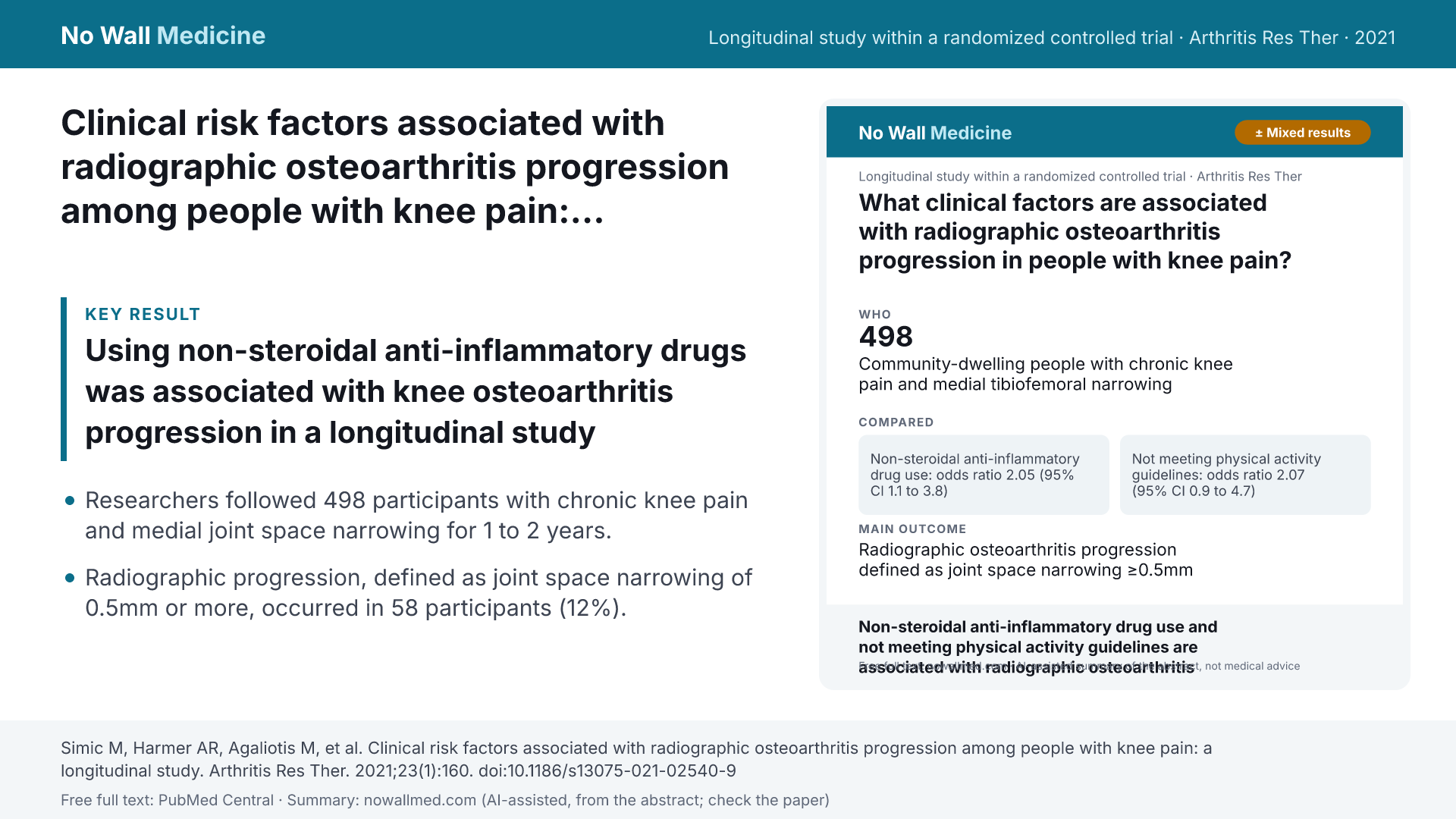
Key result: Using non-steroidal anti-inflammatory drugs was associated with knee osteoarthritis progression in a longitudinal study
Longitudinal study within a randomized controlled trialMixed results
What clinical factors are associated with radiographic osteoarthritis progression in people with knee pain?
Who
498
Community-dwelling people with chronic knee pain and medial tibiofemoral narrowing
Compared
Non-steroidal anti-inflammatory drug use: odds ratio 2.05 (95% CI 1.1 to 3.8)
Not meeting physical activity guidelines: odds ratio 2.07 (95% CI 0.9 to 4.7)
Main outcome
Radiographic osteoarthritis progression defined as joint space narrowing ≥0.5mm
Bottom line: Non-steroidal anti-inflammatory drug use and not meeting physical activity guidelines are associated with radiographic osteoarthritis progression.
Arthritis Res Ther · 2021-06-04
Key points
- Researchers followed 498 participants with chronic knee pain and medial joint space narrowing for 1 to 2 years.
- Radiographic progression, defined as joint space narrowing of 0.5mm or more, occurred in 58 participants (12%).
- The use of non-steroidal anti-inflammatory drugs was associated with progression, with an adjusted odds ratio of 2.05 (95% CI 1.1 to 3.8).
Discussion prompts
- Would these patients look like yours? Who was left out?
- Is the main outcome one that matters to patients?
- Is the difference large enough to change what you do?
Cite: Simic M, Harmer AR, Agaliotis M, et al. Clinical risk factors associated with radiographic osteoarthritis progression among people with knee pain: a longitudinal study. Arthritis Res Ther. 2021;23(1):160. doi:10.1186/s13075-021-02540-9
Free full text: PubMed Central · Summary and visual abstract: nowallmed.com/a/clinical-risk-factors-associated-with-radiographic-osteoarthritis-ngo2bu/ (AI-assisted from the abstract; check the paper before relying on it).