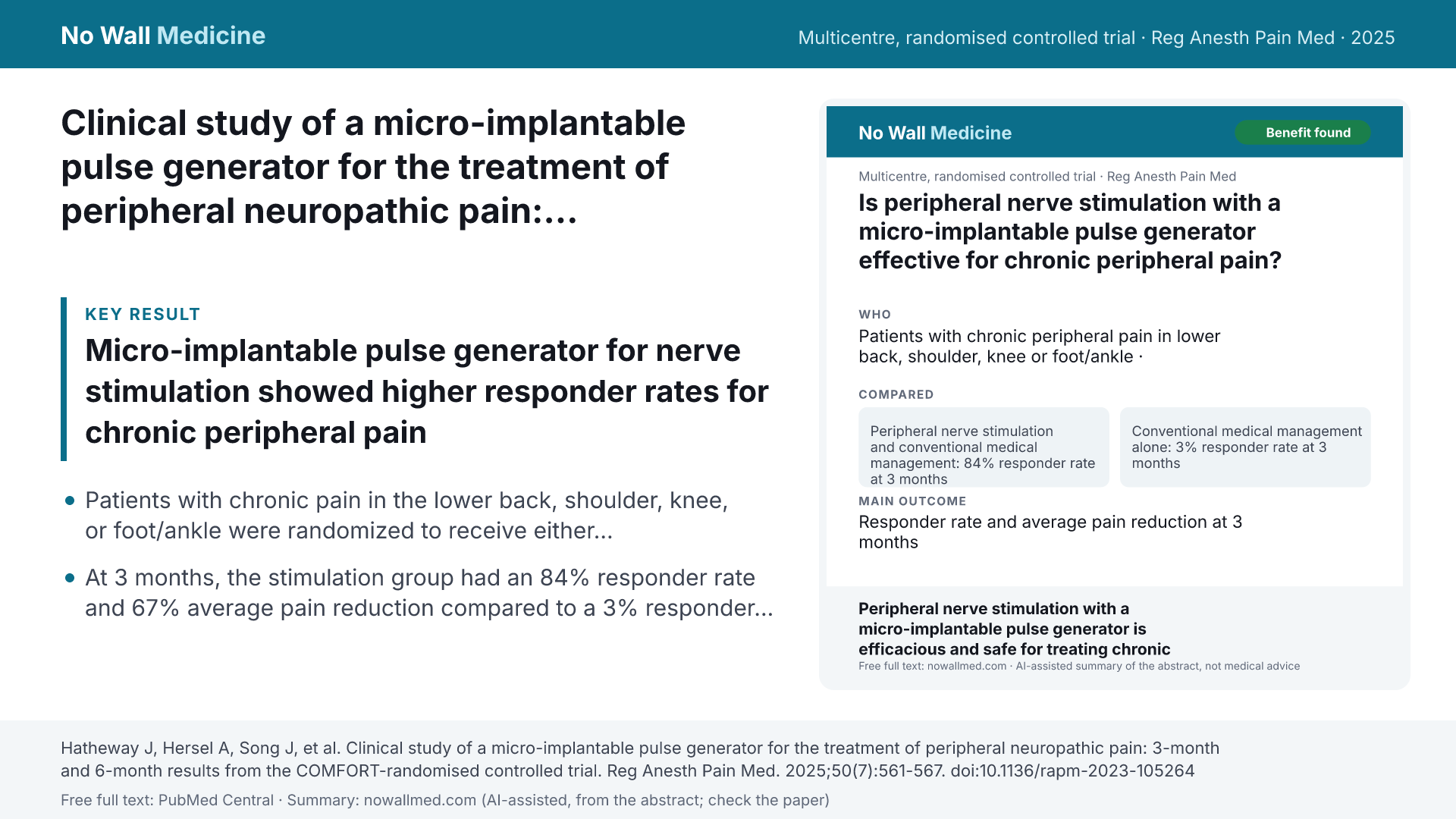
Micro-implantable pulse generator for nerve stimulation showed higher responder rates for chronic peripheral pain
Clinical study of a micro-implantable pulse generator for the treatment of peripheral neuropathic pain: 3-month and 6-month results from the COMFORT-randomised controlled trial
Multicentre, randomised controlled trialBenefit found
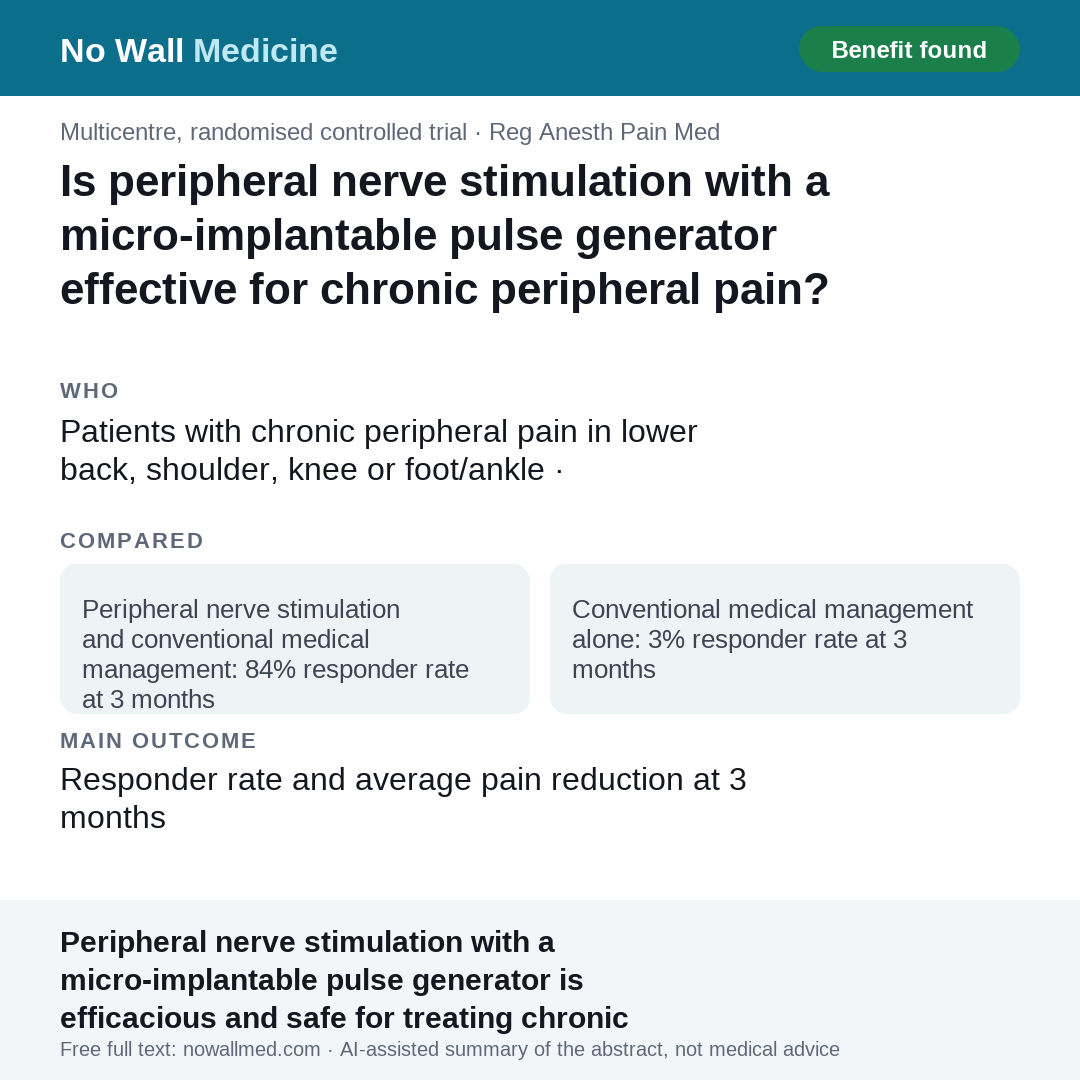
Is peripheral nerve stimulation with a micro-implantable pulse generator effective for chronic peripheral pain?
Who
Patients with chronic peripheral pain in lower back, shoulder, knee or foot/ankle · Multicentre
Compared
Peripheral nerve stimulation and conventional medical management: 84% responder rate at 3 months
Conventional medical management alone: 3% responder rate at 3 months
Main outcome
Responder rate and average pain reduction at 3 months
Bottom line: Peripheral nerve stimulation with a micro-implantable pulse generator is efficacious and safe for treating chronic peripheral pain.
Limitation: This is an ongoing study with results to be reported as they become available.
Reg Anesth Pain Med · 2025-07-04Download image
Clinical question: Is peripheral nerve stimulation with a micro-implantable pulse generator effective for chronic peripheral pain?
Why it matters: It was unknown if a micro-implantable pulse generator for peripheral nerve stimulation is effective and safe for treating chronic peripheral pain.
Key points
- Patients with chronic pain in the lower back, shoulder, knee, or foot/ankle were randomized to receive either peripheral nerve stimulation plus conventional medical management or conventional medical management alone.
- At 3 months, the stimulation group had an 84% responder rate and 67% average pain reduction compared to a 3% responder rate and 6% average pain reduction in the control group.
- At 6 months, the stimulation group achieved an 88% responder rate with a 70% average reduction in pain, and 81% of subjects found the wearable component comfortable.
Headline and key points written with AI from the paper’s abstract, with every number checked against it. Read the paper before relying on them.
Was this summary helpful?
Abstract
Background
We report the results from the first large, postmarket, multicentre, randomised controlled trial (RCT) evaluating peripheral nerve stimulation (PNS) for the treatment of chronic peripheral pain with a micro-implantable pulse generator (micro-IPG). Methods
Subjects meeting eligibility were randomised (2:1) to either the active arm receiving PNS and conventional medical management (CMM) or the control arm receiving CMM alone. Treatments were limited to the following areas: lower back, shoulder, knee and foot/ankle. Results
At 6 months, the active arm achieved an 88% responder rate with a 70% average reduction in pain. At the 3-month primary endpoint, the active arm achieved an 84% responder rate with an average pain reduction of 67% compared with the control arm, which achieved a 3% responder rate with an average pain reduction of 6%. Both responder rate and pain reduction in the active arm were significantly better than in the control arm (p<0.001). A majority of patient-reported outcomes also reached statistical significance. There have been no reports of pocket pain and no serious adverse device effects. 81% of subjects found the external wearable component of the PNS system to be comfortable. Conclusions
This study successfully reached its primary endpoint-the active arm achieved a statistically significant superior responder rate as compared with the control arm at 3 months. These RCT results demonstrated that PNS, with this micro-IPG, is efficacious and safe. This ongoing study will follow subjects for 3 years, the results of which will be reported as they become available.
Abstract reproduced under the article’s CC BY NC licence.
Subject terms
Cite this article
Hatheway J, Hersel A, Song J, Engle M, Gutierrez G, Khemlani V. Clinical study of a micro-implantable pulse generator for the treatment of peripheral neuropathic pain: 3-month and 6-month results from the COMFORT-randomised controlled trial. Reg Anesth Pain Med. 2025. doi:10.1136/rapm-2023-105264
Spotted a mistake? Suggest a correction
Top studies every Monday
The week’s key trials and guidelines in your specialties, plus any topics you follow. By email, free.
Get the weekly digest