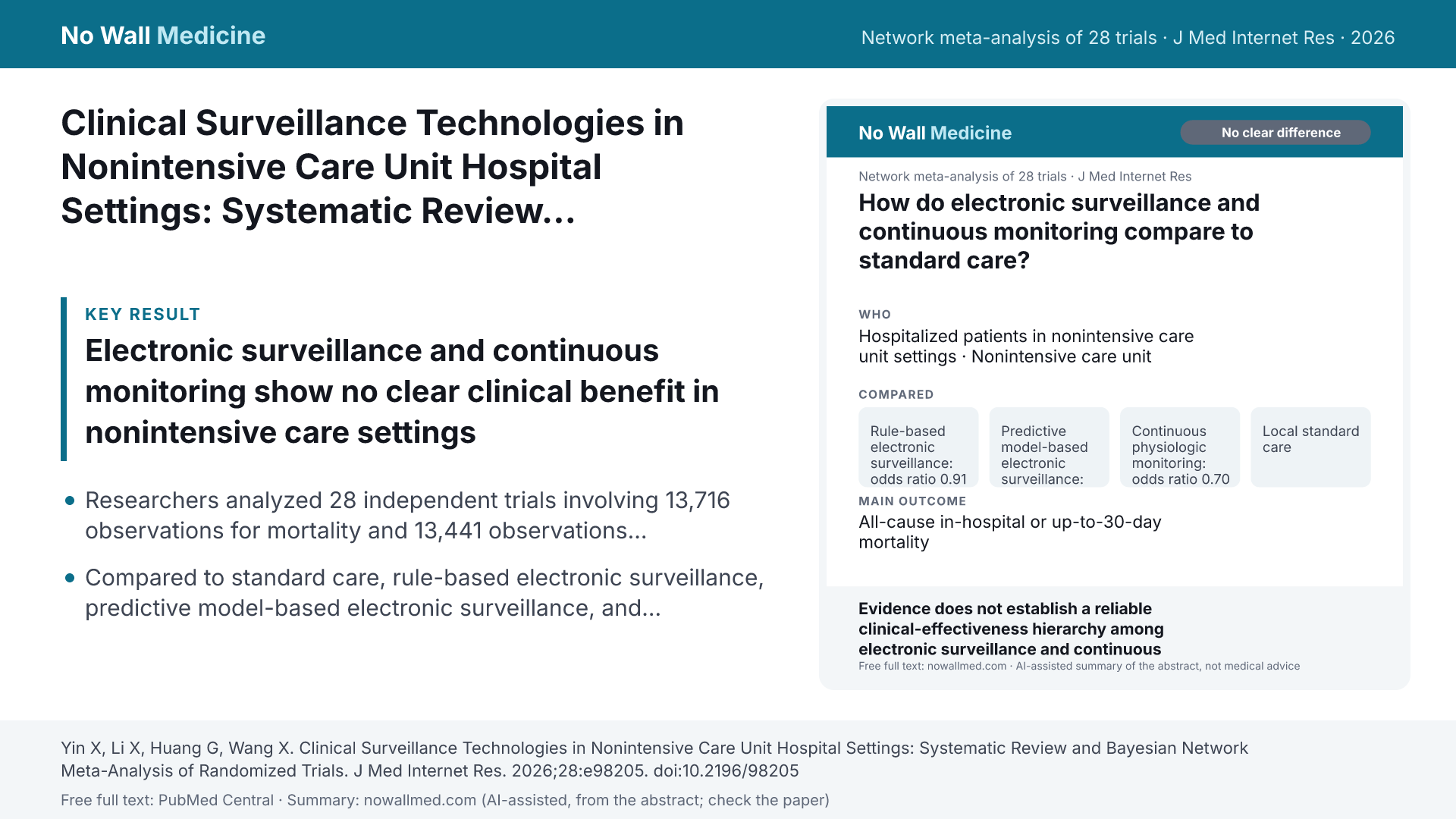
Electronic surveillance and continuous monitoring show no clear clinical benefit in nonintensive care settings
Clinical Surveillance Technologies in Nonintensive Care Unit Hospital Settings: Systematic Review and Bayesian Network Meta-Analysis of Randomized Trials
Network meta-analysis of 28 trialsNo clear difference
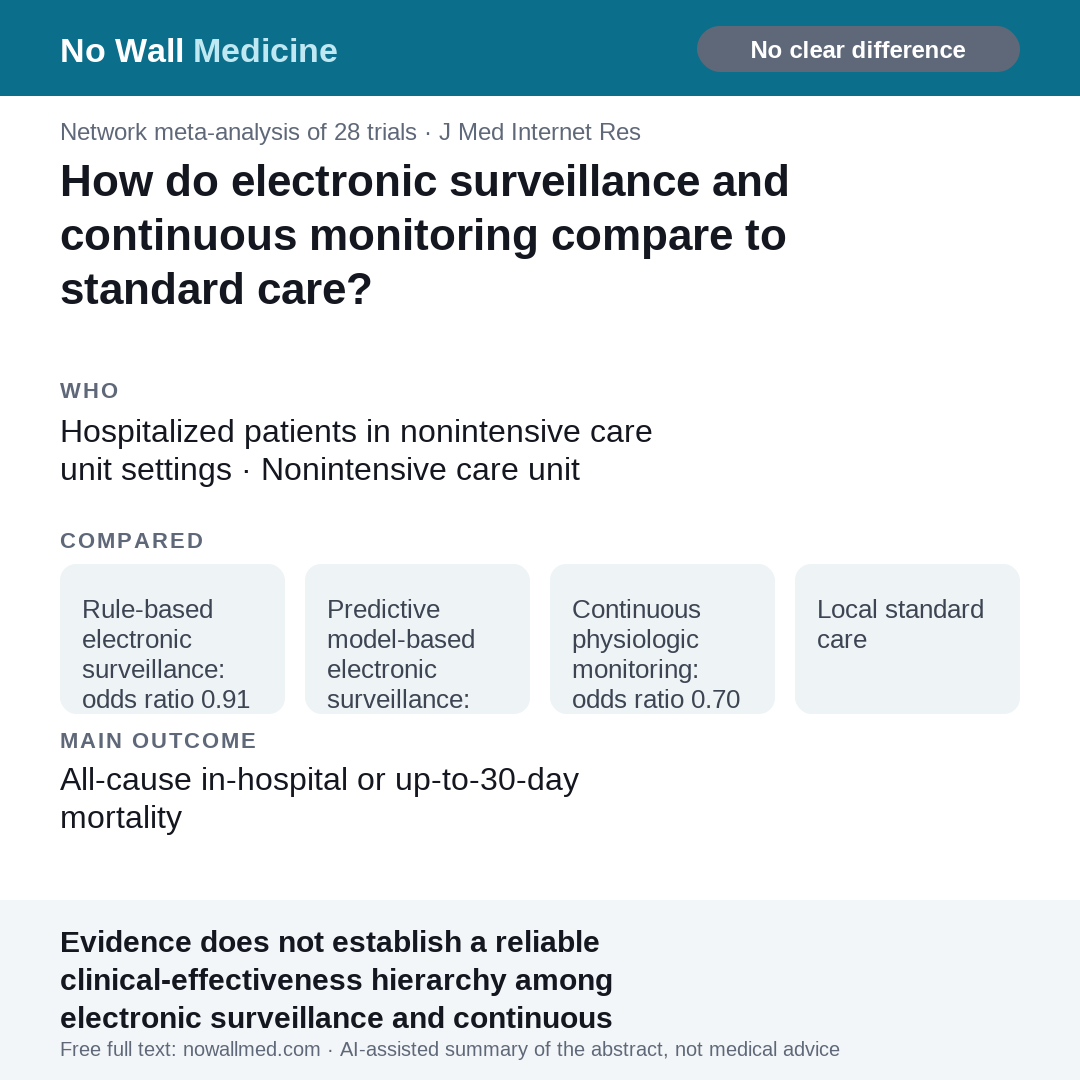
How do electronic surveillance and continuous monitoring compare to standard care?
Who
Hospitalized patients in nonintensive care unit settings · Nonintensive care unit hospital settings
Compared
Rule-based electronic surveillance: odds ratio 0.91 (95% credible interval 0.35-2.30)
Predictive model-based electronic surveillance: odds ratio 1.22 (95% credible interval 0.61-2.31)
Continuous physiologic monitoring: odds ratio 0.70 (95% credible interval 0.36-1.29)
Local standard care
Main outcome
All-cause in-hospital or up-to-30-day mortality
Bottom line: Evidence does not establish a reliable clinical-effectiveness hierarchy among electronic surveillance and continuous monitoring technologies.
Limitation: Confidence in all network comparisons was very low.
J Med Internet Res · 2026-09-24Download image
Clinical question: How do electronic surveillance and continuous monitoring compare to standard care?
Key points
- Researchers analyzed 28 independent trials involving 13,716 observations for mortality and 13,441 observations for intensive care unit transfers.
- Compared to standard care, rule-based electronic surveillance, predictive model-based electronic surveillance, and continuous physiologic monitoring showed no statistically significant differences in mortality or intensive care unit transfers.
- Continuous physiologic monitoring and predictive model-based surveillance showed no clear effect on the length of hospital stays.
Limitation the authors note: Confidence in all network comparisons was very low.
Headline and key points written with AI from the paper’s abstract, with every number checked against it. Read the paper before relying on them.
Was this summary helpful?
Subject terms
Cite this article
Yin X, Li X, Huang G, Wang X. Clinical Surveillance Technologies in Nonintensive Care Unit Hospital Settings: Systematic Review and Bayesian Network Meta-Analysis of Randomized Trials. J Med Internet Res. 2026. doi:10.2196/98205
Spotted a mistake? Suggest a correction