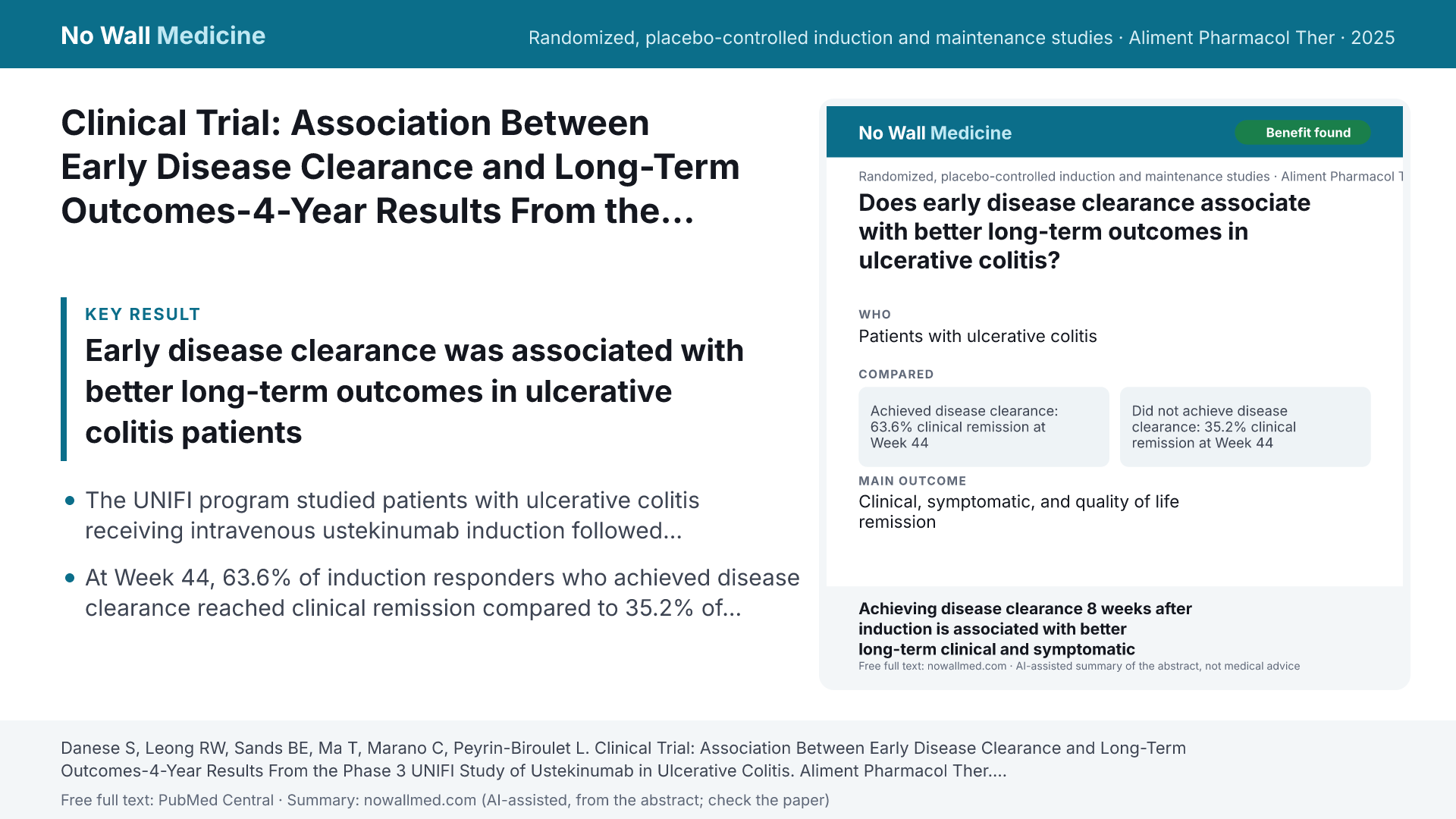
Early disease clearance was associated with better long-term outcomes in ulcerative colitis patients
Clinical Trial: Association Between Early Disease Clearance and Long-Term Outcomes-4-Year Results From the Phase 3 UNIFI Study of Ustekinumab in Ulcerative Colitis
Randomized, placebo-controlled induction and maintenance studiesBenefit found
Does early disease clearance associate with better long-term outcomes in ulcerative colitis?
Who
Patients with ulcerative colitis
Compared
Achieved disease clearance: 63.6% clinical remission at Week 44
Did not achieve disease clearance: 35.2% clinical remission at Week 44
Main outcome
Clinical, symptomatic, and quality of life remission
Bottom line: Achieving disease clearance 8 weeks after induction is associated with better long-term clinical and symptomatic remission.
Aliment Pharmacol Ther · 2025-07-16Download image
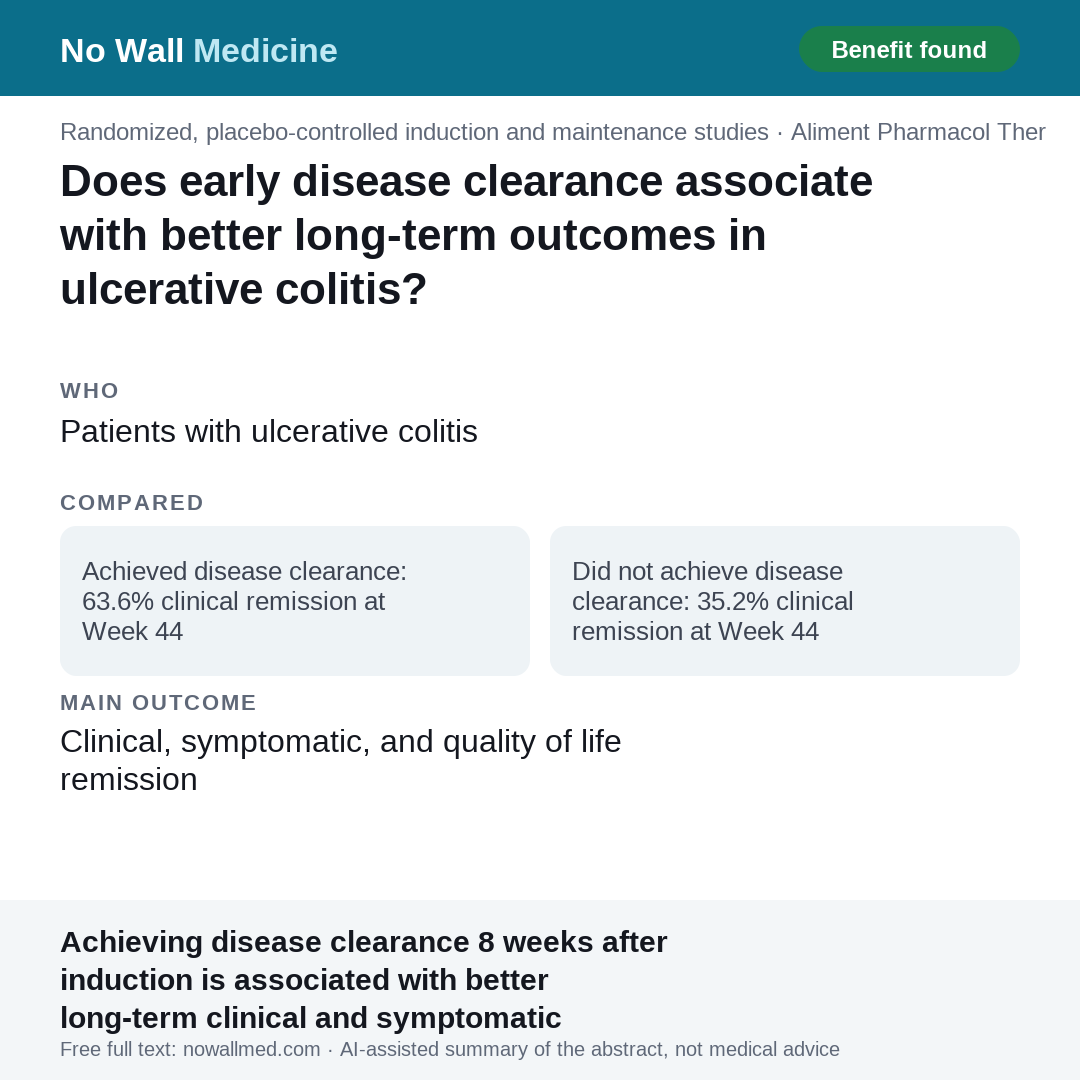
Clinical question: Does early disease clearance associate with better long-term outcomes in ulcerative colitis?
Why it matters: It is unclear if achieving simultaneous symptomatic remission and mucosal improvement during induction therapy leads to better long-term results in ulcerative colitis.
Key points
- The UNIFI program studied patients with ulcerative colitis receiving intravenous ustekinumab induction followed by subcutaneous maintenance therapy for up to 4 years.
- At Week 44, 63.6% of induction responders who achieved disease clearance reached clinical remission compared to 35.2% of those who did not.
- At Week 200, 73.4% of patients with early disease clearance achieved symptomatic remission compared to 53.5% with symptomatic remission only and 45.1% with neither.
Headline and key points written with AI from the paper’s abstract, with every number checked against it. Read the paper before relying on them.
Was this summary helpful?
Subject terms
Cite this article
Danese S, Leong RW, Sands BE, Ma T, Marano C, Peyrin-Biroulet L. Clinical Trial: Association Between Early Disease Clearance and Long-Term Outcomes-4-Year Results From the Phase 3 UNIFI Study of Ustekinumab in Ulcerative Colitis. Aliment Pharmacol Ther. 2025. doi:10.1111/apt.70264
Spotted a mistake? Suggest a correction