Clinical Trial: Predicting Response to Iron Therapy in Patients With Active Inflammatory Bowel Disease Using Hepcidin and Functional Iron Indices: A Multicentre Randomised Trial
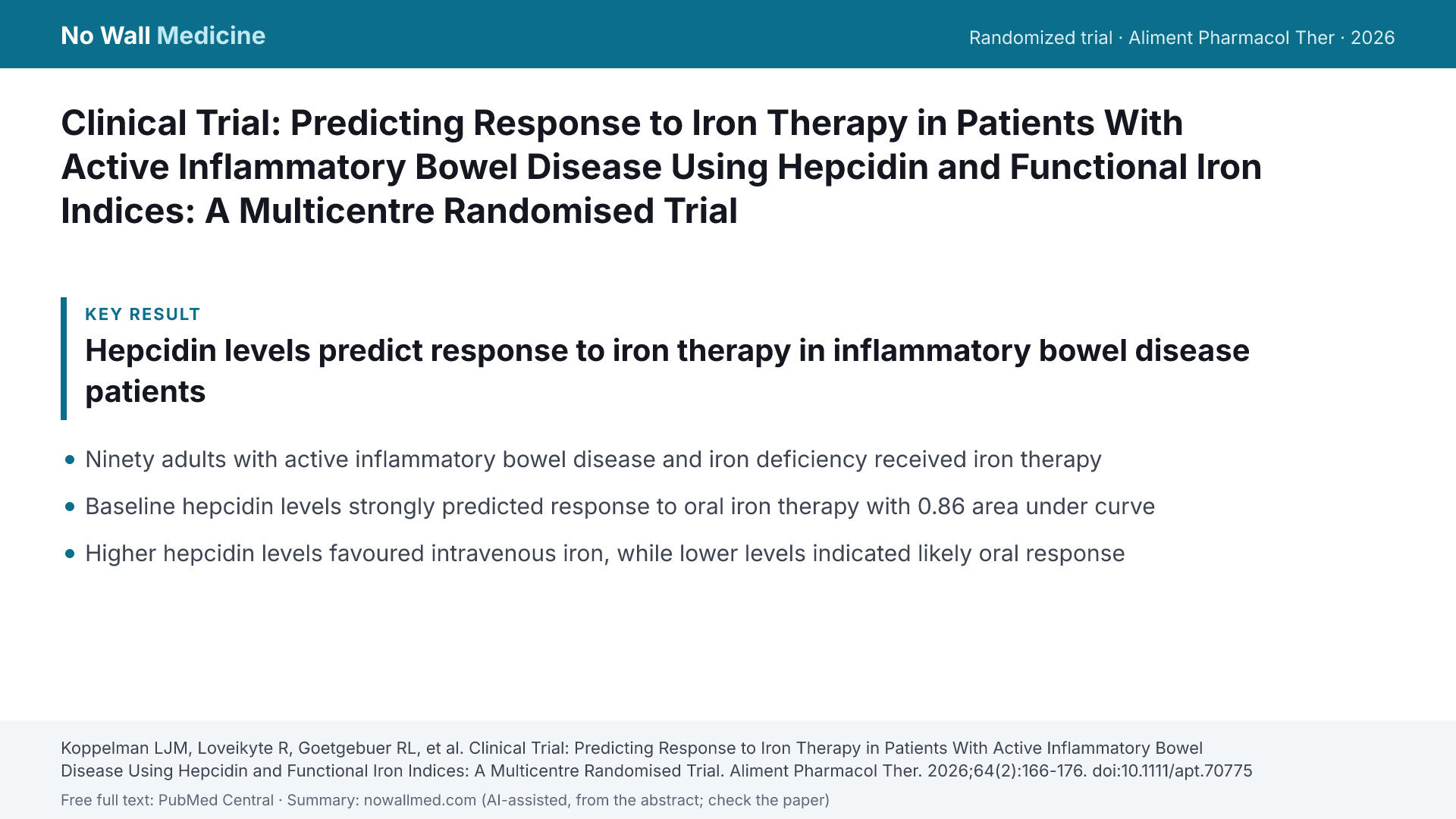
Key result: Hepcidin levels predict response to iron therapy in inflammatory bowel disease patients
Key points
- Ninety adults with active inflammatory bowel disease and iron deficiency received iron therapy.
- Baseline hepcidin levels strongly predicted response to oral iron therapy with 0.86 area under curve.
- Higher hepcidin levels favoured intravenous iron, while lower levels indicated likely oral response.
Why it matters: Doctors have had little guidance on predicting response to iron therapy in inflammatory bowel disease
Discussion prompts
- Would these patients look like yours? Who was left out?
- Is the main outcome one that matters to patients?
- Is the difference large enough to change what you do?
Cite: Koppelman LJM, Loveikyte R, Goetgebuer RL, et al. Clinical Trial: Predicting Response to Iron Therapy in Patients With Active Inflammatory Bowel Disease Using Hepcidin and Functional Iron Indices: A Multicentre Randomised Trial. Aliment Pharmacol Ther. 2026;64(2):166-176. doi:10.1111/apt.70775
Free full text: PubMed Central · Summary and visual abstract: nowallmed.com/a/clinical-trial-predicting-response-to-iron-therapy-in-patients-with-yejzeg/ (AI-assisted from the abstract; check the paper before relying on it).