Clinical utility of diffusion tensor imaging in sport-related concussion: a systematic review
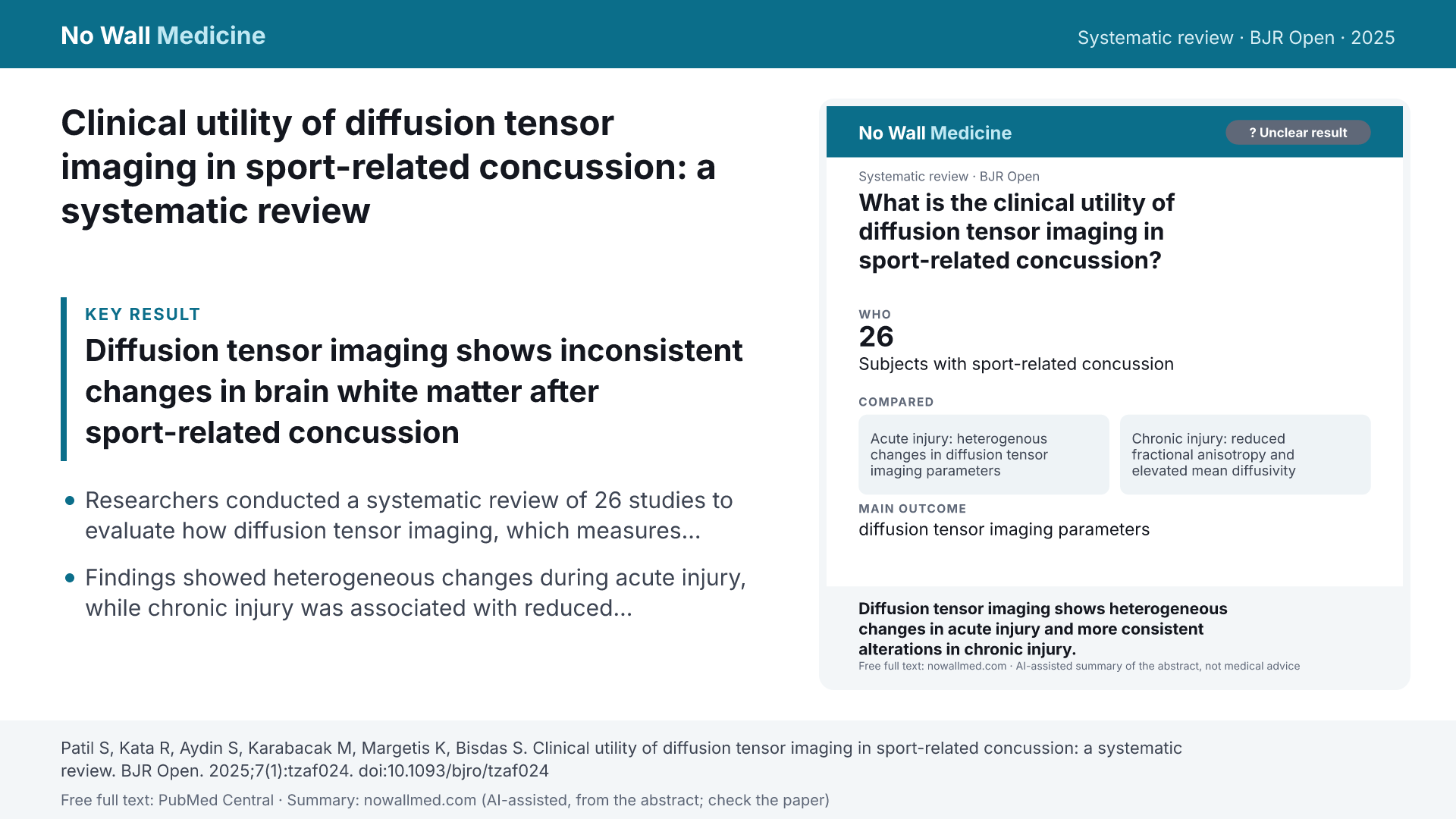
Key result: Diffusion tensor imaging shows inconsistent changes in brain white matter after sport-related concussion
Systematic reviewUnclear result
What is the clinical utility of diffusion tensor imaging in sport-related concussion?
Who
26
Subjects with sport-related concussion
Compared
Acute injury: heterogenous changes in diffusion tensor imaging parameters
Chronic injury: reduced fractional anisotropy and elevated mean diffusivity
Main outcome
diffusion tensor imaging parameters
Bottom line: Diffusion tensor imaging shows heterogeneous changes in acute injury and more consistent alterations in chronic injury.
BJR Open · 2025-10-08 · Save PNG

Key points
- Researchers conducted a systematic review of 26 studies to evaluate how diffusion tensor imaging, which measures water movement in brain tissue, detects concussion.
- Findings showed heterogeneous changes during acute injury, while chronic injury was associated with reduced fractional anisotropy and elevated mean diffusivity.
- Significant variability in study design and methodology was observed across the included research.
Why it matters: The biological variability of concussion and a lack of objective biomarkers make it difficult to diagnose and predict outcomes for athletes.
Discussion prompts
- Would these patients look like yours? Who was left out?
- Is the main outcome one that matters to patients?
- Is the difference large enough to change what you do?
Cite: Patil S, Kata R, Aydin S, Karabacak M, Margetis K, Bisdas S. Clinical utility of diffusion tensor imaging in sport-related concussion: a systematic review. BJR Open. 2025;7(1):tzaf024. doi:10.1093/bjro/tzaf024
Free full text: PubMed Central · Summary and visual abstract: nowallmed.com/a/clinical-utility-of-diffusion-tensor-imaging-in-sport-related-n2wih9/ (AI-assisted from the abstract; check the paper before relying on it).