Clinician-Created Video Education for Patients With AF: A Randomized Clinical Trial
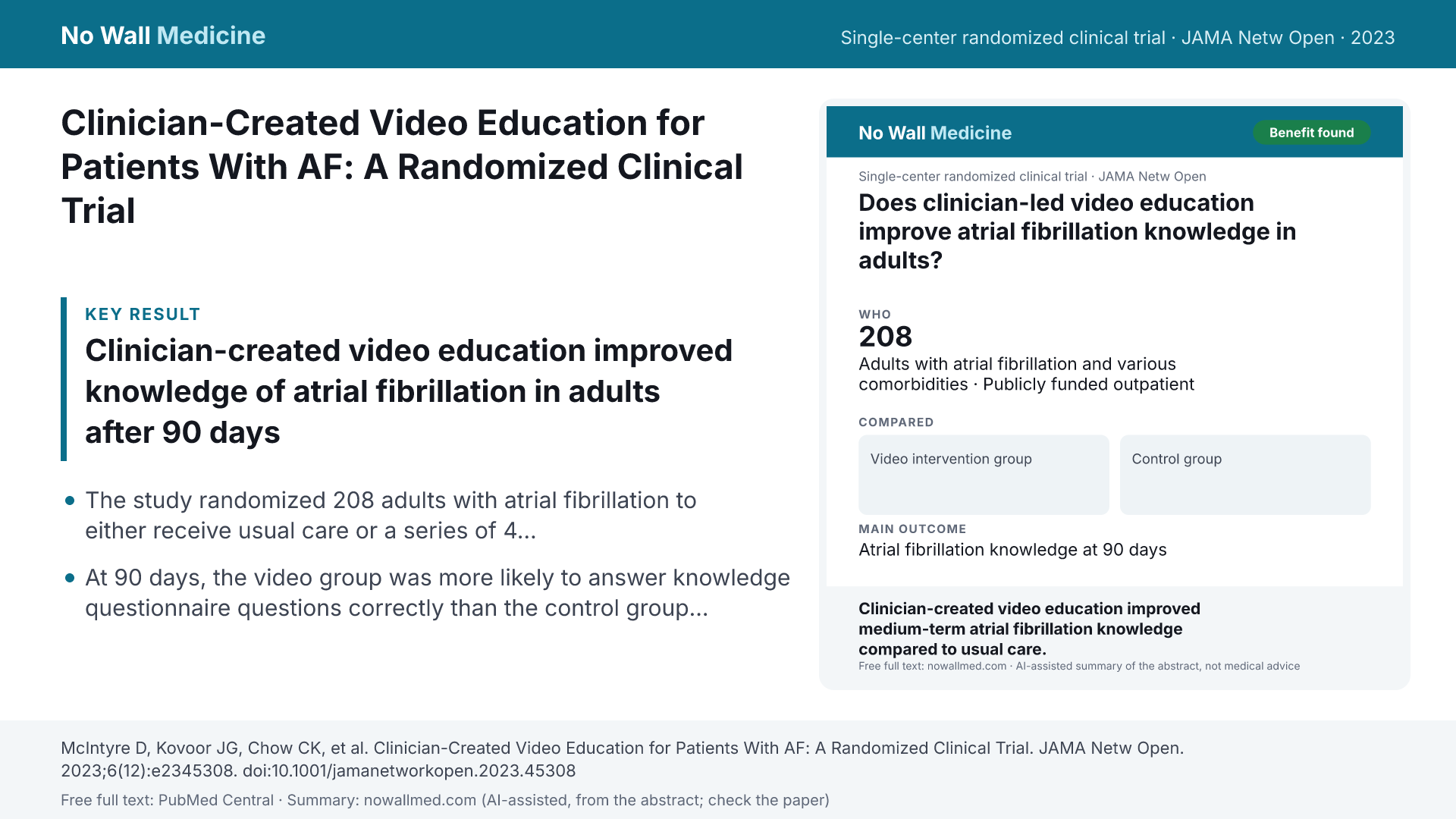
Key result: Clinician-created video education improved knowledge of atrial fibrillation in adults after 90 days
Single-center randomized clinical trialBenefit found
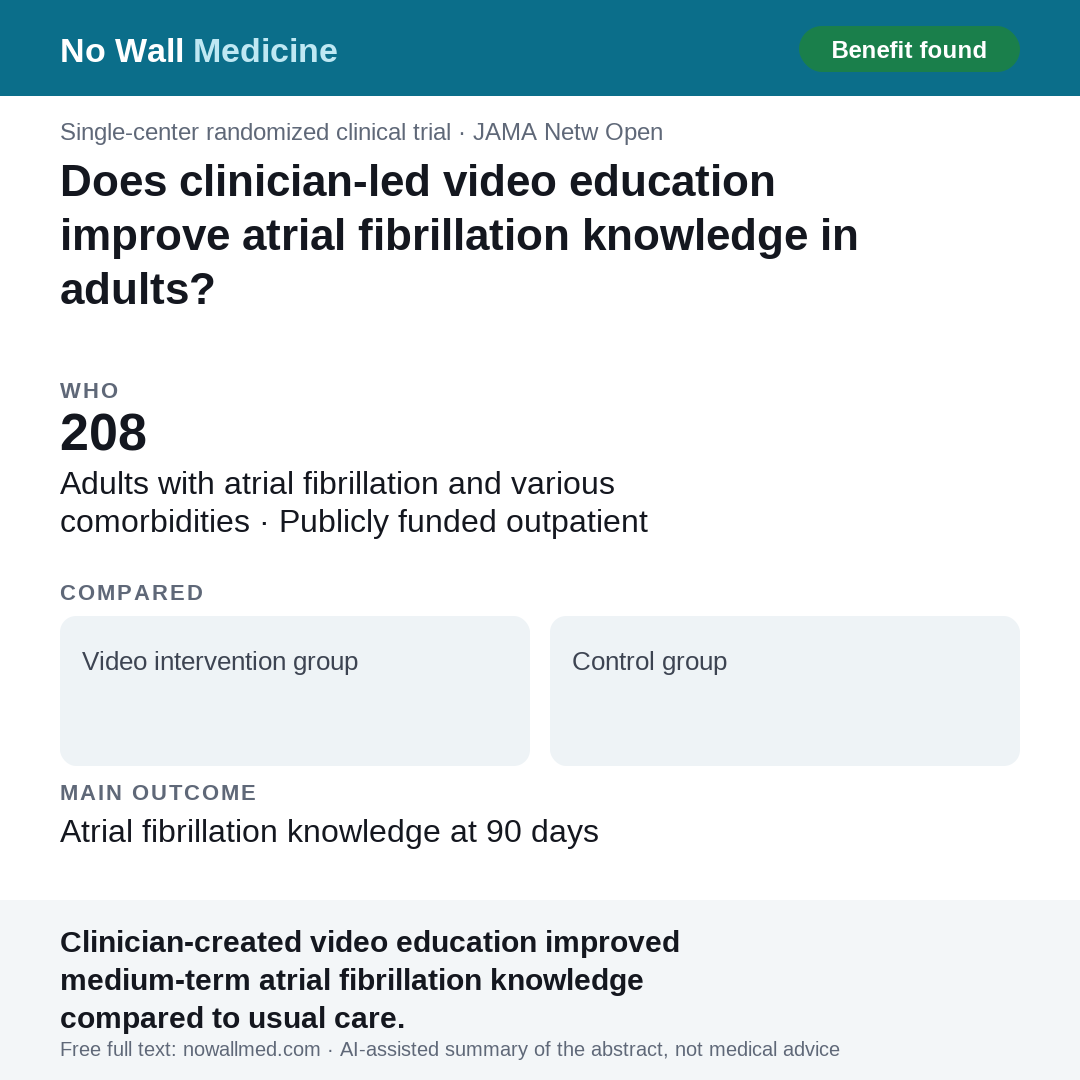
Does clinician-led video education improve atrial fibrillation knowledge in adults?
Who
208
Adults with atrial fibrillation and various comorbidities · Publicly funded outpatient cardiology clinics at a tertiary teaching hospital
Compared
Video intervention group
Control group
Main outcome
Atrial fibrillation knowledge at 90 days
Result: odds ratio 1.23 (95% CI 1.01-1.49)
Bottom line: Clinician-created video education improved medium-term atrial fibrillation knowledge compared to usual care.
Limitation: Further work is needed to assess impact on clinical outcomes.
JAMA Netw Open · 2023-12-01Download image
Key points
- The study randomized 208 adults with atrial fibrillation to either receive usual care or a series of 4 clinician-designed videos.
- At 90 days, the video group was more likely to answer knowledge questionnaire questions correctly than the control group (odds ratio, 1.23).
- The knowledge difference was higher for participants who accessed the videos remotely on 3 or more occasions (odds ratio, 1.46).
Why it matters: Clinicians have limited time for patient education during routine care and online resources often vary in quality.
Discussion prompts
- Would these patients look like yours? Who was left out?
- Is the main outcome one that matters to patients?
- Is the difference large enough to change what you do?
Cite: McIntyre D, Kovoor JG, Chow CK, et al. Clinician-Created Video Education for Patients With AF: A Randomized Clinical Trial. JAMA Netw Open. 2023. doi:10.1001/jamanetworkopen.2023.45308
Free full text: PubMed Central · Summary and visual abstract: nowallmed.com/a/clinician-created-video-education-for-patients-with-af-a-randomized-qhlo0x/ (AI-assisted from the abstract; check the paper before relying on it).