Clonal hematopoiesis of indeterminate potential was associated with a higher risk of kidney function decline
Clonal Hematopoiesis of Indeterminate Potential and Kidney Function Decline in the General Population
Cohort study with fixed-effect meta-analysisHarm found
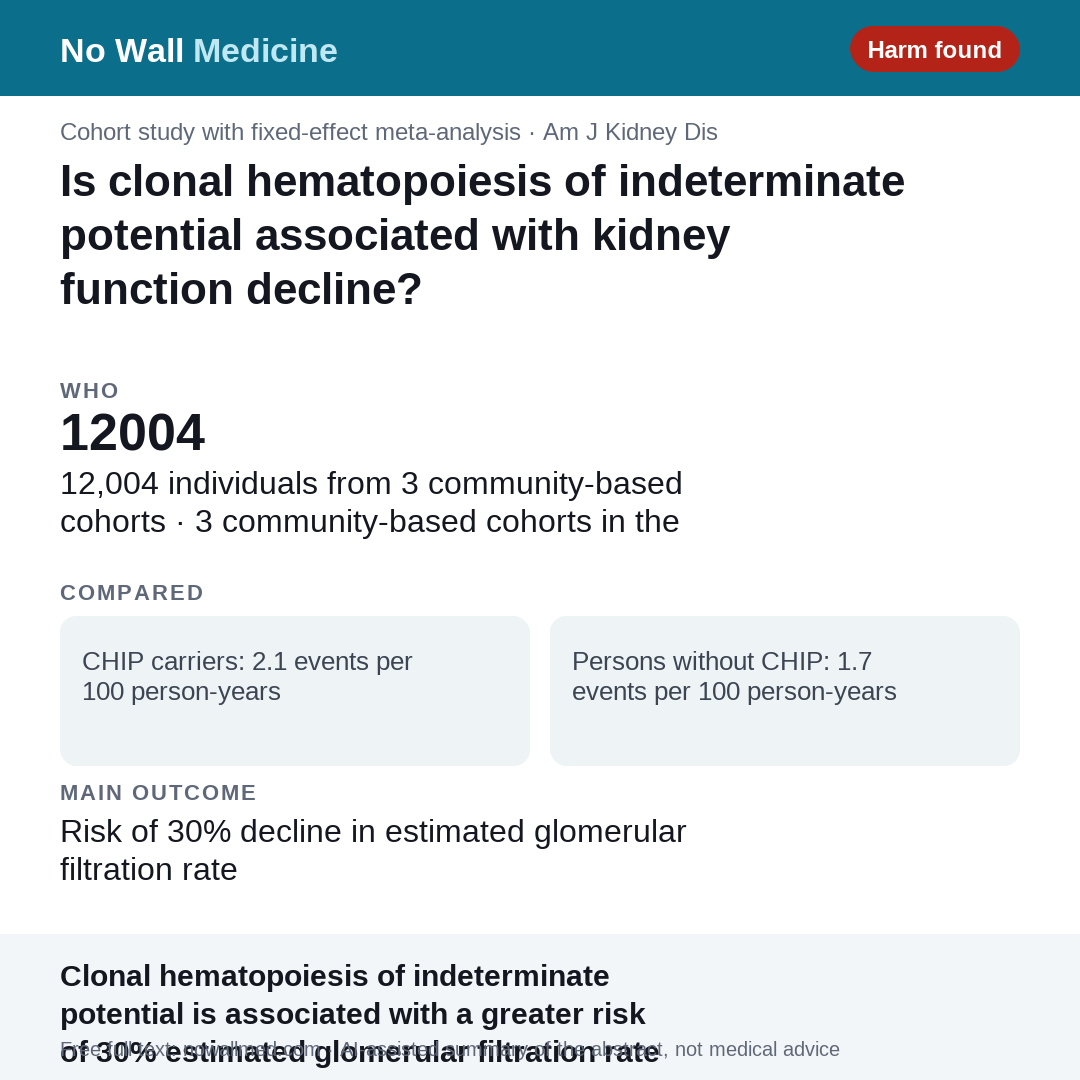
Is clonal hematopoiesis of indeterminate potential associated with kidney function decline?
Who
12004
12,004 individuals from 3 community-based cohorts · 3 community-based cohorts in the TOPMed Consortium
Compared
CHIP carriers: 2.1 events per 100 person-years
Persons without CHIP: 1.7 events per 100 person-years
Main outcome
Risk of 30% decline in estimated glomerular filtration rate
Result: 17% (95% CI, 1%-36%) higher
Bottom line: Clonal hematopoiesis of indeterminate potential is associated with a greater risk of 30% estimated glomerular filtration rate decline.
Limitation: Small number of participants with moderate-to-advanced kidney disease and restricted set of driver variants.
Am J Kidney Dis · 2022-10-11Download image
Clinical question: Is clonal hematopoiesis of indeterminate potential associated with kidney function decline?
Why it matters: It was unknown whether clonal hematopoiesis of indeterminate potential, a condition involving genetically distinct blood cells, is associated with kidney function decline in the general population.
Key points
- Researchers studied 12,004 individuals from three community-based cohorts to measure the link between clonal hematopoiesis of indeterminate potential and kidney function.
- Clonal hematopoiesis of indeterminate potential was associated with a 17% higher risk of a 30% decline in the estimated glomerular filtration rate, a measure of kidney function.
- The prevalence of this condition was 6.6% in people aged 50-60, 9.0% in those aged 60-70, and 12.2% in those over 70 years.
Limitation the authors note: The authors noted a small number of participants with moderate-to-advanced kidney disease and a restricted set of driver variants.
Headline and key points written with AI from the paper’s abstract, with every number checked against it. Read the paper before relying on them.
Was this summary helpful?
Subject terms
Cite this article
Kestenbaum B, Bick AG, Vlasschaert C, Rauh MJ, Lanktree MB, Franceschini N. Clonal Hematopoiesis of Indeterminate Potential and Kidney Function Decline in the General Population. Am J Kidney Dis. 2022. doi:10.1053/j.ajkd.2022.08.014
Spotted a mistake? Suggest a correction
Top studies every Monday
The week’s key trials and guidelines in your specialties, plus any topics you follow. By email, free.
Get the weekly digest