Clonal hematopoiesis of indeterminate potential is associated with increased risks of mortality and various diseases
Clonal hematopoiesis of indeterminate potential as a prognostic factor: a systematic review and meta-analysis
Systematic review and meta-analysisHarm found
Does clonal hematopoiesis of indeterminate potential affect the risk of clinical outcomes?
Who
45
Individuals with and without clonal hematopoiesis of indeterminate potential
Compared
With clonal hematopoiesis of indeterminate potential
Without clonal hematopoiesis of indeterminate potential
Main outcome
Risk of various clinical outcomes
Result: hazard ratio 1.34 (95% confidence interval, 1.19-1.50) for all-cause mortality
Bottom line: Clonal hematopoiesis of indeterminate potential is associated with increased risks of mortality, cancer, cardiovascular events, and severe COVID-19.
Limitation: Heterogeneity due to differences in definitions, measurements, and populations studied.
Blood Adv · 2024-06-05Download image
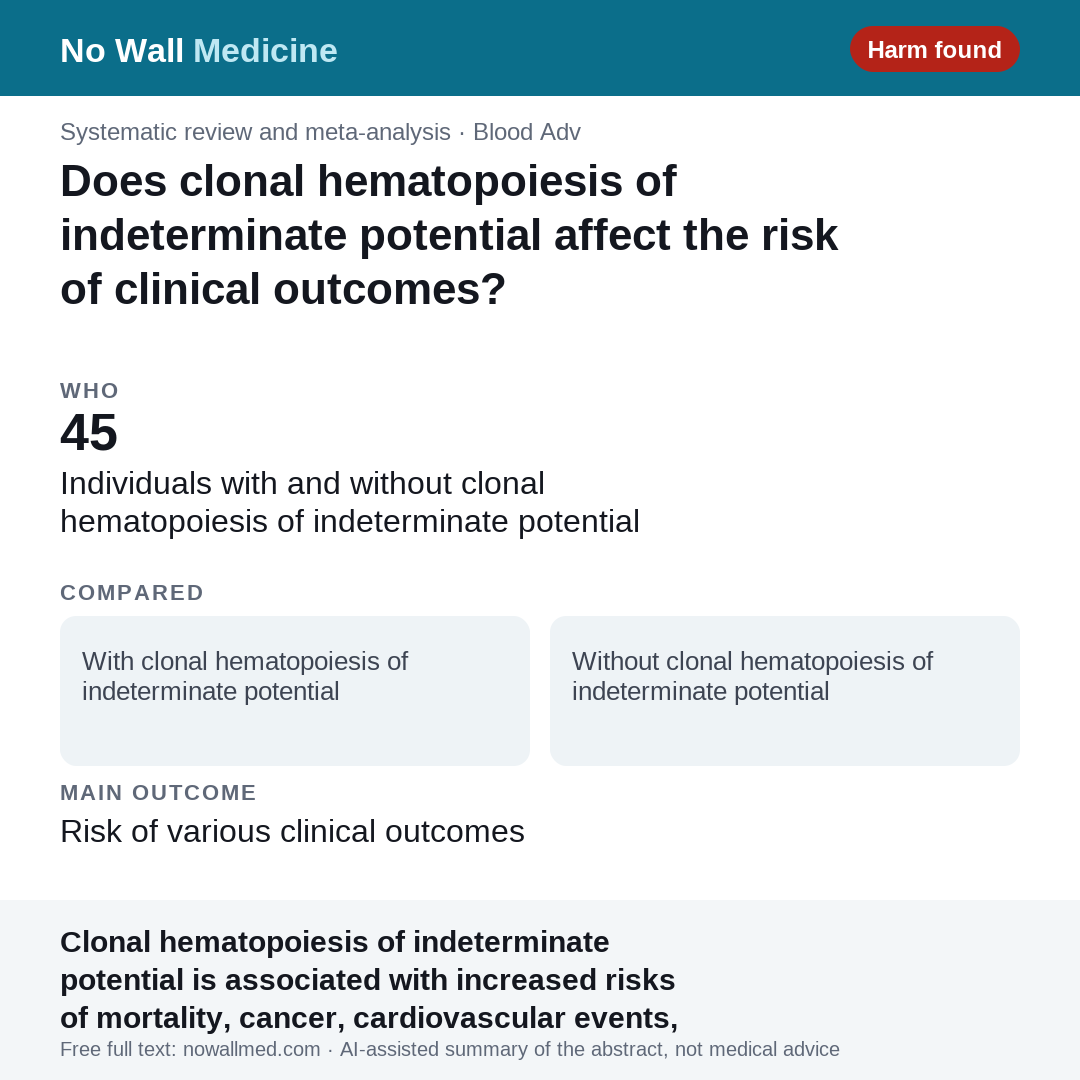
Clinical question: Does clonal hematopoiesis of indeterminate potential affect the risk of clinical outcomes?
Why it matters: The prognostic implications of clonal hematopoiesis of indeterminate potential, which refers to blood cells with specific genetic mutations, remain unclear as sequencing technology identifies more individuals.
Key points
- Researchers analyzed 88 studies involving 45 to 470,960 participants to compare clinical outcomes in people with and without clonal hematopoiesis of indeterminate potential (CHIP).
- CHIP was associated with increased risks for all-cause mortality (hazard ratio, 1.34), cancer mortality (hazard ratio, 1.46), and composite cardiovascular events (hazard ratio, 1.40).
- The condition was also linked to higher risks for coronary heart disease (hazard ratio, 1.76), stroke (hazard ratio, 1.16), heart failure (hazard ratio, 1.27), and hematologic malignancy (hazard ratio, 4.28).
Limitation the authors note: Differences in definitions, measurements of clonal hematopoiesis of indeterminate potential, and the populations studied caused heterogeneity between the included studies.
Headline and key points written with AI from the paper’s abstract, with every number checked against it. Read the paper before relying on them.
Was this summary helpful?
Abstract
With advances in sequencing, individuals with clonal hematopoiesis of indeterminate potential (CHIP) are increasingly being identified, making it essential to understand its prognostic implications. We conducted a systematic review of studies comparing the risk of clinical outcomes in individuals with and without CHIP. We searched MEDLINE and EMBASE and included original research reporting an outcome risk measure in individuals with CHIP, adjusted for the effect of age. From the 3305 studies screened, we included 88 studies with 45 to 470 960 participants. Most studies had a low-to-moderate risk of bias in all domains of the Quality in Prognostic Factor Studies tool. Random-effects meta-analyses were performed for outcomes reported in at least 3 studies. CHIP conferred an increased risk of all-cause mortality (hazard ratio [HR], 1.34; 95% confidence interval, 1.19-1.50), cancer mortality (HR, 1.46; 1.13-1.88), composite cardiovascular events (HR, 1.40; 1.19-1.65), coronary heart disease (HR, 1.76; 1.27-2.44), stroke (HR, 1.16; 1.05-1.28), heart failure (HR, 1.27; 1.15-1.41), hematologic malignancy (HR, 4.28; 2.29-7.98), lung cancer (HR, 1.40; 1.27-1.54), renal impairment (HR, 1.25; 1.18-1.33) and severe COVID-19 (odds ratio [OR], 1.46; 1.18-1.80). CHIP was not associated with cardiovascular mortality (HR, 1.09; 0.97-1.22), except in the subgroup analysis restricted to larger clones (HR, 1.31; 1.12-1.54). Isolated DNMT3A mutations did not increase the risk of myeloid malignancy, all-cause mortality, or renal impairment. The reasons for heterogeneity between studies included differences in definitions and measurements of CHIP and the outcomes, and populations studied. In summary, CHIP is associated with diverse clinical outcomes, with clone size, specific gene, and inherent patient characteristics important mediators of risk.
Abstract reproduced under the article’s CC BY NC ND licence.
Subject terms
Cite this article
Singh J, Li N, Ashrafi E, Thao LTP, Curtis DJ, Wood EM. Clonal hematopoiesis of indeterminate potential as a prognostic factor: a systematic review and meta-analysis. Blood Adv. 2024. doi:10.1182/bloodadvances.2024013228
Spotted a mistake? Suggest a correction
Top studies every Monday
The week’s key trials and guidelines in your specialties, plus any topics you follow. By email, free.
Get the weekly digest