Clonal relatedness linked to poorer survival in Richter transformation patients
Clonal relatedness as a prognostic marker in Richter transformation of chronic lymphocytic leukemia: a systematic review
Systematic reviewMixed results
Is clonal relatedness a prognostic marker in Richter transformation of chronic lymphocytic leukemia?
Who
336
Patients with Richter transformation of chronic lymphocytic leukemia
Compared
Clonally related Richter transformation: significantly poorer prognosis
Clonally unrelated Richter transformation
Main outcome
Survival outcomes
Bottom line: Clonal relatedness may confer poorer survival, but it is not independent of other known clinical and genomic variables.
Blood Adv · 2025-03-24Download image
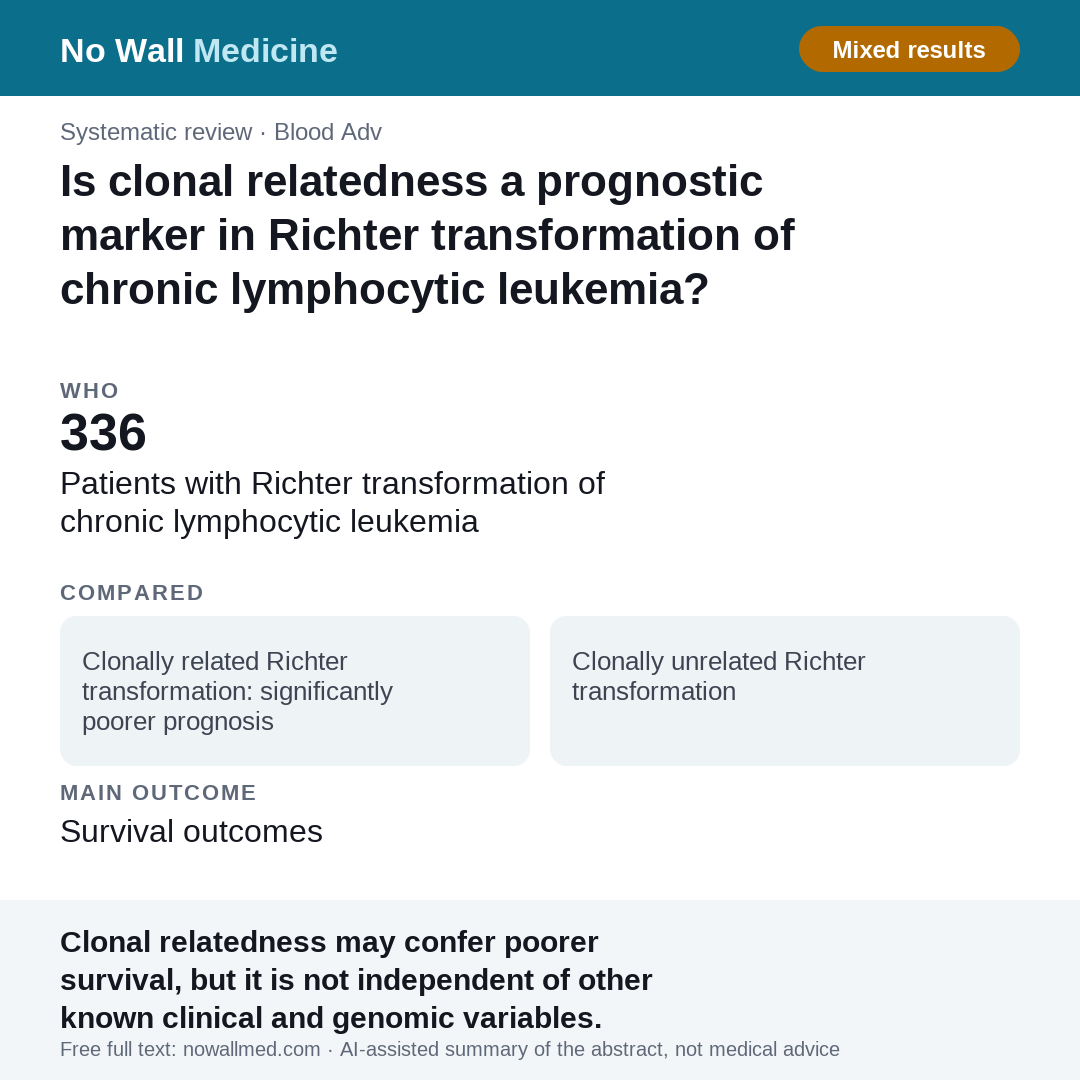
Clinical question: Is clonal relatedness a prognostic marker in Richter transformation of chronic lymphocytic leukemia?
Why it matters: Prognosis of Richter transformation relies on factors like TP53 disruption and treatment status
Key points
- Researchers studied 336 patients with Richter transformation of chronic lymphocytic leukemia.
- 4 studies found clonally related cases had significantly poorer survival outcomes.
- Clonally related cases were often enriched for underlying CLL with certain genetic characteristics.
Headline and key points written with AI from the paper’s abstract, with every number checked against it. Read the paper before relying on them.
Was this summary helpful?
Abstract
The disease shift of chronic lymphocytic leukemia (CLL) to diffuse large B-cell lymphoma (DLBCL), so-called Richter transformation (RT), is a catastrophic clinical event. Rarely, survival can outperform expectations and accurate prognostication for patients may affect therapeutic choices. To date, prognosis has relied on readily available factors such as TP53 disruption, previous CLL treatment status, and performance score. Recently, a shared clonality assessment by immunoglobulin heavy-chain variable region gene (IgHV) sequencing of the CLL and RT has been considered therapeutically relevant, but this is infrequently performed. We performed a systematic review of peer-reviewed manuscripts where outcomes in relation to clonal relatedness and lack thereof (clonally related and clonally unrelated RT-DLBCL) were examined. Fifteen manuscripts that included 336 patients were found, of which 6 compared survival outcomes between the 2 groups in a statistically meaningful way. Two analyses showed no difference in survival outcomes with 4 studies reporting a significantly poorer prognosis with clonally related RT-DLBCL. In 2 of these studies, the baseline characteristics of clonally related and clonally unrelated groups were compared and the clonally related cases were enriched for underlying CLL, which was TP53 disrupted, IgHV unmutated, more heavily pretreated, and exhibiting stereotyped B-cell receptor VH CDR3 and RT-DLBCL, which was MYD88 wild type. We demonstrate that although clonal relatedness of the underlying CLL confers a poorer survival, this is not demonstrated in any study to be independent of other well-described clinical and genomic variables known to influence outcomes in RT-DLBCL. Further independent validation of this prognostic factor is required to help guide universal adoption into clinical practice.
Abstract reproduced under the article’s CC BY NC ND licence.
Subject terms
Cite this article
Barrett A, Harris C, Eyre TA. Clonal relatedness as a prognostic marker in Richter transformation of chronic lymphocytic leukemia: a systematic review. Blood Adv. 2025. doi:10.1182/bloodadvances.2024015594
Spotted a mistake? Suggest a correction
Top studies every Monday
The week’s key trials and guidelines in your specialties, plus any topics you follow. By email, free.
Get the weekly digest