Clonazepam showed no additional therapeutic value for patients with ARID1B intellectual disability
Clonazepam repurposing in ARID1B patients through conventional RCT and N-of-1 trials: an experimental strategy for orphan disease development
Medical Genetics & GenomicsAdult and pediatric
Randomized, double-blinded, placebo-controlled, two-way crossover studyNo clear difference
Does clonazepam provide therapeutic value in patients with ARID1B intellectual disability?
Who
16
Patients with ARID1B intellectual disability
Compared
clonazepam: 44% reported improvement on Clinician Global Impression of Improvement
placebo: 13% reported improvement on Clinician Global Impression of Improvement
Main outcome
Clinician Global Impression of Improvement
Bottom line: Clonazepam has no additional therapeutic value in patients with ARID1B intellectual disability.
Limitation: Low prevalence and patient phenotype variability in rare disorders.
J Med Genet · 2025-02-26Download image
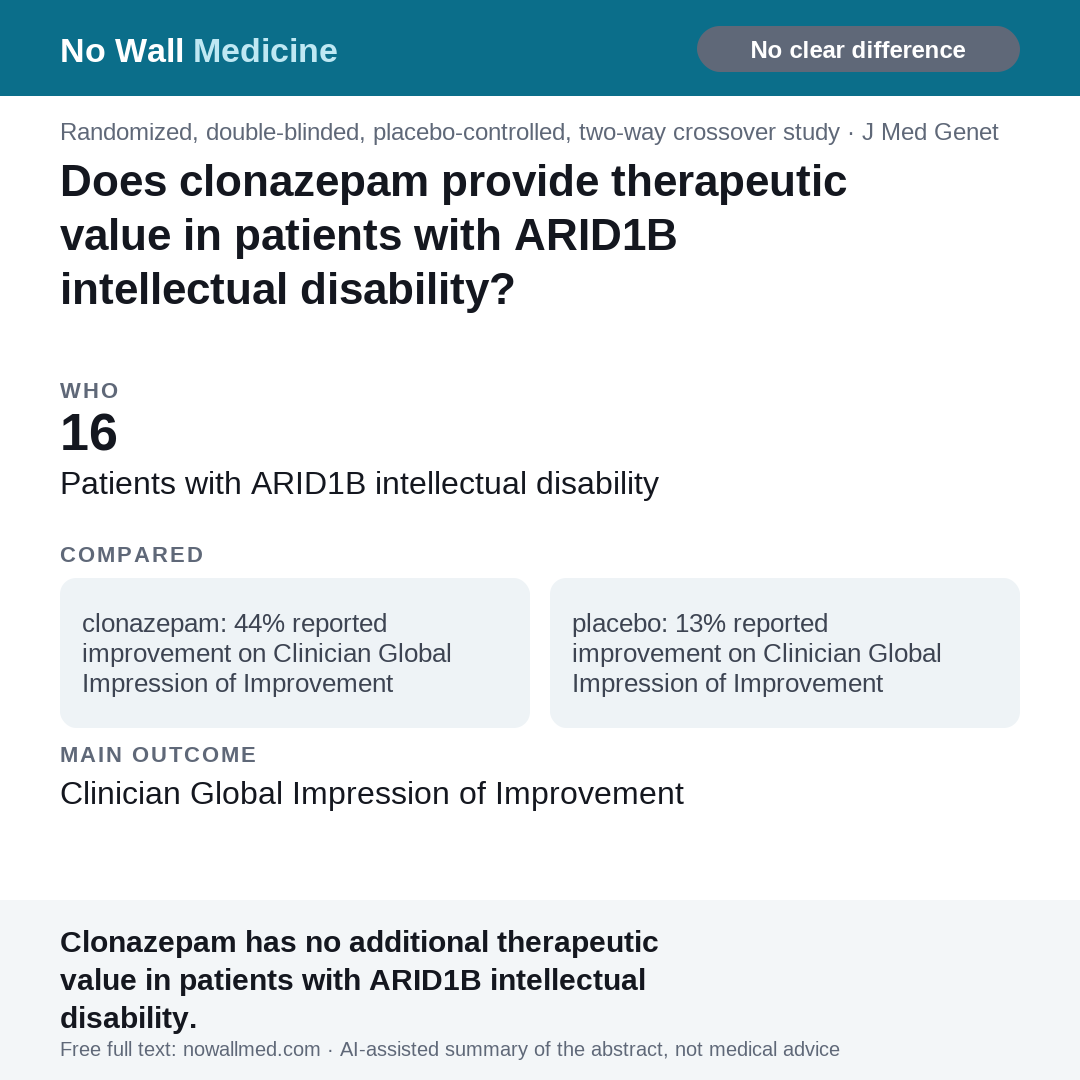
Clinical question: Does clonazepam provide therapeutic value in patients with ARID1B intellectual disability?
Why it matters: It is unknown if repurposing clonazepam provides therapeutic benefits for patients with ARID1B-related intellectual disability.
Key points
- Researchers conducted a randomized, double-blind, placebo-controlled crossover study and N-of-1 trials involving 16 patients with ARID1B-related intellectual disability.
- While 44% of patients reported improvement on clonazepam compared to 13% on placebo, 44% on clonazepam reported deterioration, often linked to side effects.
- In three N-of-1 trials, two patients improved during the double-blind period, but clinical evaluation deemed these improvements insufficient.
Headline and key points written with AI from the paper’s abstract, with every number checked against it. Read the paper before relying on them.
Was this summary helpful?
Abstract
Background
Clinical trials for rare disorders have unique challenges due to low prevalence, patient phenotype variability and high expectations. These challenges are highlighted by our study on clonazepam in ARID1B patients, a common cause of intellectual disability. Previous studies on Arid1b-haploinsufficient mice showed positive effects of clonazepam on various cognitive aspects. Methods
This study used a randomised, double-blinded, placebo-controlled, two-way crossover study (RCT), followed by an N-of-1 design. In the crossover study, ARID1B patients received clonazepam (max 0.5 mg, two times per day) or a placebo for 22 days with a 3-week washout period. Assessments included safety, tolerability, pharmacokinetics, pharmacodynamics on neurocognitive tasks, behaviour and cognitive function. During phase I of the N-of-1 trial the optimal dosage and individual treatment goals were determined. Phase II evaluated the treatment effect. This phase was composed of three periods: an open-label period with placebo (4 weeks), followed by a double-blinded period (6 weeks), followed by an open-label period in which the patient received clonazepam (4 weeks). Results
In the clonazepam group (n=16, 15 completing both periods), seven (44%) reported improvement on Clinician Global Impression of Improvement versus two (13%) on placebo. 13 (87%) showed 'no change' after placebo (two (13%) on clonazepam), while seven (44%) on clonazepam reported deterioration, often linked to side effects (n=6), suggesting potential benefit from lower dosing. Three N-of-1 trials with RCT responders saw two patients improve on clonazepam during double-blinding, but clinical evaluation deemed the improvements insufficient. Conclusions
Our approach shows the feasibility and strength of combining conventional RCT and N-of-1 studies for therapeutic studies in populations with intellectual disabilities, distinguishing real treatment effects from expectation bias. Our findings suggest that clonazepam has no additional therapeutic value in ARID1B patients. Trial registration number
EUCTR2019-003558-98, ISRCTN11225608.
Abstract reproduced under the article’s CC BY licence.
Subject terms
Cite this article
van der Sluijs PJ, Safai Pour K, Berends CL, Kruizinga MD, Müller AR, van Eeghen AM. Clonazepam repurposing in ARID1B patients through conventional RCT and N-of-1 trials: an experimental strategy for orphan disease development. J Med Genet. 2025. doi:10.1136/jmg-2024-109951
Spotted a mistake? Suggest a correction
Top studies every Monday
The week’s key trials and guidelines in your specialties, plus any topics you follow. By email, free.
Get the weekly digest