Closed incision negative-pressure therapy was associated with lower wound dehiscence after free tissue transfer
Closed Incision Negative-Pressure Therapy on Free Flap Donor Sites: A Meta-analysis of Postoperative Outcomes
Meta-analysis of 12 studiesBenefit found
Does closed incision negative-pressure therapy reduce donor site complications after free tissue transfer?
Who
1074
Donor sites after free tissue transfer
Compared
Closed incision negative-pressure therapy
Conventional dressings
Main outcome
Postoperative complications at the donor site
Result: odds ratio 0.37 (95% CI 0.23-0.58)
Bottom line: Closed incision negative-pressure therapy significantly reduces wound dehiscence compared to conventional dressings at free flap donor sites.
Plast Reconstr Surg Glob Open · 2024-07-18 · Save PNG
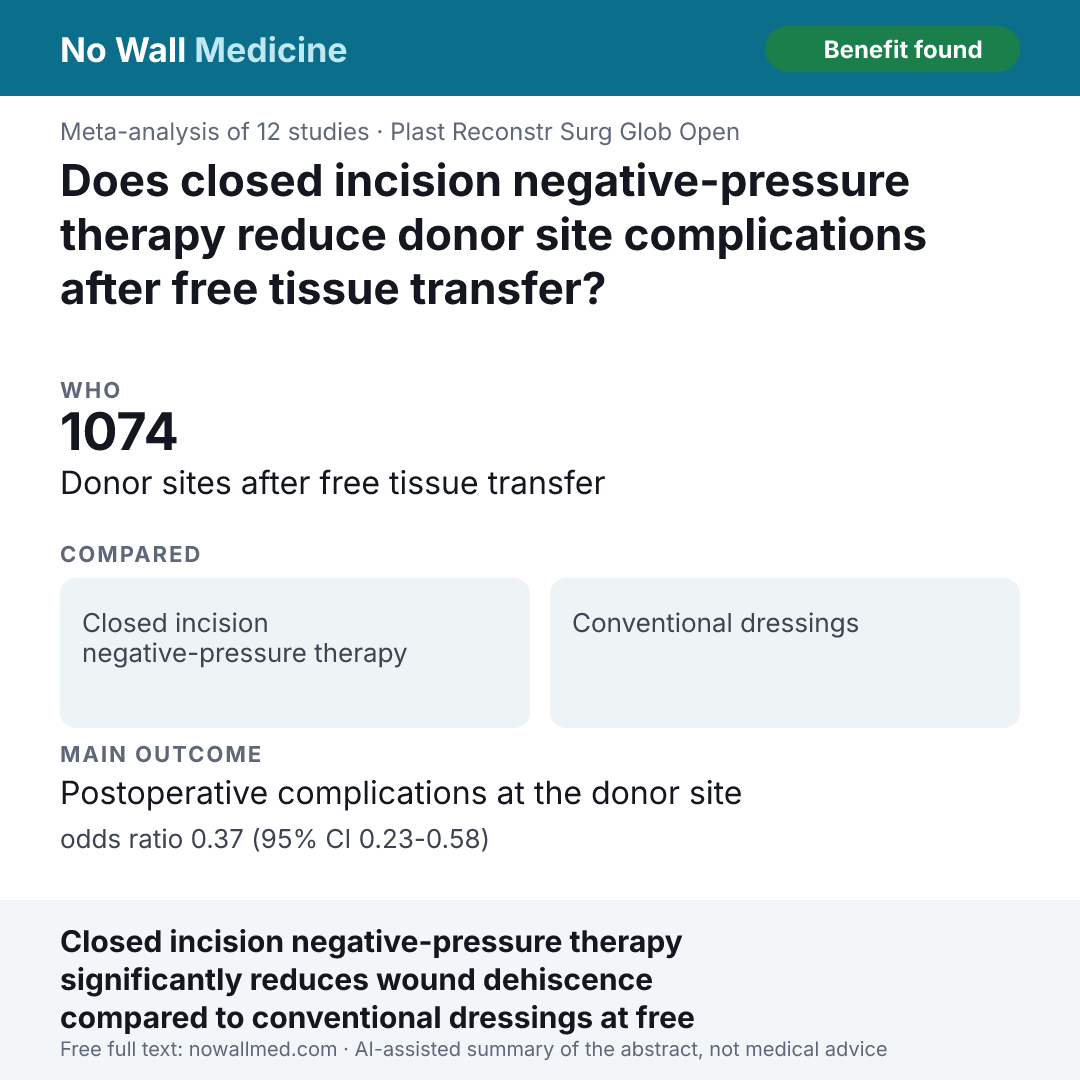
Clinical question: Does closed incision negative-pressure therapy reduce donor site complications after free tissue transfer?
Why it matters: The benefits of using closed incision negative-pressure therapy to reduce complications at donor sites after free tissue transfer are currently limited in existing literature.
Key points
- Researchers analyzed 12 studies involving 1074 donor sites to compare closed incision negative-pressure therapy, a vacuum-based wound treatment, against conventional dressings.
- The use of closed incision negative-pressure therapy was associated with a lower incidence of wound dehiscence, which is the reopening of a surgical wound (OR: 0.37; 95% CI, 0.23-0.58).
- While the incidence of infection, seroma, hematoma, and skin necrosis was overall lower with the vacuum therapy, these results were not statistically significant.
Headline and key points written with AI from the paper’s abstract, with every number checked against it. Read the paper before relying on them.
Was this summary helpful?
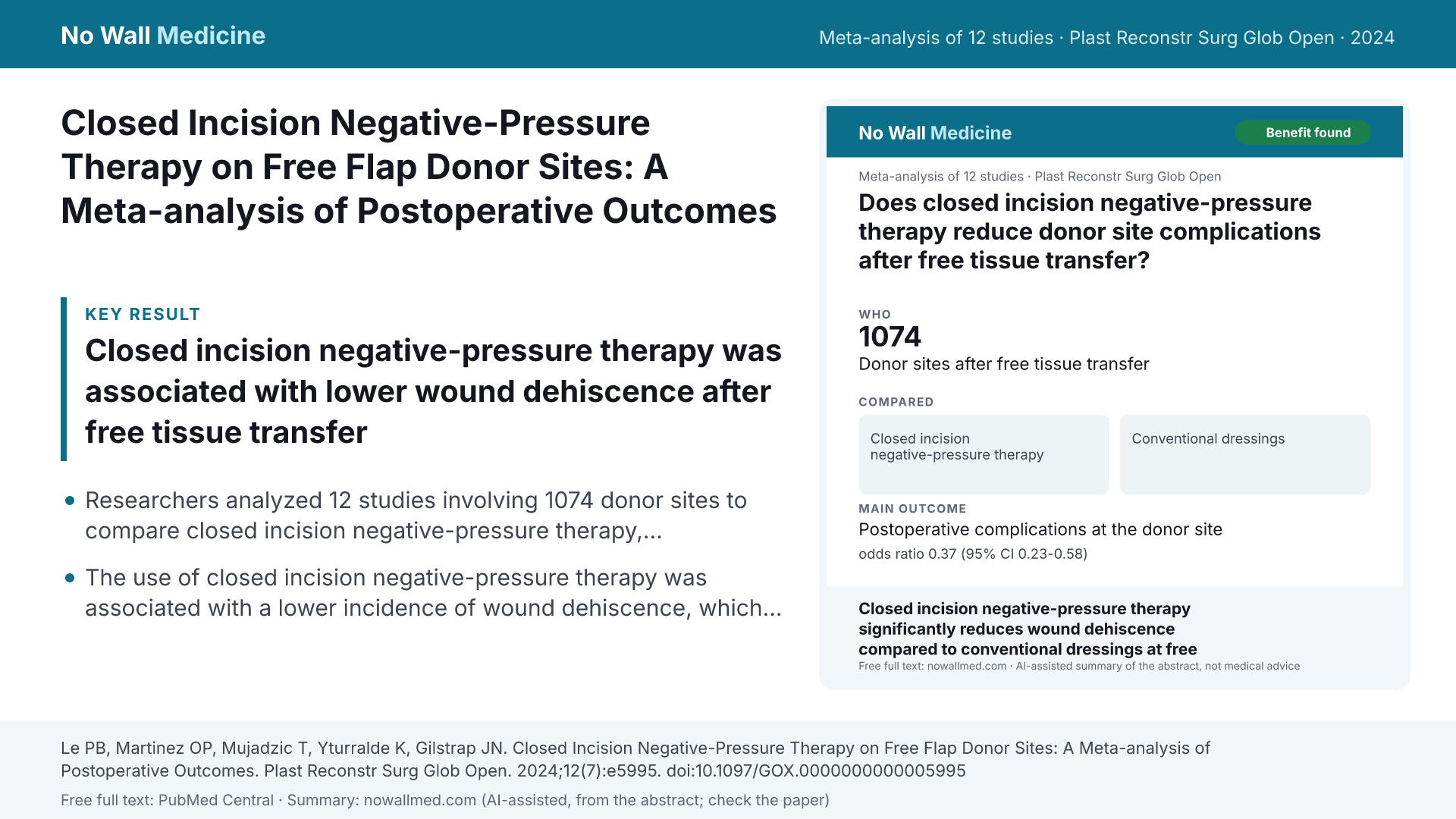
Headline, design, result, key points, caveat and citation as plain text.
Cite this article
Le PB, Martinez OP, Mujadzic T, Yturralde K, Gilstrap JN. Closed Incision Negative-Pressure Therapy on Free Flap Donor Sites: A Meta-analysis of Postoperative Outcomes. Plast Reconstr Surg Glob Open. 2024;12(7):e5995. doi:10.1097/GOX.0000000000005995
Spotted a mistake? Suggest a correction