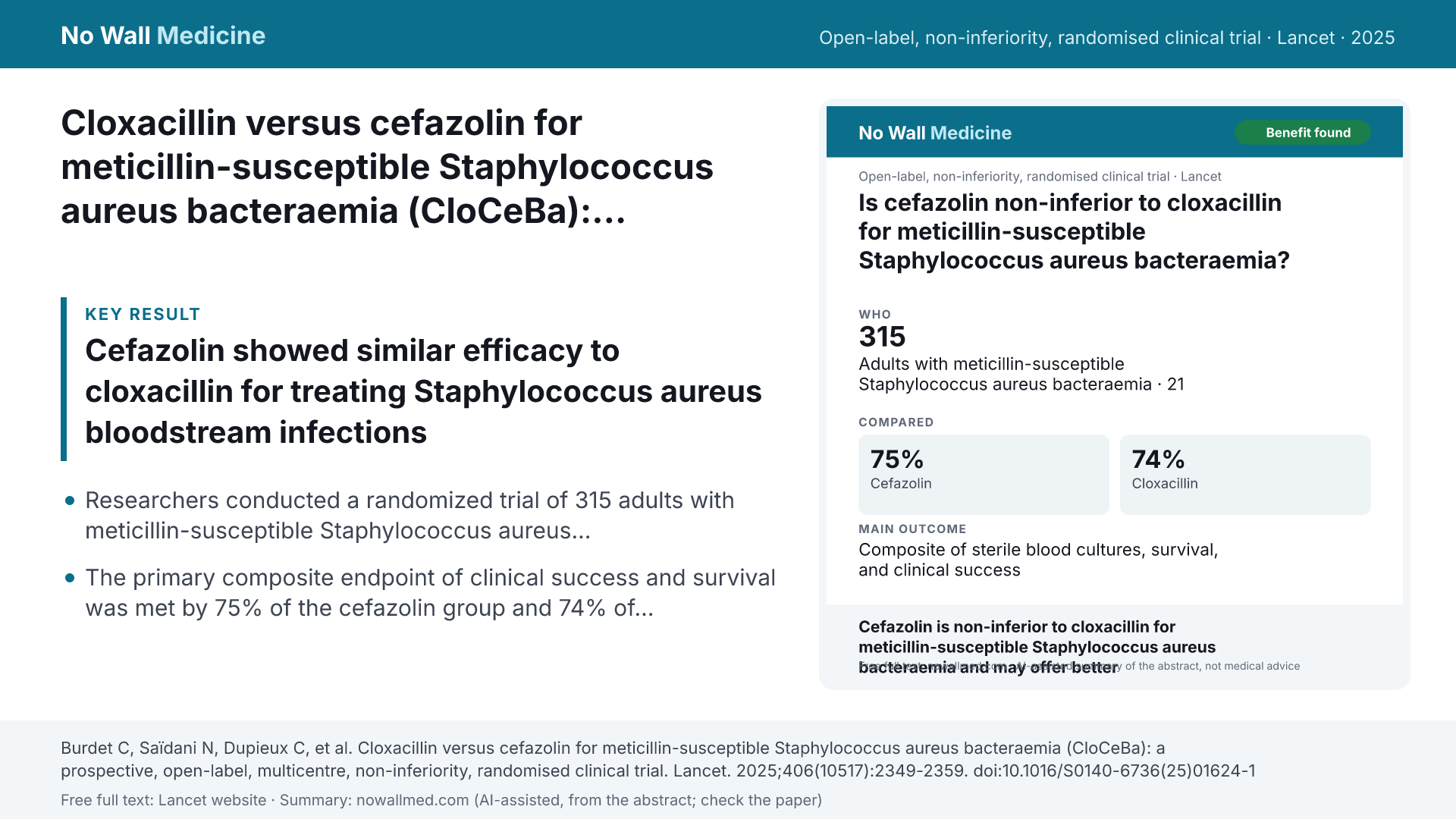
Cefazolin showed similar efficacy to cloxacillin for treating Staphylococcus aureus bloodstream infections
Cloxacillin versus cefazolin for meticillin-susceptible Staphylococcus aureus bacteraemia (CloCeBa): a prospective, open-label, multicentre, non-inferiority, randomised clinical trial
Open-label, non-inferiority, randomised clinical trialBenefit found
Is cefazolin non-inferior to cloxacillin for meticillin-susceptible Staphylococcus aureus bacteraemia?
Who
315
Adults with meticillin-susceptible Staphylococcus aureus bacteraemia · 21 hospitals in France
Compared
75%Cefazolin (109/146)
74%Cloxacillin (108/146)
Main outcome
Composite of sterile blood cultures, survival, and clinical success
Result: treatment difference -1% (95% CI -11 to 9)
Bottom line: Cefazolin is non-inferior to cloxacillin for meticillin-susceptible Staphylococcus aureus bacteraemia and may offer better tolerability.
Funded by: French Ministry of Health
Lancet · 2025-10-17Download image
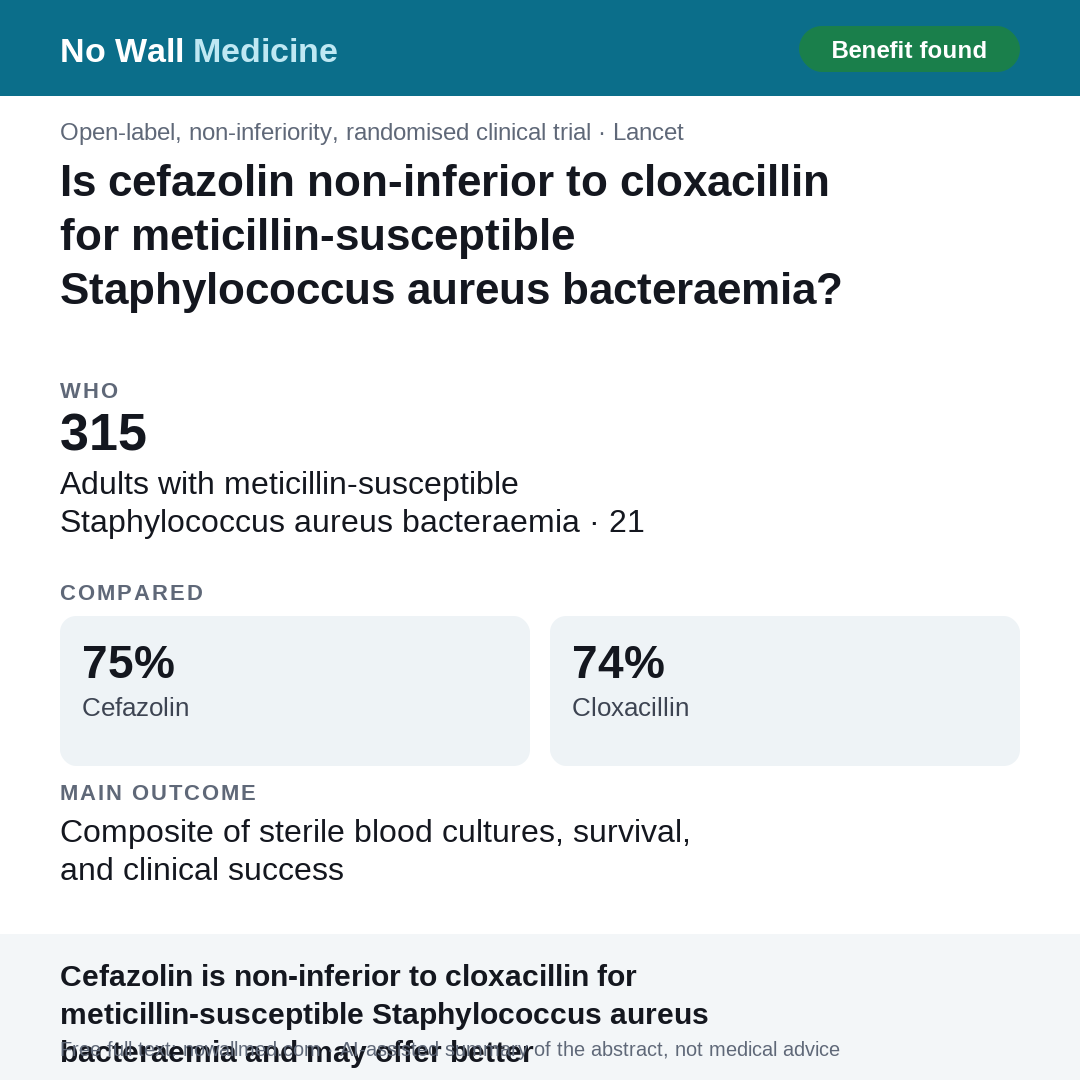
Clinical question: Is cefazolin non-inferior to cloxacillin for meticillin-susceptible Staphylococcus aureus bacteraemia?
Why it matters: The efficacy of cefazolin for treating meticillin-susceptible Staphylococcus aureus bacteraemia has not been investigated in a clinical trial.
Key points
- Researchers conducted a randomized trial of 315 adults with meticillin-susceptible Staphylococcus aureus bacteraemia, comparing intravenous cefazolin to cloxacillin.
- The primary composite endpoint of clinical success and survival was met by 75% of the cefazolin group and 74% of the cloxacillin group.
- Serious adverse events occurred in 15% of the cefazolin group and 27% of the cloxacillin group, with acute kidney injury occurring more frequently in the cloxacillin group.
Headline and key points written with AI from the paper’s abstract, with every number checked against it. Read the paper before relying on them.
Was this summary helpful?
Abstract
Background
Although widely used, cefazolin efficacy for the treatment of meticillin-susceptible Staphylococcus aureus (MSSA) bacteraemia has not thus far been investigated in a clinical trial. In this study, we aimed to compare the efficacy and safety of cefazolin with that of cloxacillin in patients with MSSA bacteraemia. Methods
We conducted an open-label, non-inferiority, randomised clinical trial in 21 university and non-university hospitals in France in adults (aged ≥18 years) with MSSA bacteraemia, without intravascular implant or suspicion of CNS infection. Participants were randomly assigned (1:1) to receive intravenously cefazolin (25-50 mg/kg every 8 h) or cloxacillin (25-50 mg/kg every 4-6 h) for the first 7 days of therapy using computer-generated blocks of various sizes and stratification on vascular-access associated bacteraemia and centre. Subsequent treatment was left to the choice of the investigator (total duration ≥14 days). The primary endpoint was a composite of sterile blood cultures at day 3 (day 5 for endocarditis) without relapse of bacteraemia, survival, and clinical success at day 90, and was assessed in the intention-to-treat population. A non-inferiority margin of 12% was chosen. This trial is registered on ClinicalTrials.gov (NCT03248063) and is complete. Findings
Between Sept 5, 2018, and Nov 16, 2023, 315 participants were enrolled and assigned to cefazolin (n=158) or cloxacillin (n=157); 12 participants were excluded from analysis in the cefazolin group, and 11 in the cloxacillin group (final population of 146 in each group). Mean age was 62·7 years (SD 16·4), 215 (74%) participants were male, and race or ethnicity data were not collected. Median Pitt score was 0 (IQR 0-0). The primary endpoint was met in 109 (75%) of 146 participants in the cefazolin group versus 108 (74%) of 146 participants in the cloxacillin group (treatment difference -1%; 95% CI -11 to 9; p=0·012). At the end of study treatment, 22 (15%) of 146 participants assigned to cefazolin and 40 (27%) of 146 participants assigned to cloxacillin had had a serious adverse event (p=0·010). Acute kidney injury occurred more frequently in participants assigned to cloxacillin (15 [12%] of 128) than in those assigned to cefazolin (one [1%] of 134; p=0·0002). Interpretation
Cefazolin constitutes an alternative to cloxacillin for the treatment of MSSA bacteraemia, offering non-inferior clinical efficacy and potentially enhanced tolerability. Funding
French Ministry of Health.
Abstract reproduced under the article’s CC BY NC ND licence.
Subject terms
Cite this article
Burdet C, Saïdani N, Dupieux C, et al. Cloxacillin versus cefazolin for meticillin-susceptible Staphylococcus aureus bacteraemia (CloCeBa): a prospective, open-label, multicentre, non-inferiority, randomised clinical trial. Lancet. 2025. doi:10.1016/S0140-6736(25)01624-1
Spotted a mistake? Suggest a correction