Enhanced prevention program was associated with lower rates of antibiotic-resistant bacteria acquisition in hospital wards
Cluster-Randomized Controlled Trial of Enhanced Carbapenem-Resistant Enterobacterales Prevention Program in General Medicine Wards, Siriraj Hospital
Cluster-randomized controlled trialBenefit found
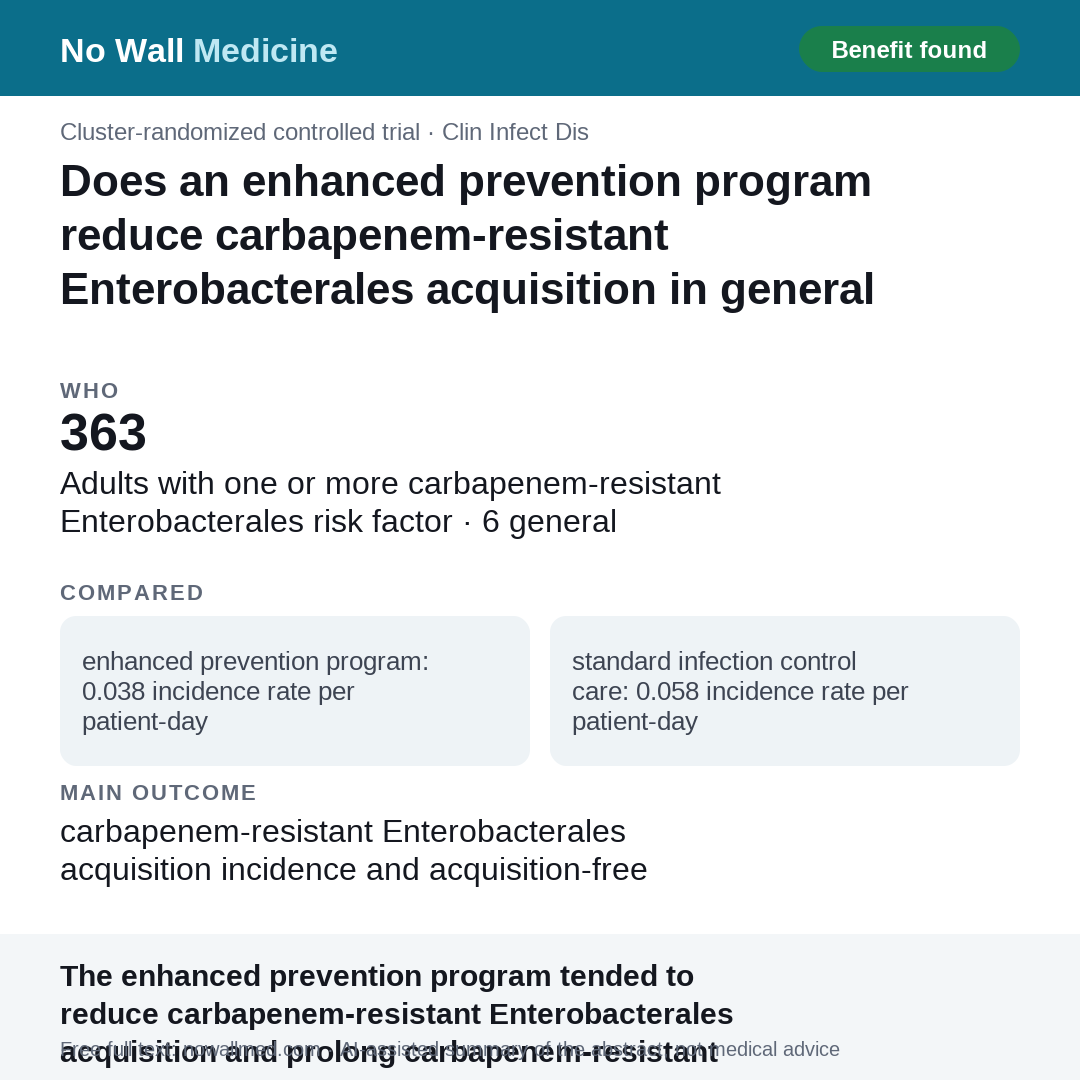
Does an enhanced prevention program reduce carbapenem-resistant Enterobacterales acquisition in general medicine wards?
Who
363
Adults with one or more carbapenem-resistant Enterobacterales risk factor · 6 general medical wards at Siriraj Hospital
Compared
enhanced prevention program: 0.038 incidence rate per patient-day
standard infection control care: 0.058 incidence rate per patient-day
Main outcome
carbapenem-resistant Enterobacterales acquisition incidence and acquisition-free time
Result: hazard ratio 0.72 (95% CI 0.52-1.00)
Bottom line: The enhanced prevention program tended to reduce carbapenem-resistant Enterobacterales acquisition and prolong carbapenem-resistant Enterobacterales-free survival.
Limitation: Larger studies are needed to explore benefits on morbidity and mortality.
Clin Infect Dis · 2025-09-22Download image
Clinical question: Does an enhanced prevention program reduce carbapenem-resistant Enterobacterales acquisition in general medicine wards?
Why it matters: Evidence is scarce regarding the effectiveness of infection prevention strategies for Carbapenem-resistant Enterobacterales in resource-limited settings.
Key points
- Researchers studied 363 adults with risk factors for Carbapenem-resistant Enterobacterales (CRE) in 6 medical wards, comparing standard care to an enhanced program.
- The enhanced program was associated with a lower incidence rate of CRE acquisition per patient-day of 0.038 compared to 0.058 in the control group.
- The cumulative incidence of CRE acquisition was 36.8% in the intervention group and 46.6% in the control group, though this difference was not statistically significant.
Limitation the authors note: Larger studies are needed to explore benefits on morbidity and mortality.
Headline and key points written with AI from the paper’s abstract, with every number checked against it. Read the paper before relying on them.
Was this summary helpful?
Subject terms
Cite this article
Taweesuk A, Rattanaumpawan P, Rachakhom S, Wangchinda W, Assanasen S, Thamlikitkul V. Cluster-Randomized Controlled Trial of Enhanced Carbapenem-Resistant Enterobacterales Prevention Program in General Medicine Wards, Siriraj Hospital. Clin Infect Dis. 2025. doi:10.1093/cid/ciaf523
Spotted a mistake? Suggest a correction
Top studies every Monday
The week’s key trials and guidelines in your specialties, plus any topics you follow. By email, free.
Get the weekly digest