Coated glucose microbeads improved glucose tolerance in prediabetic patients in clinical trials
Coated glucose microbeads stimulate enteric hormone release and improve glucose tolerance in Phase 1 and 2 clinical trials
Randomized Phase 1 and Phase 2a trialsBenefit found
Do coated glucose microbeads improve glucose tolerance and stimulate hormone release?
Who
Prediabetic subjects
Compared
Lead formulation
Placebo
Main outcome
Change in glucose tolerance area under the curve
Bottom line: Coated glucose microbeads improve glucose tolerance in pre-diabetic patients by activating endogenous enteroendocrine signaling.
Diabetes Obes Metab · 2025-09-17Download image
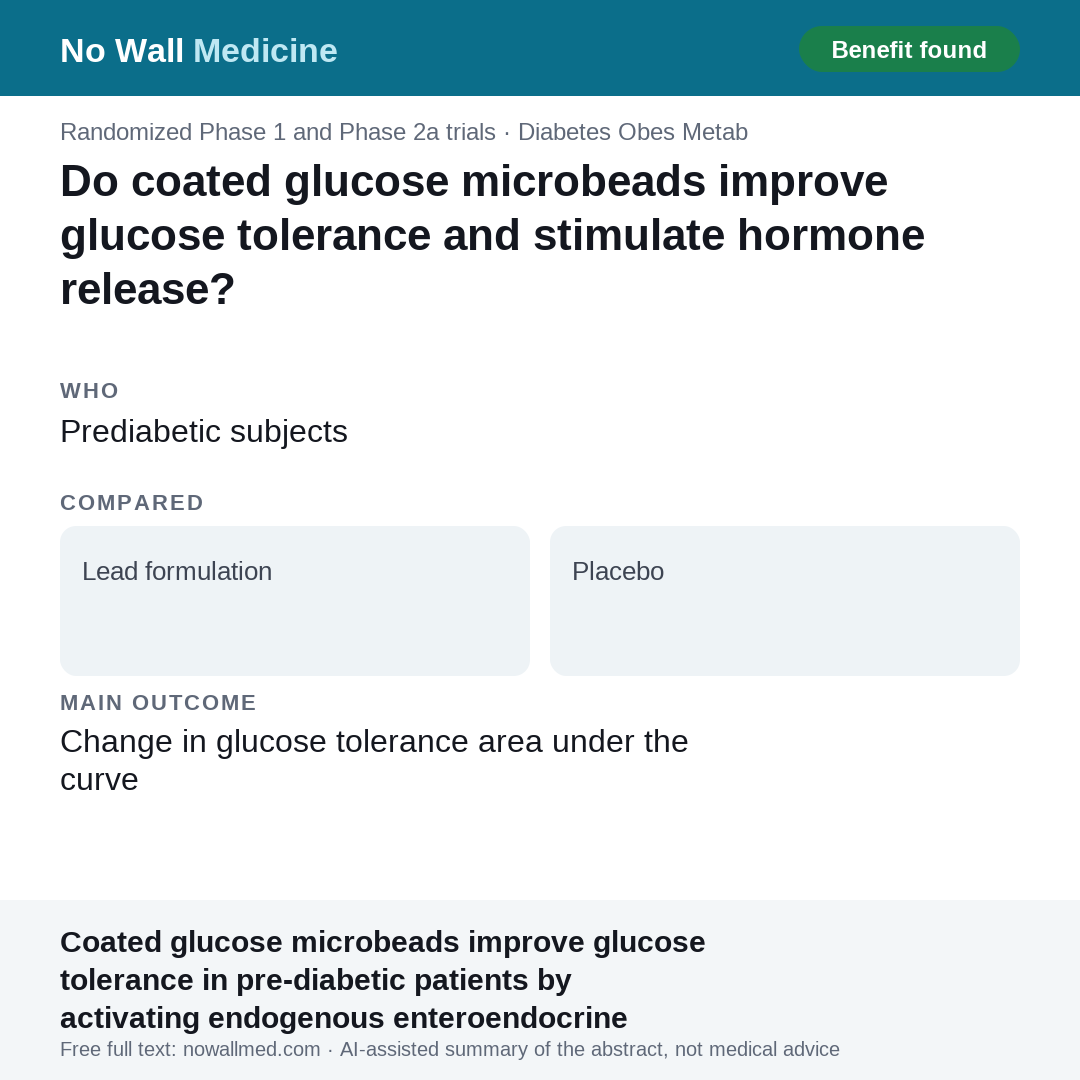
Clinical question: Do coated glucose microbeads improve glucose tolerance and stimulate hormone release?
Why it matters: Current treatments for obesity and metabolic dysfunction often use systemic hormone receptor agonists that can lead to adverse effects.
Key points
- Researchers conducted two Phase 1 studies and one Phase 2a crossover trial to test oral microbeads that deliver glucose to the distal small intestine.
- In the Phase 2a trial, the lead microbead formulation improved glucose tolerance in prediabetic subjects over 6 weeks compared to a placebo.
- The microbead formulation elicited a response in several hormones, including glucagon-like peptide 1, GLP-2, PYY, glicentin, oxyntomodulin, glucose-dependent insulinotropic peptide, C-peptide, and insulin.
Headline and key points written with AI from the paper’s abstract, with every number checked against it. Read the paper before relying on them.
Topics
Cite this article
Deusch K, Deboek A, Sina C, Capo-Velez C, Alicea V, Duller S. Coated glucose microbeads stimulate enteric hormone release and improve glucose tolerance in Phase 1 and 2 clinical trials. Diabetes Obes Metab. 2025. doi:10.1111/dom.70135
Spotted a mistake? Suggest a correction