Coblation tongue base reduction showed higher surgical success rates than radiofrequency for sleep apnea
Coblation Versus Radiofrequency for Tongue Base Reduction in Obstructive Sleep Apnea: A Meta-analysis
Meta-analysis of 40 studiesBenefit found
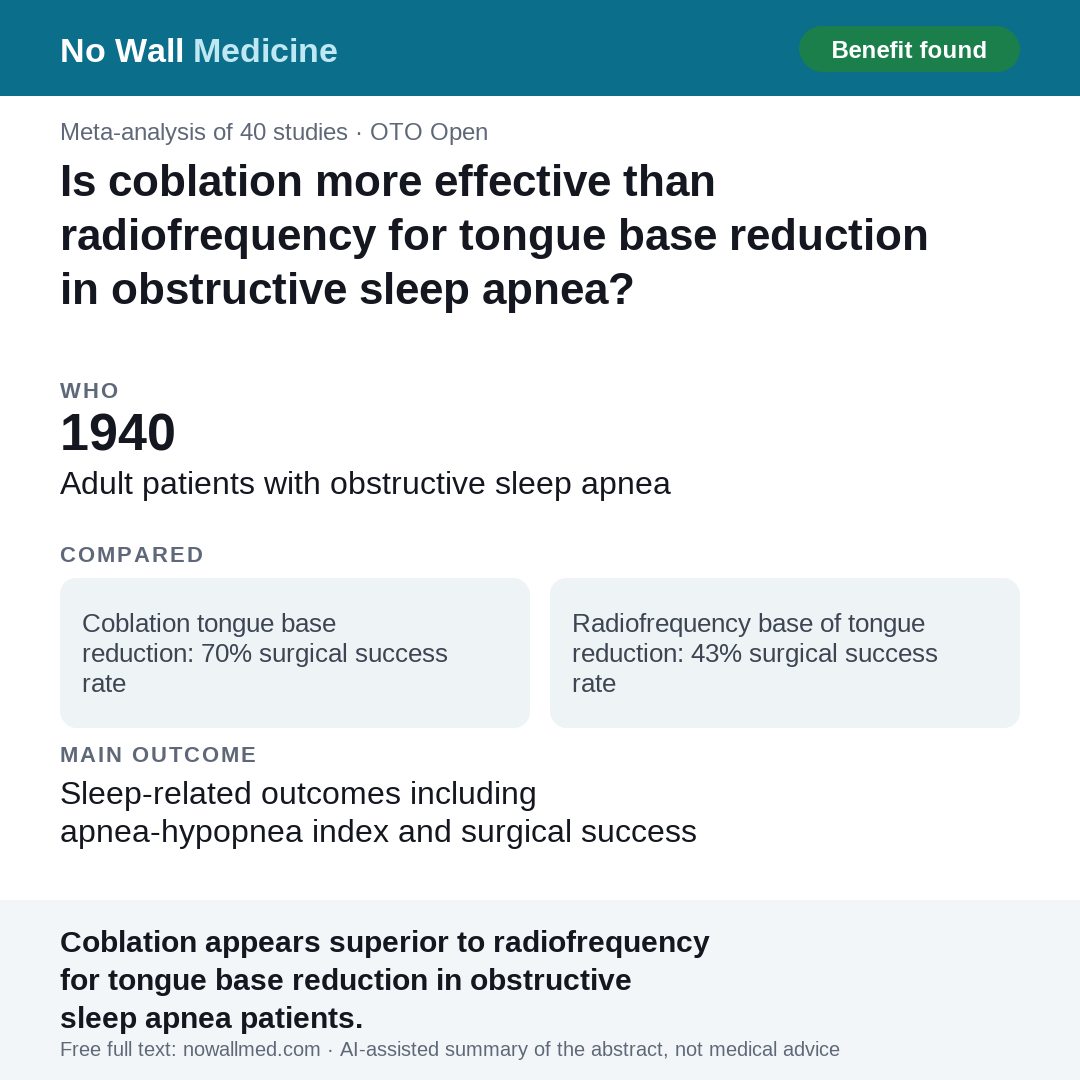
Is coblation more effective than radiofrequency for tongue base reduction in obstructive sleep apnea?
Who
1940
Adult patients with obstructive sleep apnea
Compared
Coblation tongue base reduction: 70% surgical success rate
Radiofrequency base of tongue reduction: 43% surgical success rate
Main outcome
Sleep-related outcomes including apnea-hypopnea index and surgical success
Bottom line: Coblation appears superior to radiofrequency for tongue base reduction in obstructive sleep apnea patients.
Limitation: Further studies with direct comparisons between both interventions must be performed.
OTO Open · 2025-01-19Download image
Clinical question: Is coblation more effective than radiofrequency for tongue base reduction in obstructive sleep apnea?
Why it matters: It is unclear whether coblation or radiofrequency is more effective for improving sleep-related outcomes in patients with obstructive sleep apnea.
Key points
- Researchers analyzed 40 studies involving 1940 patients to compare coblation and radiofrequency for reducing the base of the tongue in obstructive sleep apnea patients.
- Coblation had a surgical success rate of 70% compared to 43% for radiofrequency, where success was defined as a postoperative apnea-hypopnea index under 20 and a 50% drop.
- Both methods showed improvements in the apnea-hypopnea index, which measures breathing interruptions, and the Epworth sleepiness scale, which measures daytime sleepiness.
Headline and key points written with AI from the paper’s abstract, with every number checked against it. Read the paper before relying on them.
Cite this article
Hussain S, Hayat J, Chowdhury R, Ebrahim M, Alterki A, Bahgat A. Coblation Versus Radiofrequency for Tongue Base Reduction in Obstructive Sleep Apnea: A Meta-analysis. OTO Open. 2025. doi:10.1002/oto2.70076
Spotted a mistake? Suggest a correction
Top studies every Monday
The week’s key trials and guidelines in your specialties, plus any topics you follow. By email, free.
Get the weekly digest