Cognitive aids were linked to better resuscitation performance for healthcare professionals in simulation studies
Cognitive aids used in simulated resuscitation: A systematic review
Systematic reviewMixed results
Does using cognitive aids during resuscitation improve cardiopulmonary resuscitation quality and performance?
Who
29
Healthcare professionals and lay providers in simulated resuscitation · Simulation settings
Compared
Healthcare professionals: showed benefits
Lay providers: reported undesirable effects
Main outcome
Cardiopulmonary resuscitation quality and performance
Bottom line: Cognitive aids may benefit healthcare professionals but may have undesirable effects for lay providers during simulated resuscitation.
Limitation: Limited to indirect evidence from simulation studies only with significant methodological heterogeneity.
Resusc Plus · 2024-06-01Download image
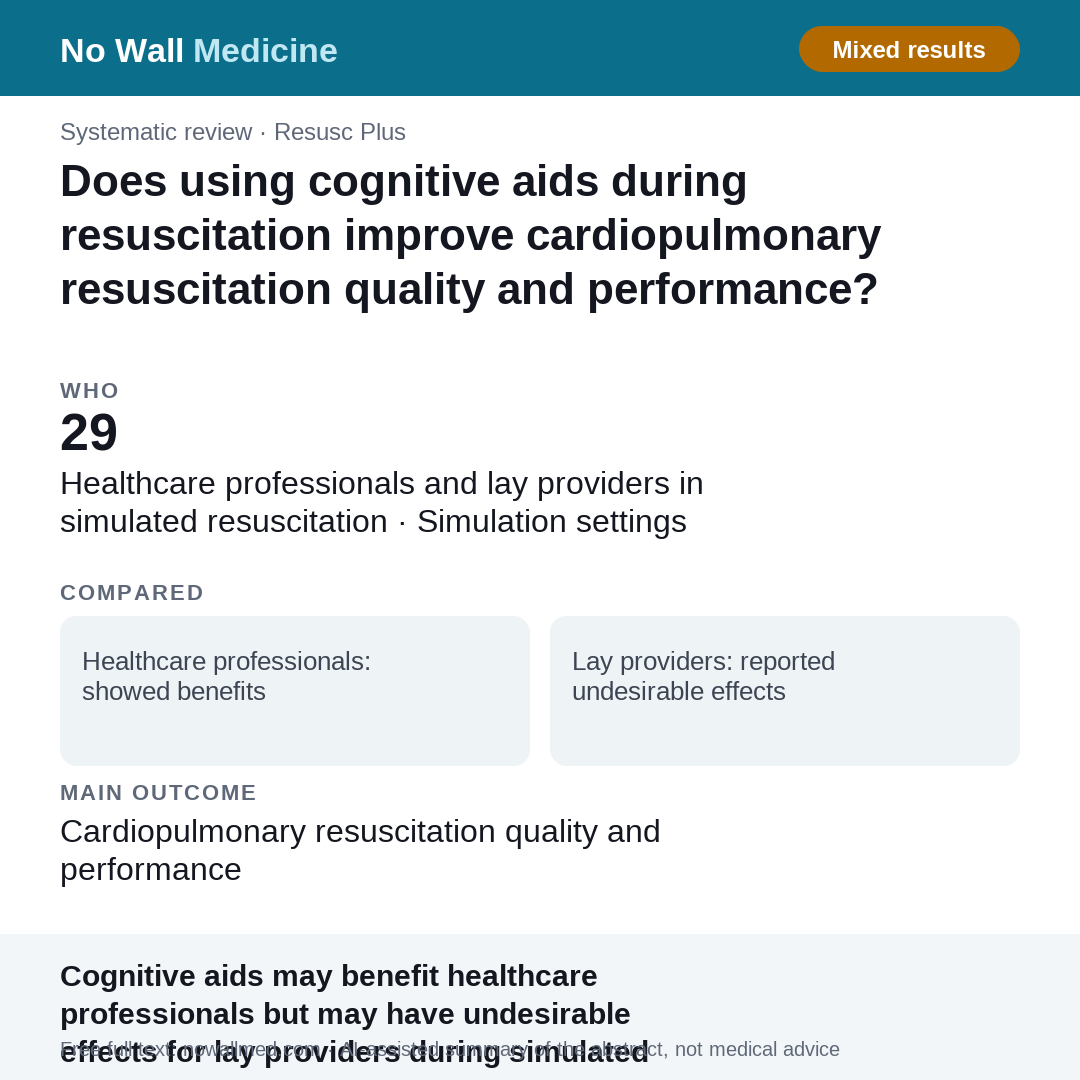
Clinical question: Does using cognitive aids during resuscitation improve cardiopulmonary resuscitation quality and performance?
Why it matters: It was unknown if using cognitive aids during resuscitation improves the quality of cardiopulmonary resuscitation and performance compared to not using them.
Key points
- Researchers reviewed 29 studies involving healthcare professionals and lay providers managing simulated resuscitations in neonates, children, adults, and other emergencies.
- Using cognitive aids, which are tools like checklists to assist memory, was linked to benefits for healthcare professionals in neonatal, paediatric, and adult life support.
- Some studies involving lay providers, or non-medical people, reported undesirable effects when using cognitive aids during simulated resuscitations.
Limitation the authors note: The review was limited to indirect evidence from simulation studies only and could not perform a meta-analysis due to significant methodological heterogeneity.
Headline and key points written with AI from the paper’s abstract, with every number checked against it. Read the paper before relying on them.
Was this summary helpful?
Cite this article
Nabecker S, Nation K, Gilfoyle E, Abelairas-Gomez C, Koota E, Lin Y. Cognitive aids used in simulated resuscitation: A systematic review. Resusc Plus. 2024. doi:10.1016/j.resplu.2024.100675
Spotted a mistake? Suggest a correction
Top studies every Monday
The week’s key trials and guidelines in your specialties, plus any topics you follow. By email, free.
Get the weekly digest