Cognitive Behavior Therapy With and Without Narrative Assessment and Suicide Attempts: A Systematic Review and Meta-Analysis
Systematic review and meta-analysisBenefit found
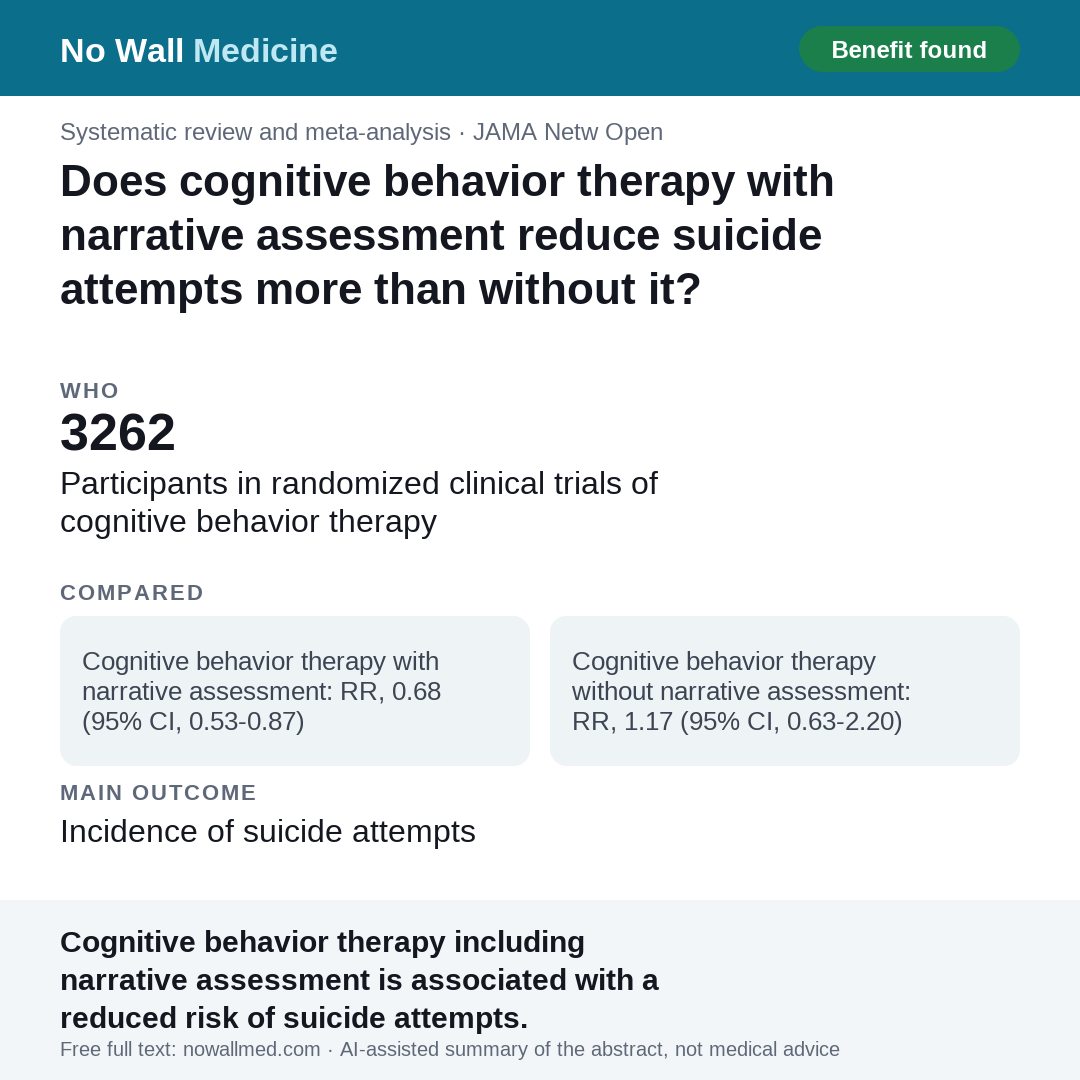
Does cognitive behavior therapy with narrative assessment reduce suicide attempts more than without it?
Who
3262
Participants in randomized clinical trials of cognitive behavior therapy
Compared
Cognitive behavior therapy with narrative assessment: RR, 0.68 (95% CI, 0.53-0.87)
Cognitive behavior therapy without narrative assessment: RR, 1.17 (95% CI, 0.63-2.20)
Main outcome
Incidence of suicide attempts
Result: RR, 0.68 (95% CI, 0.53-0.87)
Bottom line: Cognitive behavior therapy including narrative assessment is associated with a reduced risk of suicide attempts.
Limitation: Causal conclusions require direct head-to-head trials.
JAMA Netw Open · 2025-11-03Download image
Clinical question: Does cognitive behavior therapy with narrative assessment reduce suicide attempts more than without it?
Abstract
Importance
There is currently no evidence-based method to identify the forces that may drive someone to attempt suicide. Objective
To examine whether cognitive behavior therapy (CBT) interventions that incorporate a narrative assessment are associated with a greater reduction in suicide attempts than comparable interventions without this component. Data sources
Studies were identified through version 25.0.1 of the Metapsy Suicide Prevention Database, which includes randomized clinical trials published up to April 2025 retrieved through PubMed, Embase, Web of Science, Scopus, and Cochrane Central, including unpublished studies and references from relevant articles. Study selection
Included studies were randomized clinical trials of CBT interventions reporting suicide attempts as an outcome. Studies using waiting list controls, reporting only suicidal ideation, or lacking information on the type of assessment used were excluded. Data extraction and synthesis
Two reviewers independently extracted data and assessed risk of bias using the Cochrane Risk of Bias 2 tool. Meta-analyses were conducted using 3-level models with robust variance estimation. Relative risks (RRs) were pooled using the Mantel-Haenszel method. Analyses followed Preferred Reporting Items for Systematic Reviews and Meta-Analyses reporting guidelines. Data were pooled using a random-effects model. Main outcomes and measures
The primary outcome was the incidence of suicide attempts. Interventions were grouped by presence or absence of a narrative assessment component. Results
Twenty-three studies with 3262 participants met inclusion criteria. CBT interventions including a narrative assessment were associated with a significantly reduced risk of suicide attempt compared with controls (RR, 0.68; 95% CI, 0.53-0.87; 1764 participants across 14 studies), whereas CBT interventions without this component were not associated with risk of suicide attempt (RR, 1.17; 95% CI, 0.63-2.20; 1498 participants across 9 studies). Subgroup comparison indicated a significant difference between groups (Q1 = 7.27; P = .007; I2 = 86%). Studies without a narrative assessment had significantly younger participants, a lower event rate, and slightly higher risk of bias. Conclusions and relevance
In this systematic review and meta-analysis, CBT interventions including a narrative assessment were associated with a reduced risk of suicide attempt, while CBT without this component did not have an association with risk of suicide attempt. Age differences between study populations may partly explain this finding, as interventions in younger populations often show smaller and more inconsistent effect sizes. These results suggest that a narrative assessment may be a simple and effective way to capture the forces that lead to suicide attempts and to direct interventions toward their prevention. Causal conclusions require direct head-to-head trials.
Topics
Cite this article
Janssen WC, Mérelle SYM, van Ballegooijen W, Gilissen R, Bockting CLH. Cognitive Behavior Therapy With and Without Narrative Assessment and Suicide Attempts: A Systematic Review and Meta-Analysis. JAMA Netw Open. 2025. doi:10.1001/jamanetworkopen.2025.44632
Spotted a mistake? Suggest a correction