Cognitive behavior therapy improved insomnia but not fatigue in women receiving chemotherapy for breast cancer
Cognitive Behavior vs Bright Light Therapy for Insomnia in Women Undergoing Chemotherapy for Breast Cancer: A Randomized Clinical Trial
6-week, 2x2 factorial, superiority, parallel randomized clinical trialMixed results
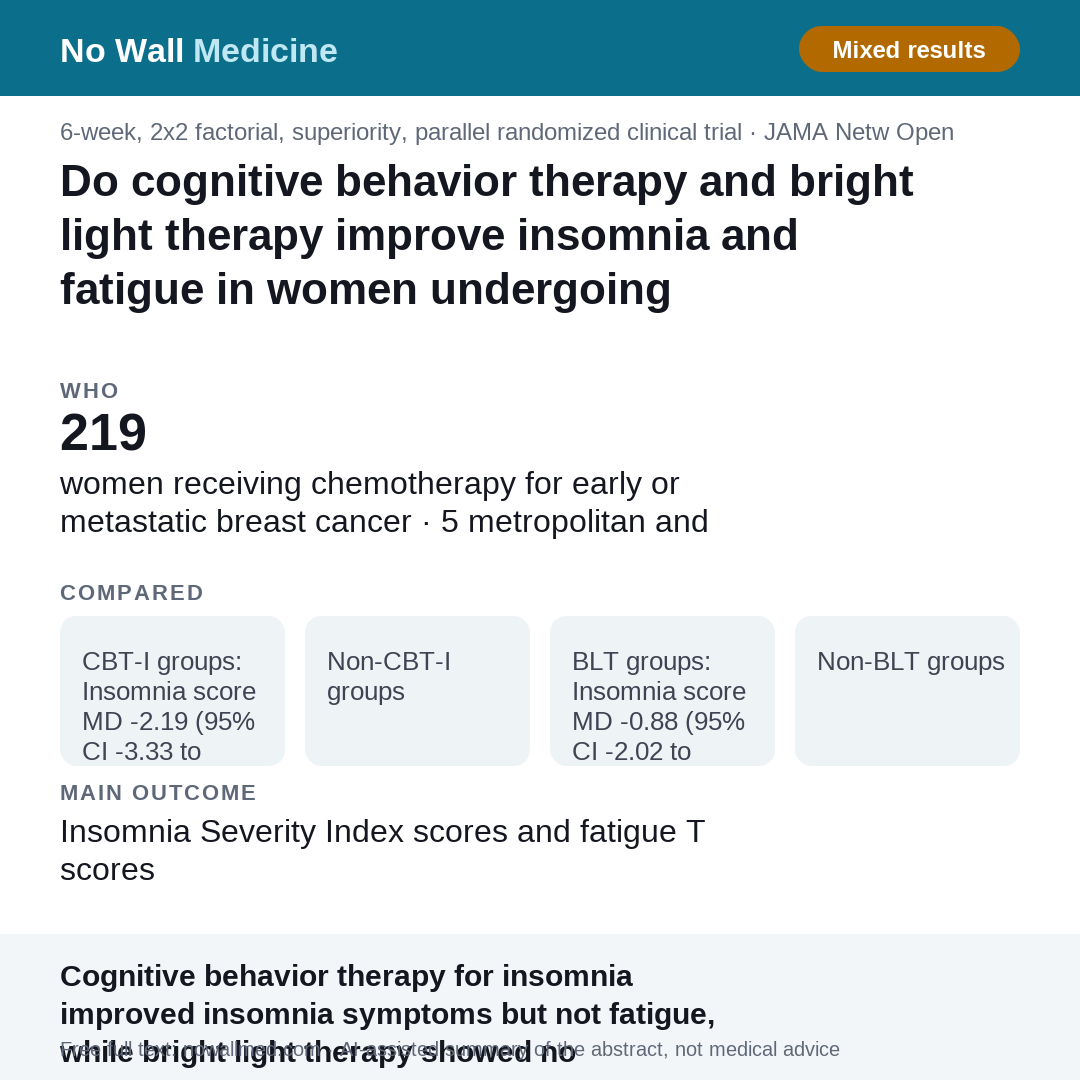
Do cognitive behavior therapy and bright light therapy improve insomnia and fatigue in women undergoing chemotherapy?
Who
219
women receiving chemotherapy for early or metastatic breast cancer · 5 metropolitan and regional hospitals in Australia
Compared
CBT-I groups: Insomnia score MD -2.19 (95% CI -3.33 to -1.05)
Non-CBT-I groups
BLT groups: Insomnia score MD -0.88 (95% CI -2.02 to 0.26)
Non-BLT groups
Main outcome
Insomnia Severity Index scores and fatigue T scores
Result: Insomnia score MD -2.19 (95% CI -3.33 to -1.05)
Bottom line: Cognitive behavior therapy for insomnia improved insomnia symptoms but not fatigue, while bright light therapy showed no significant improvement.
JAMA Netw Open · 2026-08-03Download image
Clinical question: Do cognitive behavior therapy and bright light therapy improve insomnia and fatigue in women undergoing chemotherapy?
Why it matters: No randomized clinical trials have evaluated the use of cognitive behavior therapy for insomnia and bright light therapy alone or in combination during chemotherapy.
Key points
- Researchers studied 219 women receiving chemotherapy for breast cancer to compare cognitive behavior therapy for insomnia, bright light therapy, or both.
- Cognitive behavior therapy improved insomnia symptoms but did not improve fatigue symptoms compared to other groups.
- Bright light therapy did not show significant differences in insomnia or fatigue symptoms compared to non-bright light groups.
Headline and key points written with AI from the paper’s abstract, with every number checked against it. Read the paper before relying on them.
Topics
Cite this article
Do TT, Maccora J, Wallace R, Aedo-Lopez V, Alexander M, Ancoli-Israel S. Cognitive Behavior vs Bright Light Therapy for Insomnia in Women Undergoing Chemotherapy for Breast Cancer: A Randomized Clinical Trial. JAMA Netw Open. 2026. doi:10.1001/jamanetworkopen.2026.30320
Spotted a mistake? Suggest a correction