Cognitive-behavioural therapy supplemented with cardiac rehabilitation reduces anxiety and depression in younger patients
Cognitive-behavioural therapy reduces psychological distress in younger patients with cardiac disease: a randomized trial
Multicentre randomized controlled trialBenefit found
Does cognitive-behavioural therapy supplemented to cardiac rehabilitation reduce anxiety and depression?
Who
147
Cardiac patients with psychological distress · Multicentre
Compared
Group CBT plus usual cardiac rehabilitation: mean total HADS score improved by 8.0 (standard deviation 5.6)
Usual cardiac rehabilitation alone: mean total HADS score improved by 4.1 (standard deviation 7.8)
Main outcome
Total Hospital Anxiety and Depression Scale score after 3 months
Bottom line: Adding brief cognitive-behavioural therapy to cardiac rehabilitation reduces anxiety, depression, and cardiac readmissions.
Eur Heart J · 2023-01-18Download image
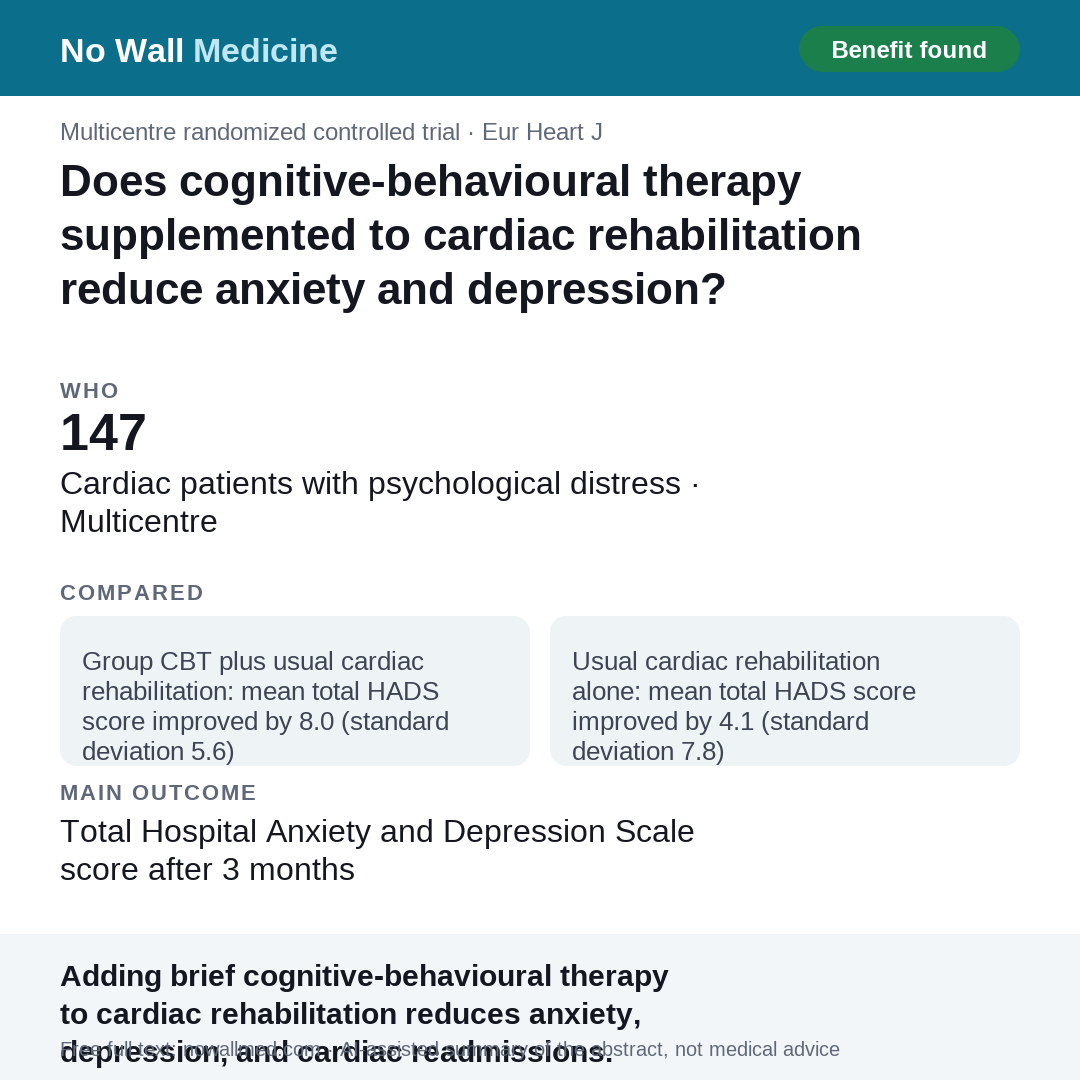
Clinical question: Does cognitive-behavioural therapy supplemented to cardiac rehabilitation reduce anxiety and depression?
Why it matters: It was unknown if adding cognitive-behavioural therapy to standard outpatient cardiac rehabilitation could reduce anxiety and depression in patients with cardiac disease.
Key points
- Researchers randomized 147 cardiac patients with psychological distress to receive either usual cardiac rehabilitation or cardiac rehabilitation plus five sessions of group cognitive-behavioural therapy.
- The intervention group showed a mean total Hospital Anxiety and Depression Scale score improvement of 8.0 (standard deviation 5.6) compared to 4.1 (standard deviation 7.8) in the control group.
- Patients receiving the therapy also showed greater adherence to cardiac rehabilitation, improved heart-related quality of life, and fewer cardiac hospital readmissions at 12 months.
Headline and key points written with AI from the paper’s abstract, with every number checked against it. Read the paper before relying on them.
Was this summary helpful?
Subject terms
Cite this article
Holdgaard A, Eckhardt-Hansen C, Lassen CF, Kjesbu IE, Dall CH, Michaelsen KL. Cognitive-behavioural therapy reduces psychological distress in younger patients with cardiac disease: a randomized trial. Eur Heart J. 2023. doi:10.1093/eurheartj/ehac792
Spotted a mistake? Suggest a correction
Top studies every Monday
The week’s key trials and guidelines in your specialties, plus any topics you follow. By email, free.
Get the weekly digest