Different medication strategies for treatment-resistant depression showed no significant differences in global cognitive function
Cognitive changes in older adults receiving pharmacotherapy for treatment-resistant depression: a secondary analysis of the OPTIMUM randomised controlled trial
Pragmatic, randomised, comparative effectiveness trialNo clear difference
What are the acute cognitive changes associated with various pharmacotherapy strategies for treatment-resistant depression in older adults?
Who
742
Adults aged 60 years or older with treatment-resistant depression · Five academic medical centres in USA and Canada
Compared
Aripiprazole augmentation
Bupropion augmentation
Switch to bupropion monotherapy
Lithium augmentation
Main outcome
National Institutes of Health Toolbox Fluid Cognition Composite Score
Bottom line: Global cognitive functioning did not differ between various pharmacotherapy strategies for treatment-resistant depression in older adults.
Funded by: US National Institute of Mental Health and Patient-Centered Outcomes Research Institute
Lancet Healthy Longev · 2025-11-11Download image
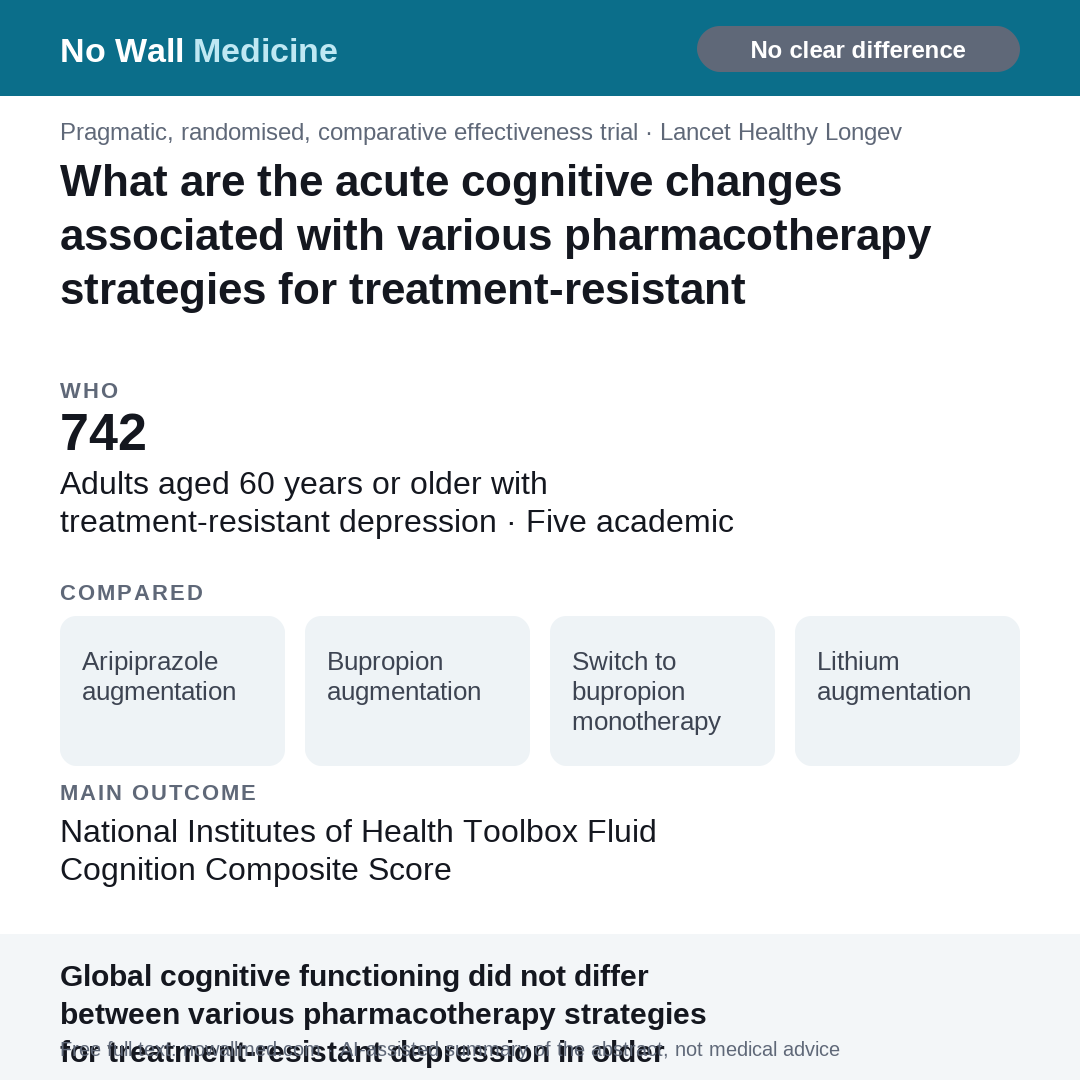
Clinical question: What are the acute cognitive changes associated with various pharmacotherapy strategies for treatment-resistant depression in older adults?
Why it matters: The cognitive effects of different antidepressant strategies for treatment-resistant depression in older adults are unclear.
Key points
- Researchers studied 742 older adults with treatment-resistant depression across two steps involving different medication additions or switches.
- Over 10 weeks, there were no significant differences between the various medication strategies in the National Institutes of Health Fluid Cognition Composite Score.
- In Step 1, aripiprazole augmentation was associated with an increase in inhibitory control compared to bupropion augmentation, while in Step 2, nortriptyline monotherapy showed an increase in inhibitory control compared to lithium augmentation.
Headline and key points written with AI from the paper’s abstract, with every number checked against it. Read the paper before relying on them.
Topics
Cite this article
Oughli HA, Ainsworth NJ, Butters MA, Brown PJ, Gebara MA, Gettinger TR. Cognitive changes in older adults receiving pharmacotherapy for treatment-resistant depression: a secondary analysis of the OPTIMUM randomised controlled trial. Lancet Healthy Longev. 2025. doi:10.1016/j.lanhl.2025.100767
Spotted a mistake? Suggest a correction