Bariatric surgery showed no significant difference in memory or executive function compared to non-surgical treatment
Cognitive functioning in adolescents with severe obesity undergoing bariatric surgery or intensive non-surgical treatment in Sweden (AMOS2): a multicentre, open-label, randomised controlled trial
Multicentre, open-label, randomised controlled trialNo clear difference
Does bariatric surgery improve cognitive functioning in adolescents with severe obesity over two years?
Who
46
Adolescents aged 13-16 years with severe obesity · Three specialised obesity centres in Sweden
Compared
Bariatric surgery
Intensive non-surgical treatment
Main outcome
Change in cognitive functioning
Bottom line: Bariatric surgery did not show overall greater improvement in executive functions and memory compared to intensive non-surgical treatment.
Limitation: Lack of statistical power is a potential limitation.
Funded by: Sweden's innovation agency (VINNOVA) and others
eClinicalMedicine · 2024-02-27Download image
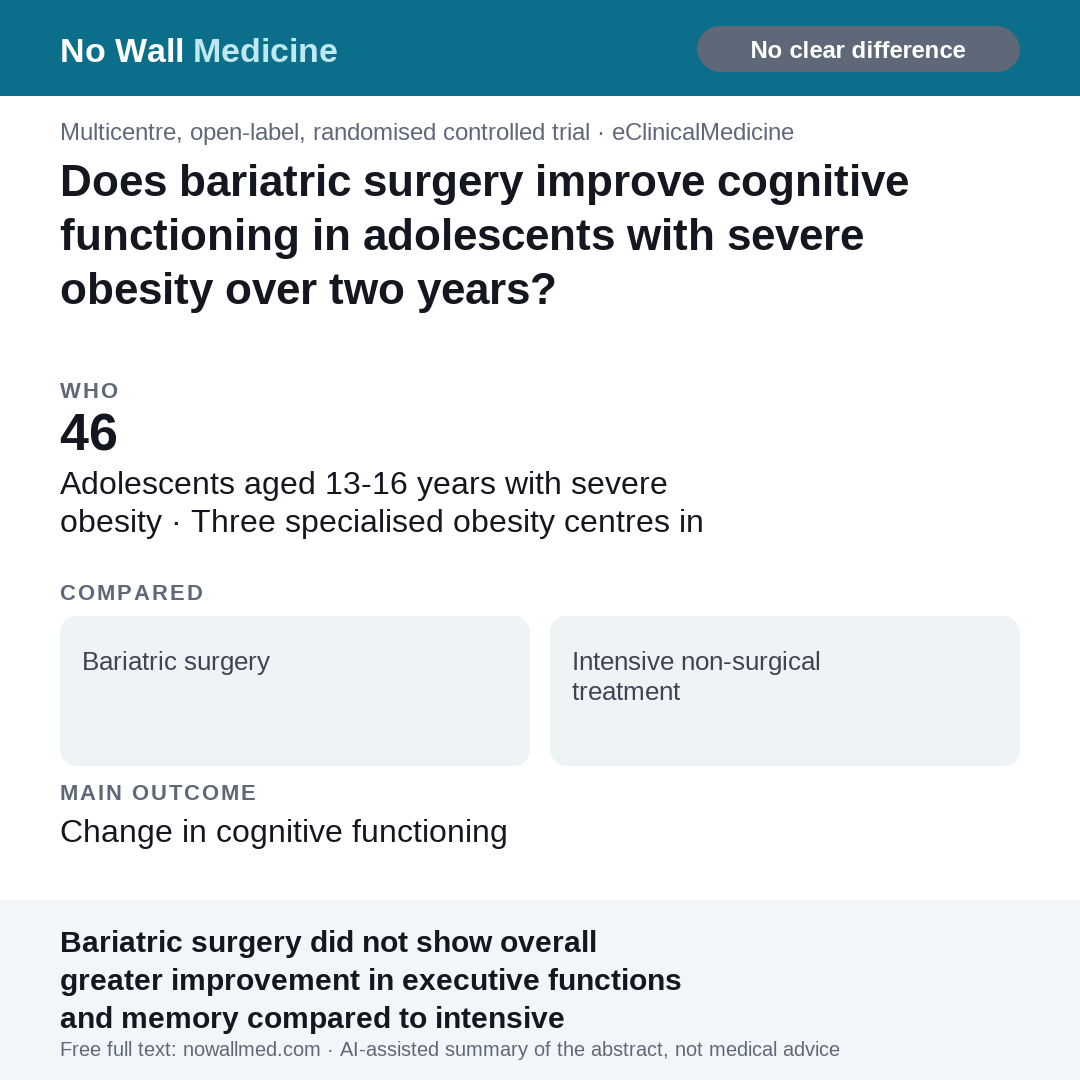
Clinical question: Does bariatric surgery improve cognitive functioning in adolescents with severe obesity over two years?
Why it matters: It is unknown if bariatric surgery leads to greater improvements in executive functioning and memory in adolescents compared to intensive non-surgical treatment.
Key points
- The study randomized 46 adolescents with severe obesity to either bariatric surgery or intensive non-surgical treatment and measured cognitive changes over two years.
- No significant differences were found between groups for 15/18 aspects of cognitive functioning, including memory, verbal recall, and estimated intelligence quotient.
- Three sub-tests for fundamental cognitive skills, including letter fluency, visual scanning, and word reading, showed more improvement in the surgery group.
Limitation the authors note: The authors state that a lack of statistical power is a potential limitation.
Headline and key points written with AI from the paper’s abstract, with every number checked against it. Read the paper before relying on them.
Cite this article
Järvholm K, Gronowitz E, Janson A, Peltonen M, Sjögren L, Beamish AJ. Cognitive functioning in adolescents with severe obesity undergoing bariatric surgery or intensive non-surgical treatment in Sweden (AMOS2): a multicentre, open-label, randomised controlled trial. eClinicalMedicine. 2024. doi:10.1016/j.eclinm.2024.102505
Spotted a mistake? Suggest a correction
Top studies every Monday
The week’s key trials and guidelines in your specialties, plus any topics you follow. By email, free.
Get the weekly digest