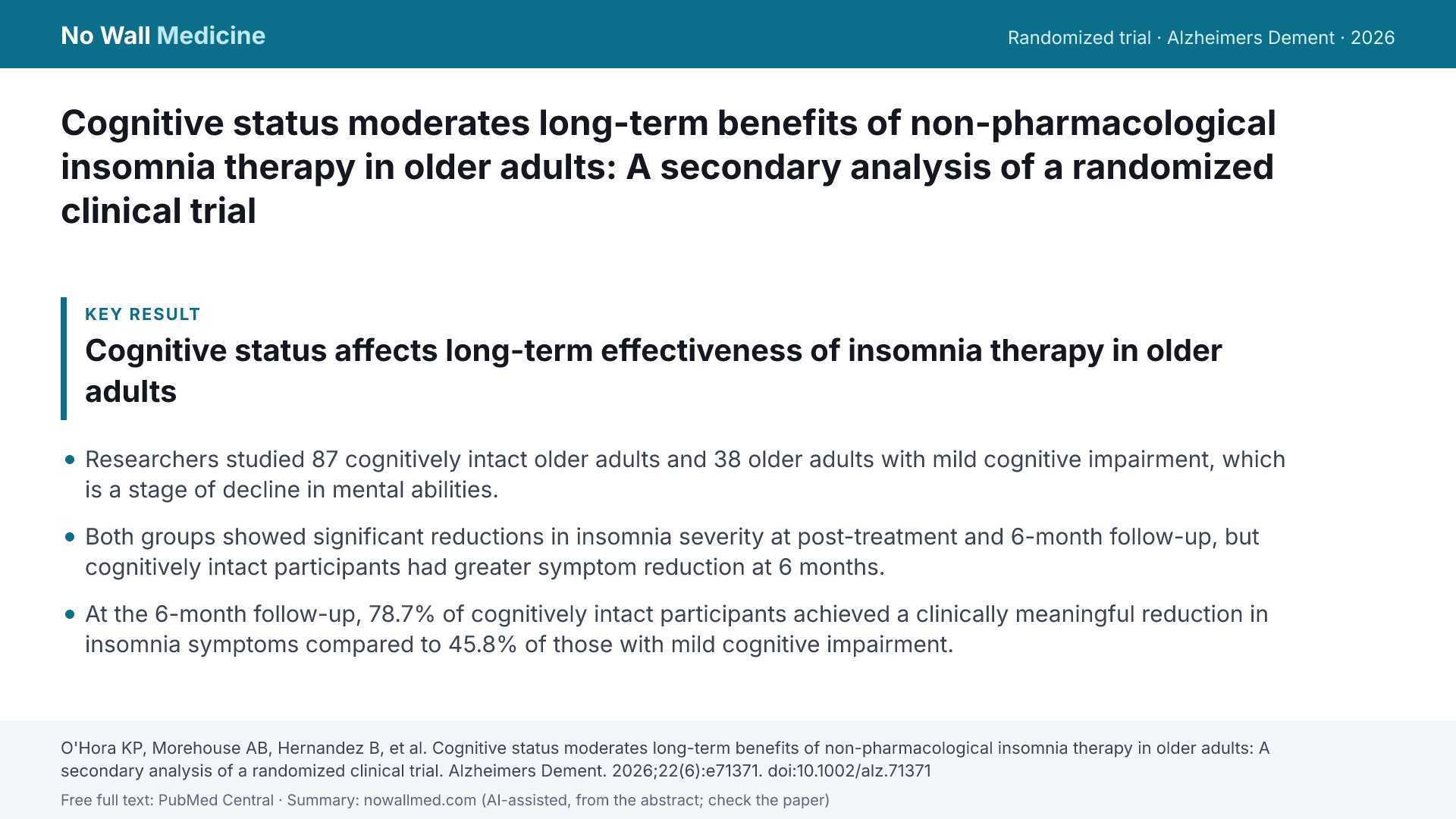
Cognitive status affects long-term effectiveness of insomnia therapy in older adults
Cognitive status moderates long-term benefits of non-pharmacological insomnia therapy in older adults: A secondary analysis of a randomized clinical trial
Key points
- Researchers studied 87 cognitively intact older adults and 38 older adults with mild cognitive impairment, which is a stage of decline in mental abilities.
- Both groups showed significant reductions in insomnia severity at post-treatment and 6-month follow-up, but cognitively intact participants had greater symptom reduction at 6 months.
- At the 6-month follow-up, 78.7% of cognitively intact participants achieved a clinically meaningful reduction in insomnia symptoms compared to 45.8% of those with mild cognitive impairment.
Headline and key points written with AI from the paper’s abstract, with every number checked against it. Read the paper before relying on them.
Was this summary helpful?
Subject terms
Headline, design, result, key points, caveat and citation as plain text.
Cite this article
O'Hora KP, Morehouse AB, Hernandez B, et al. Cognitive status moderates long-term benefits of non-pharmacological insomnia therapy in older adults: A secondary analysis of a randomized clinical trial. Alzheimers Dement. 2026;22(6):e71371. doi:10.1002/alz.71371
Spotted a mistake? Suggest a correction