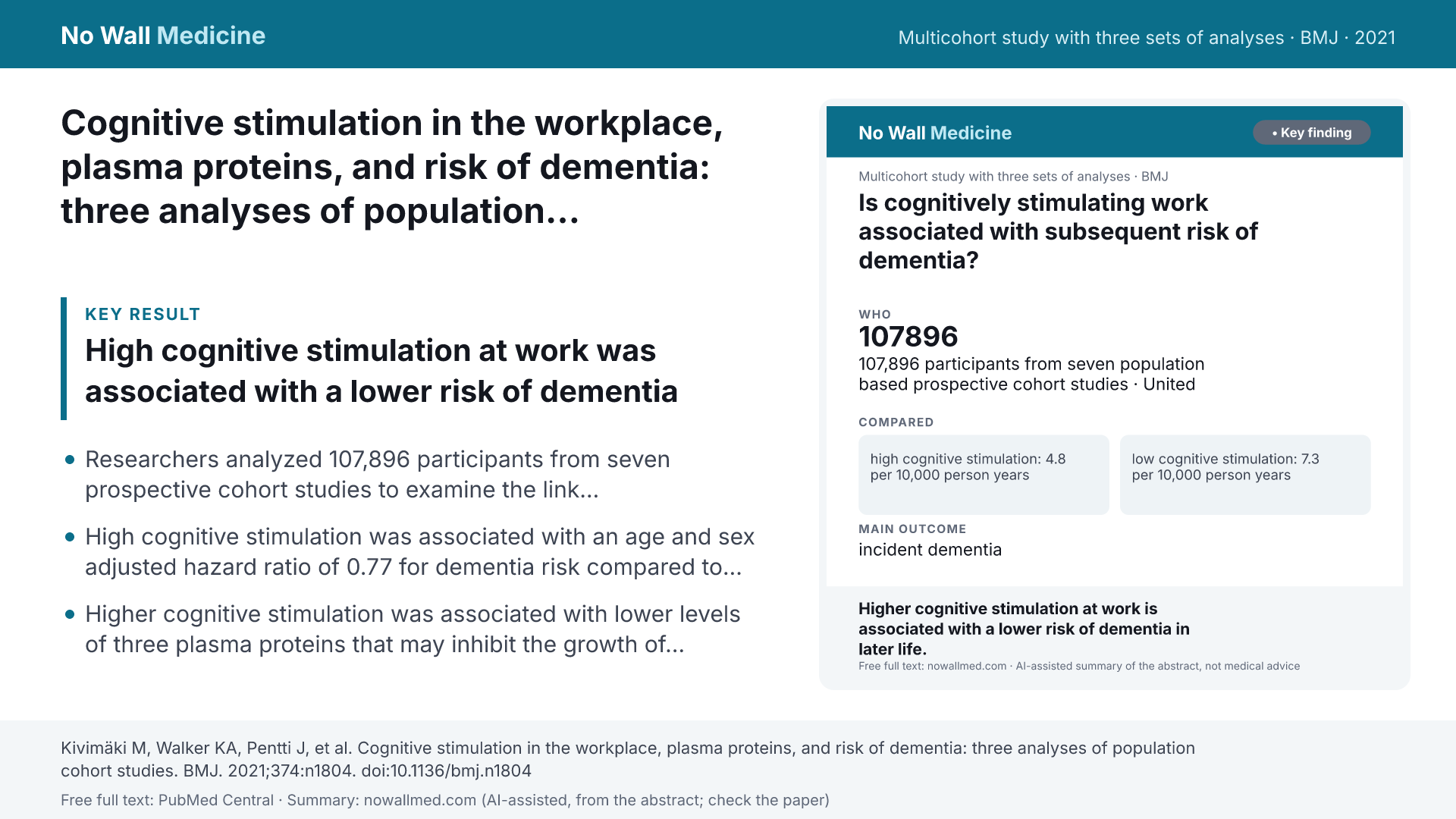
High cognitive stimulation at work was associated with a lower risk of dementia
Cognitive stimulation in the workplace, plasma proteins, and risk of dementia: three analyses of population cohort studies
Multicohort study with three sets of analysesKey finding
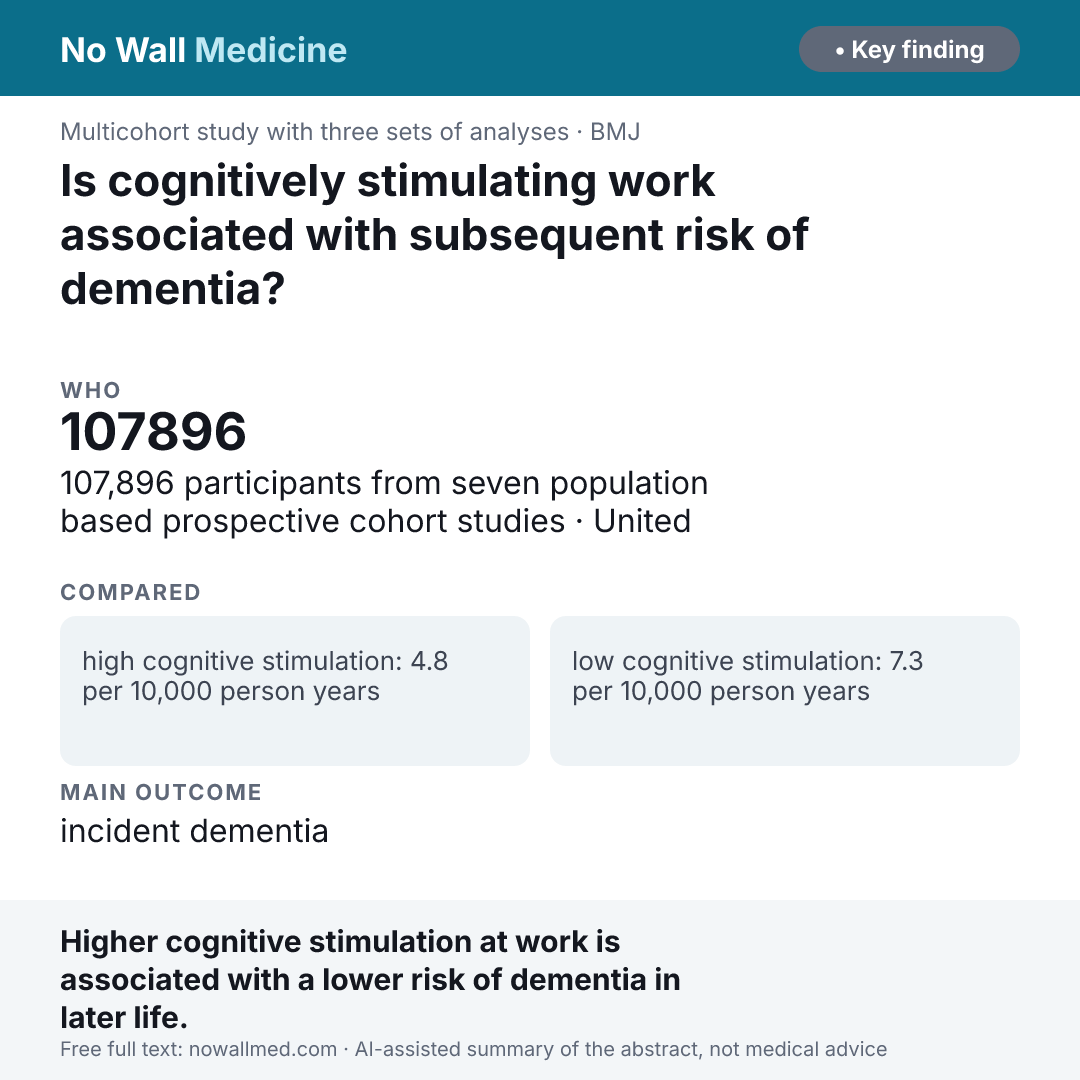
Is cognitively stimulating work associated with subsequent risk of dementia?
Who
107896
107,896 participants from seven population based prospective cohort studies · United Kingdom, Europe, and the United States
Compared
high cognitive stimulation: 4.8 per 10,000 person years
low cognitive stimulation: 7.3 per 10,000 person years
Main outcome
incident dementia
Result: age and sex adjusted hazard ratio 0.77 (95% CI 0.65 to 0.92)
Bottom line: Higher cognitive stimulation at work is associated with a lower risk of dementia in later life.
BMJ · 2021-08-18 · Save PNG
Clinical question: Is cognitively stimulating work associated with subsequent risk of dementia?
Key points
- Researchers analyzed 107,896 participants from seven prospective cohort studies to examine the link between cognitively stimulating jobs and dementia risk.
- High cognitive stimulation was associated with an age and sex adjusted hazard ratio of 0.77 for dementia risk compared to low stimulation.
- Higher cognitive stimulation was associated with lower levels of three plasma proteins that may inhibit the growth of nerve cells and brain connections.
Headline and key points written with AI from the paper’s abstract, with every number checked against it. Read the paper before relying on them.
Was this summary helpful?
Abstract
Objectives
To examine the association between cognitively stimulating work and subsequent risk of dementia and to identify protein pathways for this association. Design
Multicohort study with three sets of analyses. Setting
United Kingdom, Europe, and the United States. Participants
Three associations were examined: cognitive stimulation and dementia risk in 107 896 participants from seven population based prospective cohort studies from the IPD-Work consortium (individual participant data meta-analysis in working populations); cognitive stimulation and proteins in a random sample of 2261 participants from one cohort study; and proteins and dementia risk in 13 656 participants from two cohort studies. Main outcome measures
Cognitive stimulation was measured at baseline using standard questionnaire instruments on active versus passive jobs and at baseline and over time using a job exposure matrix indicator. 4953 proteins in plasma samples were scanned. Follow-up of incident dementia varied between 13.7 to 30.1 years depending on the cohort. People with dementia were identified through linked electronic health records and repeated clinical examinations. Results
During 1.8 million person years at risk, 1143 people with dementia were recorded. The risk of dementia was found to be lower for participants with high compared with low cognitive stimulation at work (crude incidence of dementia per 10 000 person years 4.8 in the high stimulation group and 7.3 in the low stimulation group, age and sex adjusted hazard ratio 0.77, 95% confidence interval 0.65 to 0.92, heterogeneity in cohort specific estimates I2=0%, P=0.99). This association was robust to additional adjustment for education, risk factors for dementia in adulthood (smoking, heavy alcohol consumption, physical inactivity, job strain, obesity, hypertension, and prevalent diabetes at baseline), and cardiometabolic diseases (diabetes, coronary heart disease, stroke) before dementia diagnosis (fully adjusted hazard ratio 0.82, 95% confidence interval 0.68 to 0.98). The risk of dementia was also observed during the first 10 years of follow-up (hazard ratio 0.60, 95% confidence interval 0.37 to 0.95) and from year 10 onwards (0.79, 0.66 to 0.95) and replicated using a repeated job exposure matrix indicator of cognitive stimulation (hazard ratio per 1 standard deviation increase 0.77, 95% confidence interval 0.69 to 0.86). In analysis controlling for multiple testing, higher cognitive stimulation at work was associated with lower levels of proteins that inhibit central nervous system axonogenesis and synaptogenesis: slit homologue 2 (SLIT2, fully adjusted β -0.34, P<0.001), carbohydrate sulfotransferase 12 (CHSTC, fully adjusted β -0.33, P<0.001), and peptidyl-glycine α-amidating monooxygenase (AMD, fully adjusted β -0.32, P<0.001). These proteins were associated with increased dementia risk, with the fully adjusted hazard ratio per 1 SD being 1.16 (95% confidence interval 1.05 to 1.28) for SLIT2, 1.13 (1.00 to 1.27) for CHSTC, and 1.04 (0.97 to 1.13) for AMD. Conclusions
The risk of dementia in old age was found to be lower in people with cognitively stimulating jobs than in those with non-stimulating jobs. The findings that cognitive stimulation is associated with lower levels of plasma proteins that potentially inhibit axonogenesis and synaptogenesis and increase the risk of dementia might provide clues to underlying biological mechanisms.
Abstract reproduced under the article’s CC BY licence.
Subject terms
Headline, design, result, key points, caveat and citation as plain text.
Cite this article
Kivimäki M, Walker KA, Pentti J, et al. Cognitive stimulation in the workplace, plasma proteins, and risk of dementia: three analyses of population cohort studies. BMJ. 2021;374:n1804. doi:10.1136/bmj.n1804
Spotted a mistake? Suggest a correction