Cognitive Training for Reduction of Delirium in Patients Undergoing Cardiac Surgery: A Randomized Clinical Trial
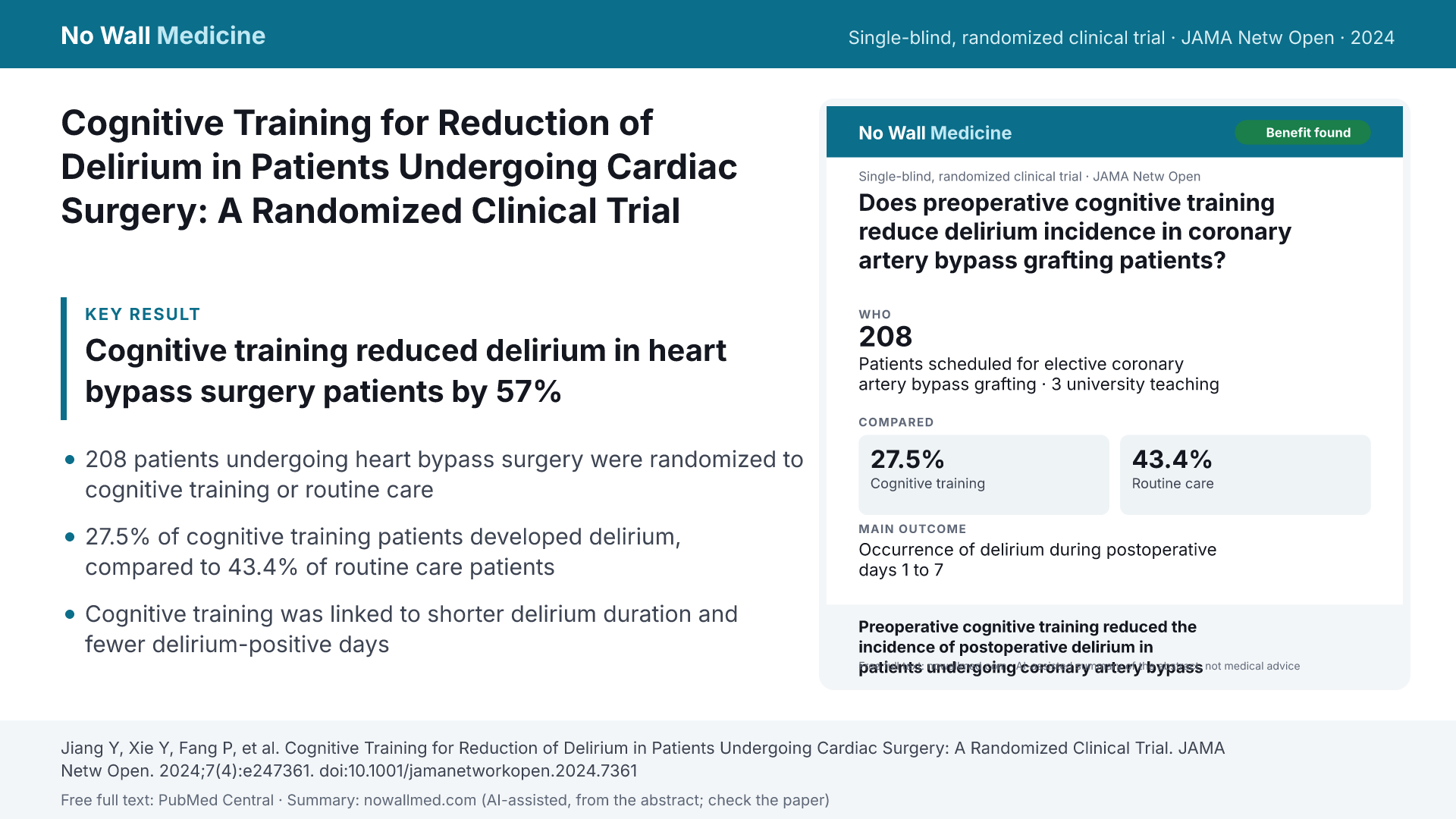
Key result: Cognitive training reduced delirium in heart bypass surgery patients by 57%
Single-blind, randomized clinical trialBenefit found
Does preoperative cognitive training reduce delirium incidence in coronary artery bypass grafting patients?
Who
208
Patients scheduled for elective coronary artery bypass grafting · 3 university teaching hospitals in southeastern China
Compared
27.5%Cognitive training
43.4%Routine care
Main outcome
Occurrence of delirium during postoperative days 1 to 7
Result: adjusted odds ratio 0.43 (95% CI 0.23-0.77)
Bottom line: Preoperative cognitive training reduced the incidence of postoperative delirium in patients undergoing coronary artery bypass grafting.
Limitation: Primary analysis was based on fewer than 75 events and should be considered exploratory.
JAMA Netw Open · 2024-04-01
Key points
- 208 patients undergoing heart bypass surgery were randomized to cognitive training or routine care.
- 27.5% of cognitive training patients developed delirium, compared to 43.4% of routine care patients.
- Cognitive training was linked to shorter delirium duration and fewer delirium-positive days.
Discussion prompts
- Would these patients look like yours? Who was left out?
- Is the main outcome one that matters to patients?
- Is the difference large enough to change what you do?
Cite: Jiang Y, Xie Y, Fang P, et al. Cognitive Training for Reduction of Delirium in Patients Undergoing Cardiac Surgery: A Randomized Clinical Trial. JAMA Netw Open. 2024;7(4):e247361. doi:10.1001/jamanetworkopen.2024.7361
Free full text: PubMed Central · Summary and visual abstract: nowallmed.com/a/cognitive-training-for-reduction-of-delirium-in-patients-undergoing-1ilxxvr/ (AI-assisted from the abstract; check the paper before relying on it).