Colchicine was associated with higher stroke rates in patients with symptomatic intracranial artery stenosis
Colchicine for preventing stroke in patients with and without intracranial atherosclerotic stenosis: a prespecified analysis of a randomized clinical trial
Randomized, double-blind, placebo-controlled clinical trialHarm found
Does colchicine prevent stroke in patients with or without symptomatic intracranial artery stenosis?
Who
7567
Patients with ischemic stroke or transient ischemic attack · 244 centers in China
Compared
10.5%sICAS colchicine
8.5%sICAS placebo
4.2%without sICAS colchicine
5.2%without sICAS placebo
Main outcome
new stroke at 90 days
Result: adjusted HR 1.30 (95% CI 1.01-1.69) for sICAS
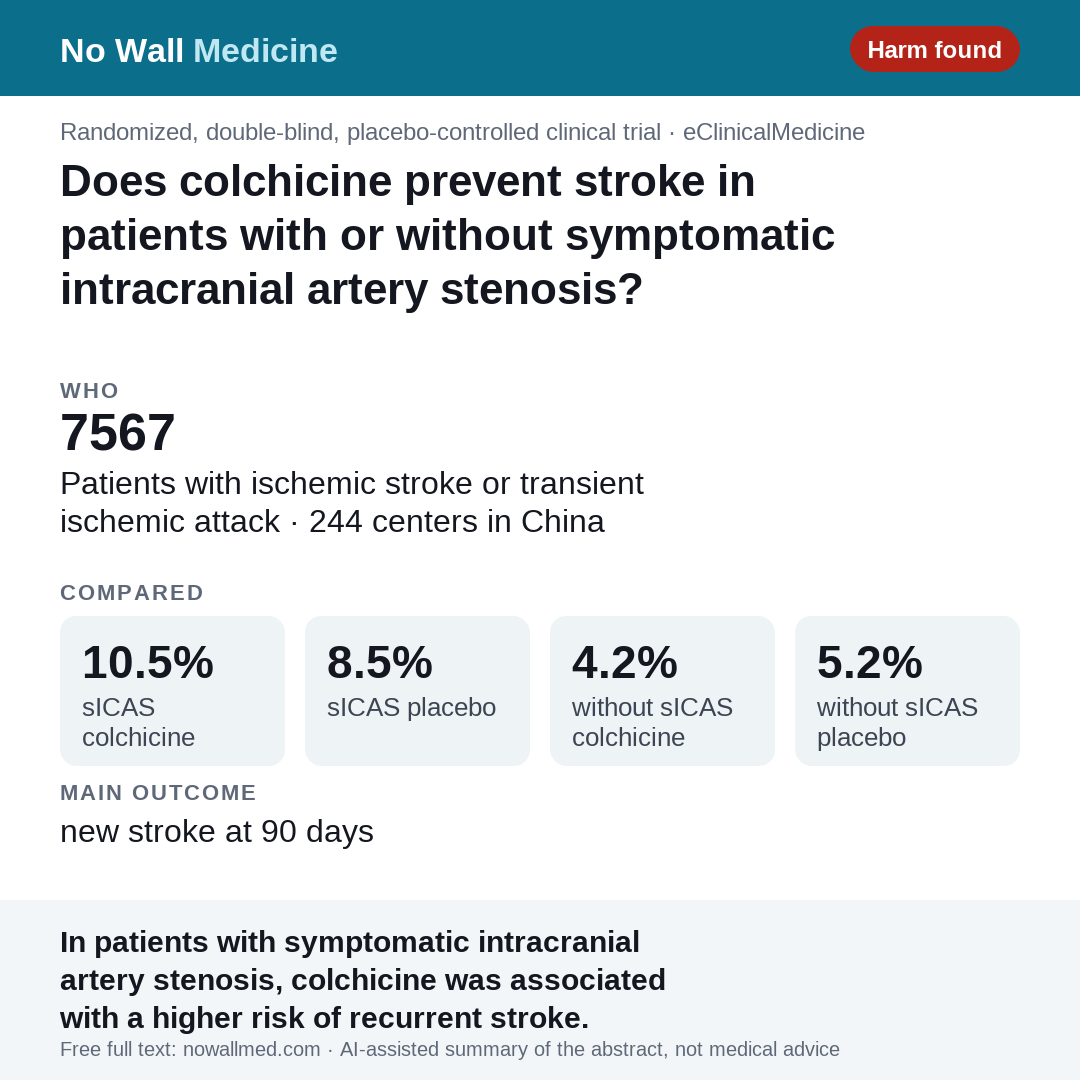
Bottom line: In patients with symptomatic intracranial artery stenosis, colchicine was associated with a higher risk of recurrent stroke.
Funded by: National Key R&D Program of China and others
eClinicalMedicine · 2025-05-19Download image
Clinical question: Does colchicine prevent stroke in patients with or without symptomatic intracranial artery stenosis?
Why it matters: It is unknown if colchicine affects stroke risk differently in patients with or without symptomatic intracranial artery stenosis or if age changes this effect.
Key points
- Researchers analyzed 7567 patients with ischemic stroke or transient ischemic attack, a temporary blockage of blood flow to the brain, to see how colchicine affected stroke risk.
- In patients with symptomatic intracranial artery stenosis, 10.5% on colchicine and 8.5% on placebo had a recurrent stroke within 90 days.
- In patients without symptomatic intracranial artery stenosis, the stroke rates were 4.2% for colchicine and 5.2% for placebo, which was not a statistically significant difference.
Headline and key points written with AI from the paper’s abstract, with every number checked against it. Read the paper before relying on them.
Was this summary helpful?
Cite this article
Li J, Jing J, Meng X, Shi FD, Gu HQ, Jin A. Colchicine for preventing stroke in patients with and without intracranial atherosclerotic stenosis: a prespecified analysis of a randomized clinical trial. eClinicalMedicine. 2025. doi:10.1016/j.eclinm.2025.103226
Spotted a mistake? Suggest a correction
Top studies every Monday
The week’s key trials and guidelines in your specialties, plus any topics you follow. By email, free.
Get the weekly digest