Collaborative care model reduced opioid use in primary care patients
Collaborative Care for Opioid Use Disorder in Primary Care: A Hybrid Type 2 Cluster Randomized Clinical Trial
Randomized cluster trialBenefit found
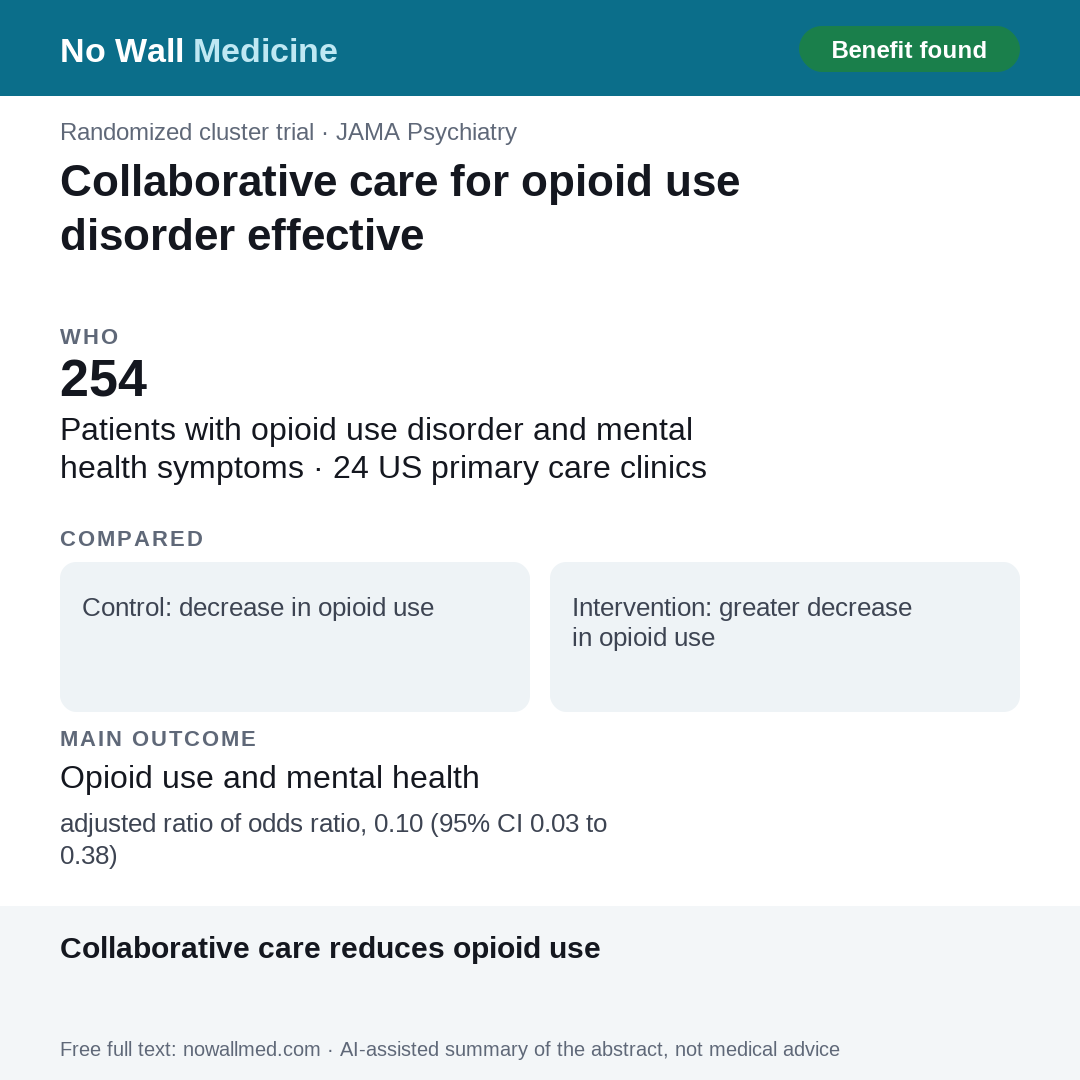
Collaborative care for opioid use disorder effective
Who
254
Patients with opioid use disorder and mental health symptoms · 24 US primary care clinics
Compared
Control: decrease in opioid use
Intervention: greater decrease in opioid use
Main outcome
Opioid use and mental health
Result: adjusted ratio of odds ratio, 0.10 (95% CI 0.03 to 0.38)
Bottom line: Collaborative care reduces opioid use
JAMA Psychiatry · 2025-08-20Download image
Key points
- 254 patients with opioid use disorder were studied in 24 US primary care clinics.
- The intervention reduced opioid use more than the control with an adjusted ratio of odds ratio of 0.10.
- Mental health scores improved slightly in both groups, but not significantly more with the intervention.
Headline and key points written with AI from the paper’s abstract, with every number checked against it. Read the paper before relying on them.
Topics
Cite this article
Fortney JC, Ratzliff AD, Blanchard BE, Ferro L, Chase E, Rouvere J. Collaborative Care for Opioid Use Disorder in Primary Care: A Hybrid Type 2 Cluster Randomized Clinical Trial. JAMA Psychiatry. 2025. doi:10.1001/jamapsychiatry.2025.2126
Spotted a mistake? Suggest a correction
Top studies every Monday
The week’s key trials and guidelines in your specialties, plus any topics you follow. By email, free.
Get the weekly digest