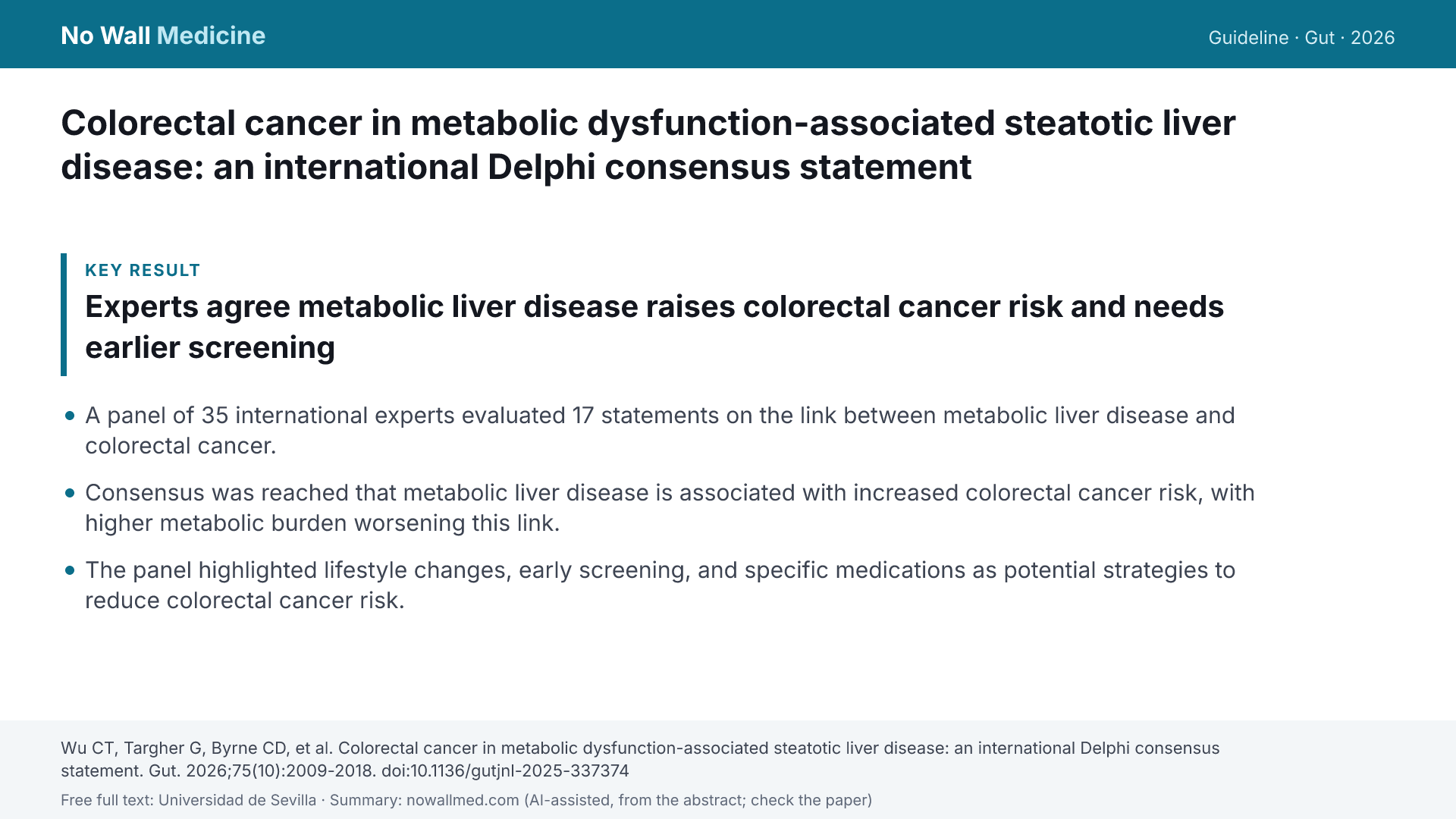
Experts agree metabolic liver disease raises colorectal cancer risk and needs earlier screening
Colorectal cancer in metabolic dysfunction-associated steatotic liver disease: an international Delphi consensus statement
Status not yet checked. We have not confirmed that this is still the issuing body's current recommendation. Check the issuing body before using it in practice.
Why it matters: An optimal strategy for identifying and managing colorectal cancer risk in individuals with metabolic liver disease remains lacking.
Key points
- A panel of 35 international experts evaluated 17 statements on the link between metabolic liver disease and colorectal cancer.
- Consensus was reached that metabolic liver disease is associated with increased colorectal cancer risk, with higher metabolic burden worsening this link.
- The panel highlighted lifestyle changes, early screening, and specific medications as potential strategies to reduce colorectal cancer risk.
Headline and key points written with AI from the paper’s abstract, with every number checked against it. Read the paper before relying on them.
Was this summary helpful?
Abstract
Background
Metabolic dysfunction-associated steatotic liver disease (MASLD) is the most common chronic liver disease worldwide. Epidemiological evidence indicates that MASLD is associated with an increased risk of developing colorectal cancer (CRC). MASLD and CRC share many common risk factors and pathophysiological mechanisms, but an optimal strategy for identifying and managing CRC risk in individuals with MASLD remains lacking. Objective
This study aimed to achieve consensus on the risk of CRC in individuals with MASLD. Design
A Delphi survey was conducted by a multidisciplinary panel of 35 international experts from diverse medical fields across Asia, Europe, North America, South America, Oceania and Africa. Experts evaluated 17 statements across three domains: epidemiology, pathogenesis and management. Results
Consensus was achieved on all 17 statements. MASLD is associated with an increased risk of CRC, and metabolic burden further increases this risk. Furthermore, the severity of MASLD is associated with worse outcomes in patients with MASLD and CRC. The gut-liver axis and gut dysbiosis play key roles in the development of MASLD and CRC, while leptin and adiponectin may also be involved. Weight loss with lifestyle interventions, early CRC screening, bariatric surgery and use of GLP-1 receptor agonists are highlighted as potential risk-reduction strategies. Conclusion
The expert panel emphasises the need for greater clinical vigilance for CRC among individuals with MASLD. This consensus supports a paradigm shift towards earlier, risk-adapted screening and integrated metabolic management to reduce the burden of CRC in the MASLD population.
Abstract reproduced under the article’s CC BY NC ND licence.
Subject terms
Cite this article
Wu CT, Targher G, Byrne CD, et al. Colorectal cancer in metabolic dysfunction-associated steatotic liver disease: an international Delphi consensus statement. Gut. 2026. doi:10.1136/gutjnl-2025-337374
Spotted a mistake? Suggest a correction