Large colon size was associated with delayed evacuation and specific responses to constipation treatments
Combined MRI, high-resolution manometry and a randomised trial of bisacodyl versus hyoscine show the significance of an enlarged colon in constipation: the RECLAIM study
Randomized cross-over study and observational studyMixed results
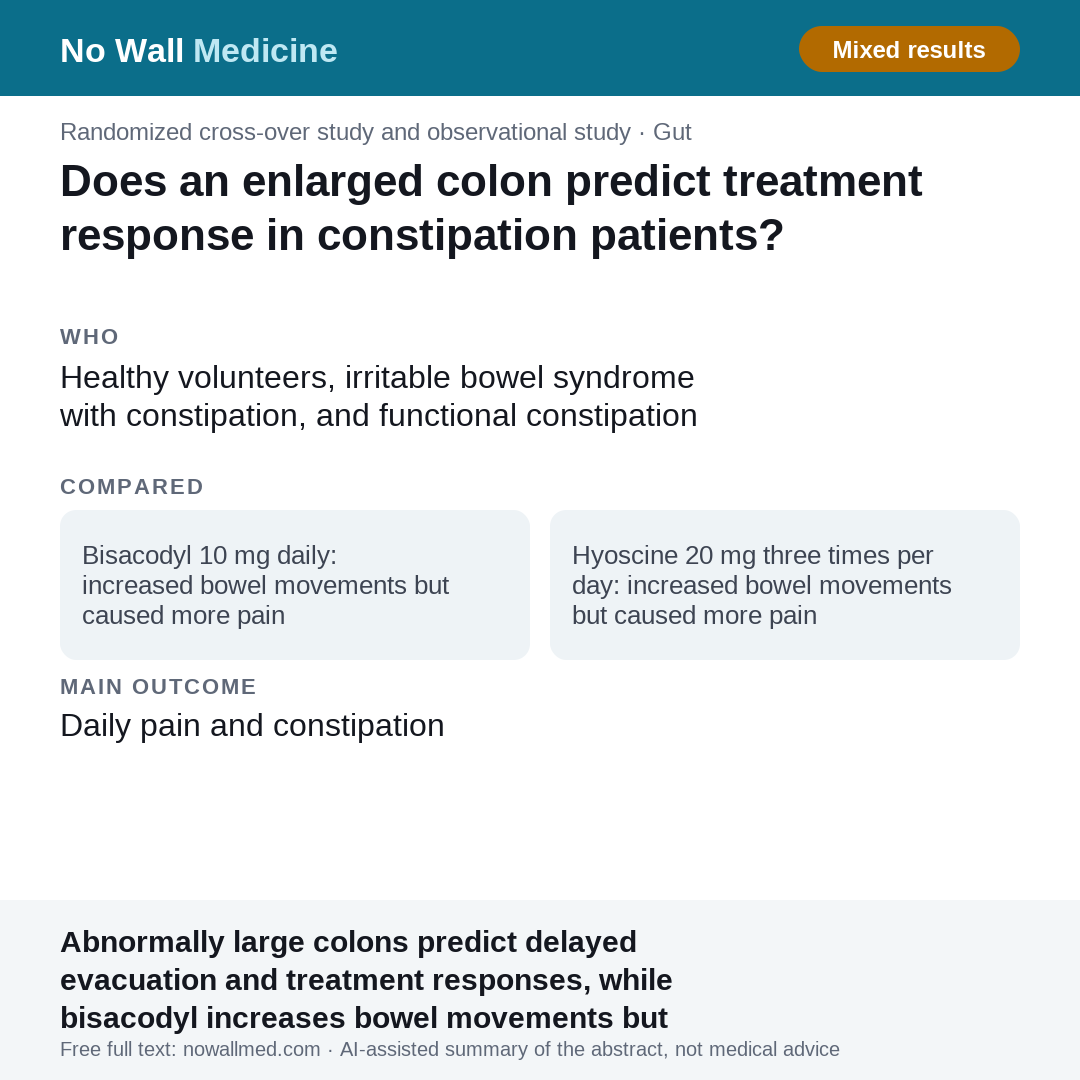
Does an enlarged colon predict treatment response in constipation patients?
Who
Healthy volunteers, irritable bowel syndrome with constipation, and functional constipation patients
Compared
Bisacodyl 10 mg daily: increased bowel movements but caused more pain
Hyoscine 20 mg three times per day: increased bowel movements but caused more pain
Main outcome
Daily pain and constipation
Bottom line: Abnormally large colons predict delayed evacuation and treatment responses, while bisacodyl increases bowel movements but causes more pain.
Gut · 2024-12-10Download image
Clinical question: Does an enlarged colon predict treatment response in constipation patients?
Why it matters: It was unknown if MRI could predict how patients with constipation respond to treatments compared to high-resolution colonic manometry.
Key points
- Researchers studied 44 healthy volunteers, 43 patients with irritable bowel syndrome with constipation, and 37 patients with functional constipation using MRI and high-resolution colonic manometry, which measures pressure in the colon.
- Abnormally large colons were associated with delayed evacuation after a macrogol challenge, impaired pressure wave response to meals, and reduced pain when using bisacodyl.
- In a randomized cross-over trial, bisacodyl was associated with more bowel movements but also more pain compared to hyoscine.
Headline and key points written with AI from the paper’s abstract, with every number checked against it. Read the paper before relying on them.
Was this summary helpful?
Abstract
Background
Colonic motility in constipation can be assessed non-invasively using MRI. Objective
To compare MRI with high-resolution colonic manometry (HRCM) for predicting treatment response. Design
Part 1: 44 healthy volunteers (HVs), 43 patients with irritable bowel syndrome with constipation (IBS-C) and 37 with functional constipation (FC) completed stool diaries and questionnaires and underwent oral macrogol (500-1000 mL) challenge. Whole gut transit time (WGTT), segmental colonic volumes (CV), MRI-derived Motility Index and chyme movement by 'tagging' were assessed using MRI and time to defecation after macrogol recorded. Left colonic HRCM was recorded before and after a 700 kcal meal. Patients then proceeded to Part 2: a randomised cross-over study of 10-days bisacodyl 10 mg daily versus hyoscine 20 mg three times per day, assessing daily pain and constipation. Results
Part 1: Total CVs median (range) were significantly greater in IBS-C (776 (595-1033)) and FC (802 (633-951)) vs HV (645 (467-780)), p<0.001. Patients also had longer WGTT and delayed evacuation after macrogol. IBS-C patients showed significantly reduced tagging index and less propagated pressure wave (PPW) activity during HRCM versus HV. Compared with FC, IBS-C patients were more anxious and reported more pain. Abnormally large colons predicted significantly delayed evacuation after macrogol challenge (p<0.02), impaired manometric meal response and reduced pain with bisacodyl (p<0.05).Part 2: Bisacodyl compared with hyoscine increased bowel movements but caused more pain in both groups (p<0.03). Conclusion
An abnormally large colon is an important feature in constipation which predicts impaired manometric response to feeding and treatment responses. HRCM shows that IBS-C patients have reduced PPW activity. Trial registration number
The study was preregistered on ClinicalTrials.gov, Reference: NCT03226145.
Abstract reproduced under the article’s CC BY licence.
Subject terms
Cite this article
Wilkinson-Smith V, Scott M, Menys A, Wiklendt L, Marciani L, Atkinson D. Combined MRI, high-resolution manometry and a randomised trial of bisacodyl versus hyoscine show the significance of an enlarged colon in constipation: the RECLAIM study. Gut. 2024. doi:10.1136/gutjnl-2024-332755
Spotted a mistake? Suggest a correction
Top studies every Monday
The week’s key trials and guidelines in your specialties, plus any topics you follow. By email, free.
Get the weekly digest