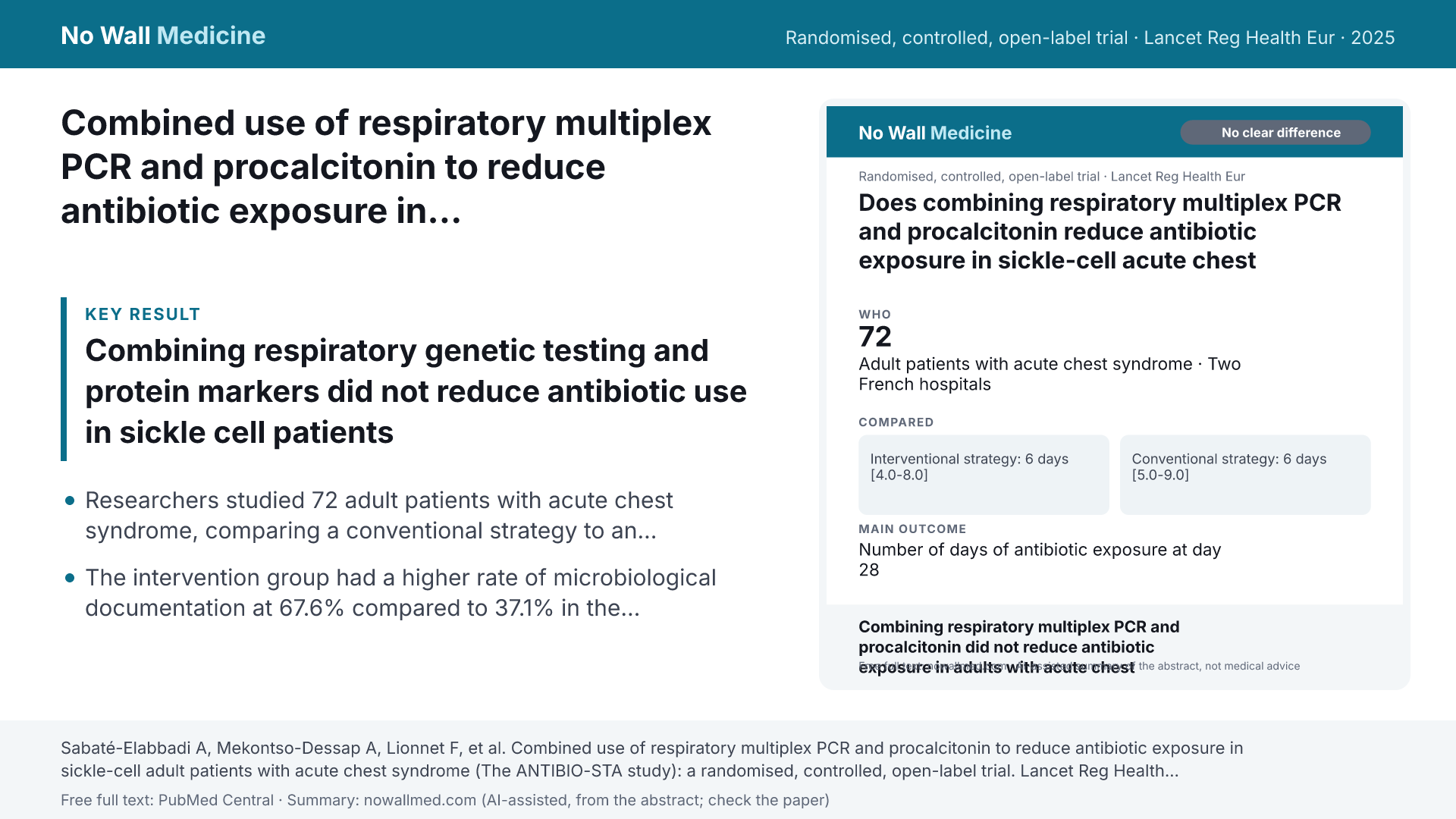
Combining respiratory genetic testing and protein markers did not reduce antibiotic use in sickle cell patients
Combined use of respiratory multiplex PCR and procalcitonin to reduce antibiotic exposure in sickle-cell adult patients with acute chest syndrome (The ANTIBIO-STA study): a randomised, controlled, open-label trial
Randomised, controlled, open-label trialNo clear difference
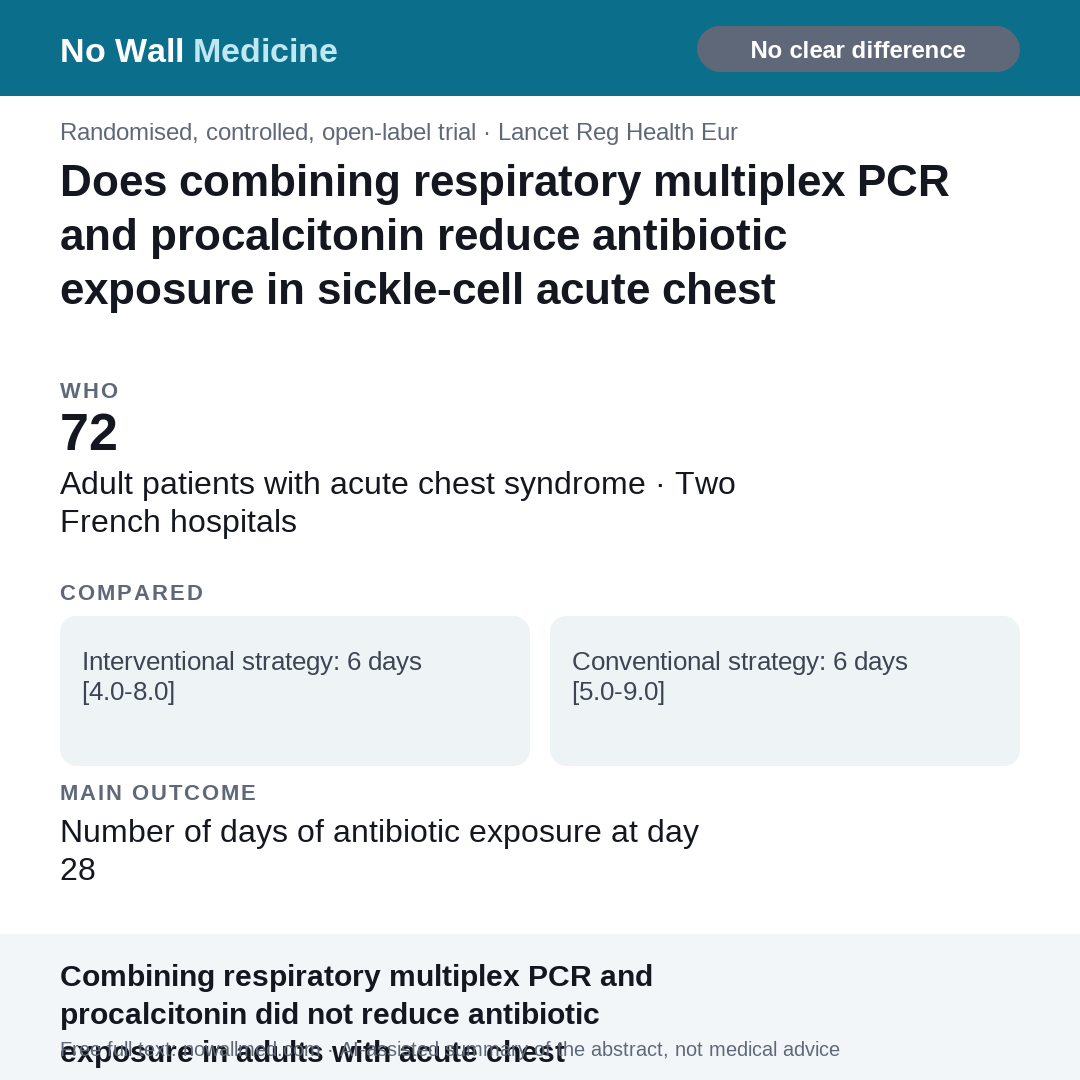
Does combining respiratory multiplex PCR and procalcitonin reduce antibiotic exposure in sickle-cell acute chest syndrome?
Who
72
Adult patients with acute chest syndrome · Two French hospitals
Compared
Interventional strategy: 6 days [4.0-8.0]
Conventional strategy: 6 days [5.0-9.0]
Main outcome
Number of days of antibiotic exposure at day 28
Result: difference, 0.0 day; 95% CI, -2.1 to 2.1
Bottom line: Combining respiratory multiplex PCR and procalcitonin did not reduce antibiotic exposure in adults with acute chest syndrome.
Funded by: Assistance Publique-Hôpitaux de Paris and bioMérieux
Lancet Reg Health Eur · 2025-02-07Download image
Clinical question: Does combining respiratory multiplex PCR and procalcitonin reduce antibiotic exposure in sickle-cell acute chest syndrome?
Why it matters: It is difficult to stop or change antibiotic therapy in sickle-cell patients with acute chest syndrome, and it is unknown if combining genetic testing with protein markers helps.
Key points
- Researchers studied 72 adult patients with acute chest syndrome, comparing a conventional strategy to an intervention using multiplex polymerase chain reaction and procalcitonin measurements.
- The intervention group had a higher rate of microbiological documentation at 67.6% compared to 37.1% in the conventional group.
- Antibiotic exposure at day 28 was similar between the two groups, with 6 days recorded for both the intervention and conventional strategies.
Headline and key points written with AI from the paper’s abstract, with every number checked against it. Read the paper before relying on them.
Was this summary helpful?
Cite this article
Sabaté-Elabbadi A, Mekontso-Dessap A, Lionnet F, et al. Combined use of respiratory multiplex PCR and procalcitonin to reduce antibiotic exposure in sickle-cell adult patients with acute chest syndrome (The ANTIBIO-STA study): a randomised, controlled, open-label trial. Lancet Reg Health Eur. 2025. doi:10.1016/j.lanepe.2025.101234
Spotted a mistake? Suggest a correction