Combining Antidepressants vs Antidepressant Monotherapy for Treatment of Patients With Acute Depression: A Systematic Review and Meta-analysis
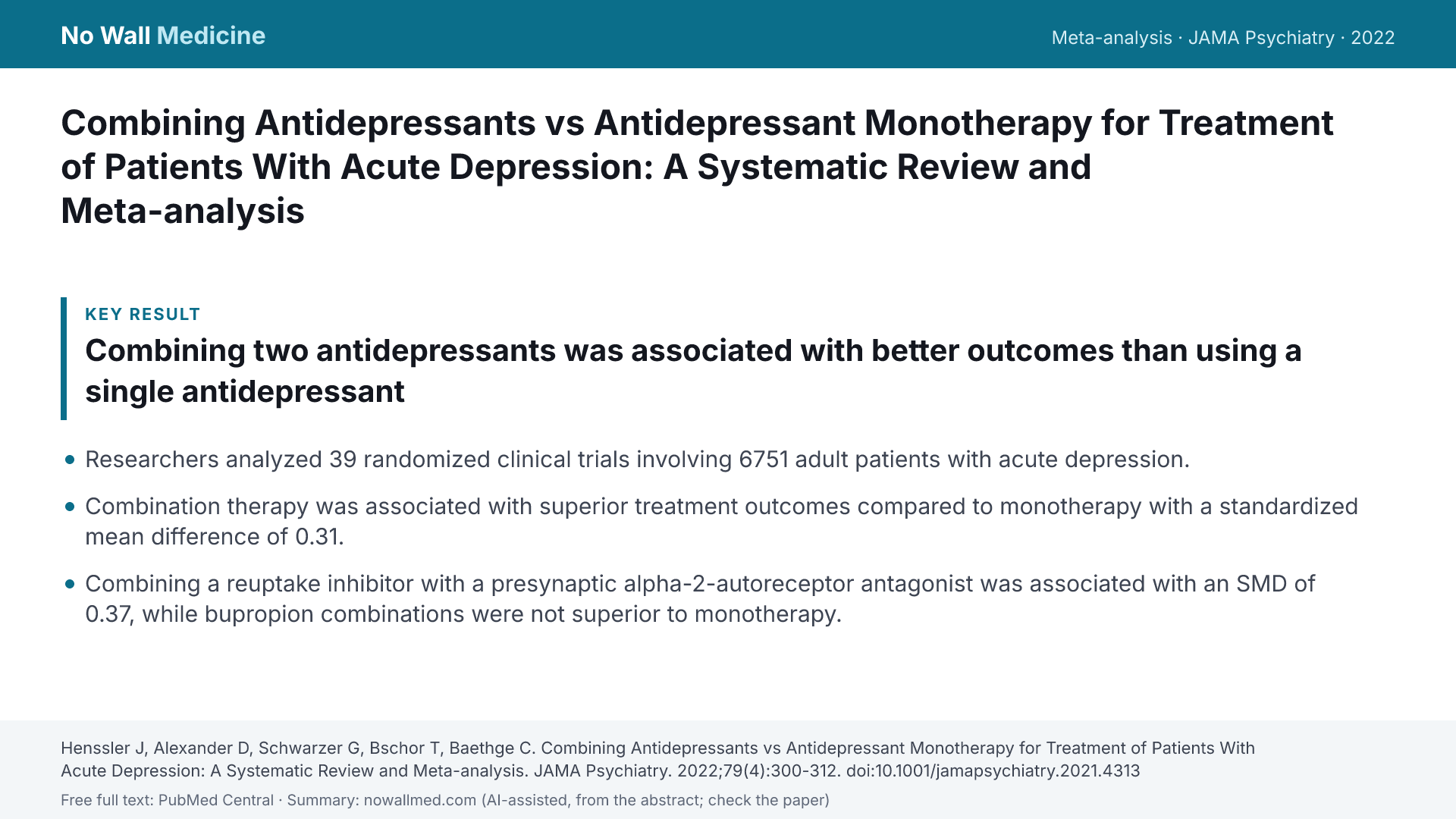
Key result: Combining two antidepressants was associated with better outcomes than using a single antidepressant
Key points
- Researchers analyzed 39 randomized clinical trials involving 6751 adult patients with acute depression.
- Combination therapy was associated with superior treatment outcomes compared to monotherapy with a standardized mean difference of 0.31.
- Combining a reuptake inhibitor with a presynaptic alpha-2-autoreceptor antagonist was associated with an SMD of 0.37, while bupropion combinations were not superior to monotherapy.
Why it matters: Studies have yielded conflicting results regarding whether combining different antidepressants is more effective or tolerable than using a single medication for acute depression.
Limitation the authors note: The studies were heterogeneous and there was indication of publication bias.
Discussion prompts
- Would these patients look like yours? Who was left out?
- Is the main outcome one that matters to patients?
- Is the difference large enough to change what you do?
Cite: Henssler J, Alexander D, Schwarzer G, Bschor T, Baethge C. Combining Antidepressants vs Antidepressant Monotherapy for Treatment of Patients With Acute Depression: A Systematic Review and Meta-analysis. JAMA Psychiatry. 2022. doi:10.1001/jamapsychiatry.2021.4313
Free full text: PubMed Central · Summary and visual abstract: nowallmed.com/a/combining-antidepressants-vs-antidepressant-monotherapy-for-treatment-496l2g/ (AI-assisted from the abstract; check the paper before relying on it).