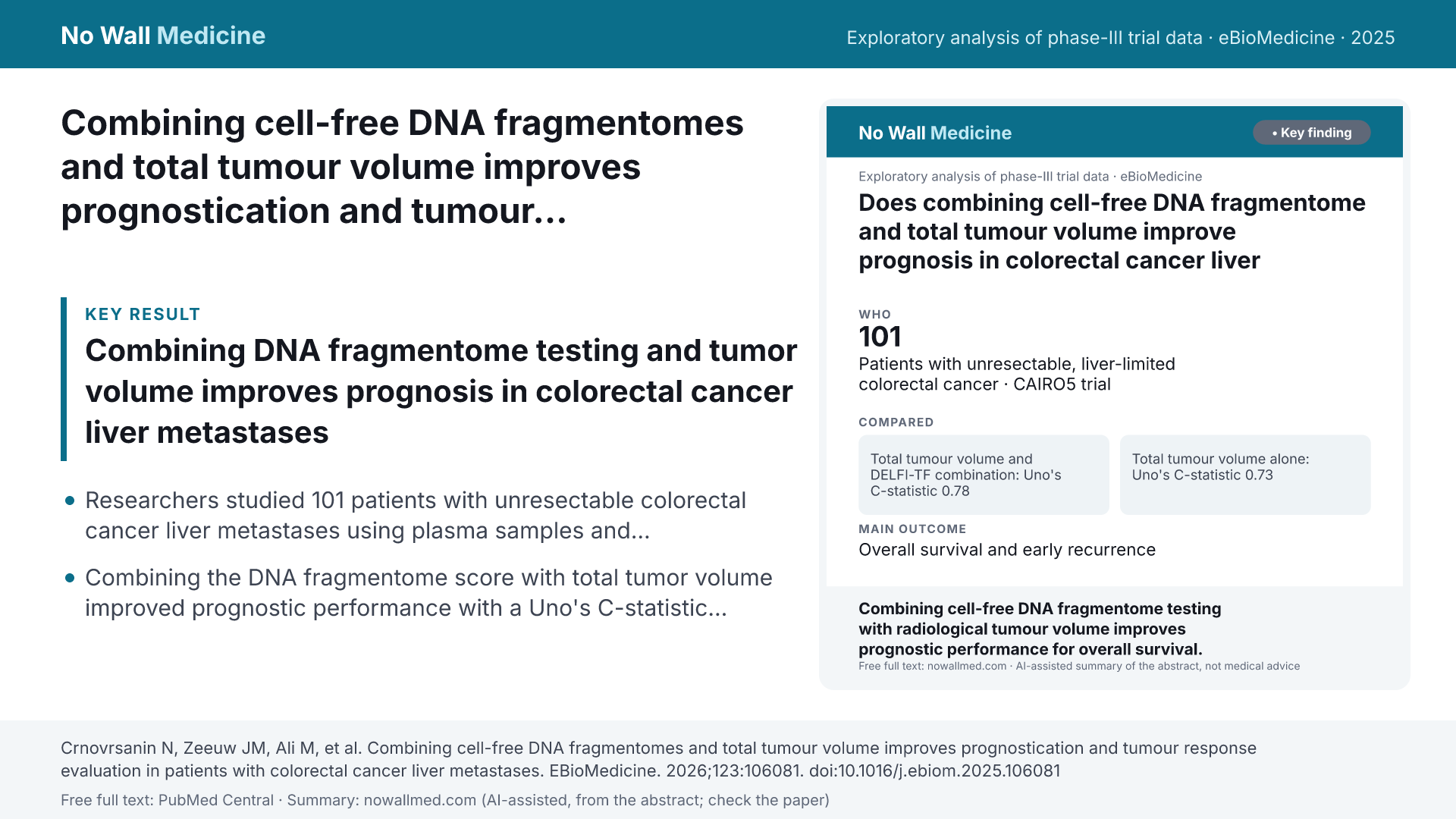
Combining DNA fragmentome testing and tumor volume improves prognosis in colorectal cancer liver metastases
Combining cell-free DNA fragmentomes and total tumour volume improves prognostication and tumour response evaluation in patients with colorectal cancer liver metastases
Exploratory analysis of phase-III trial dataKey finding
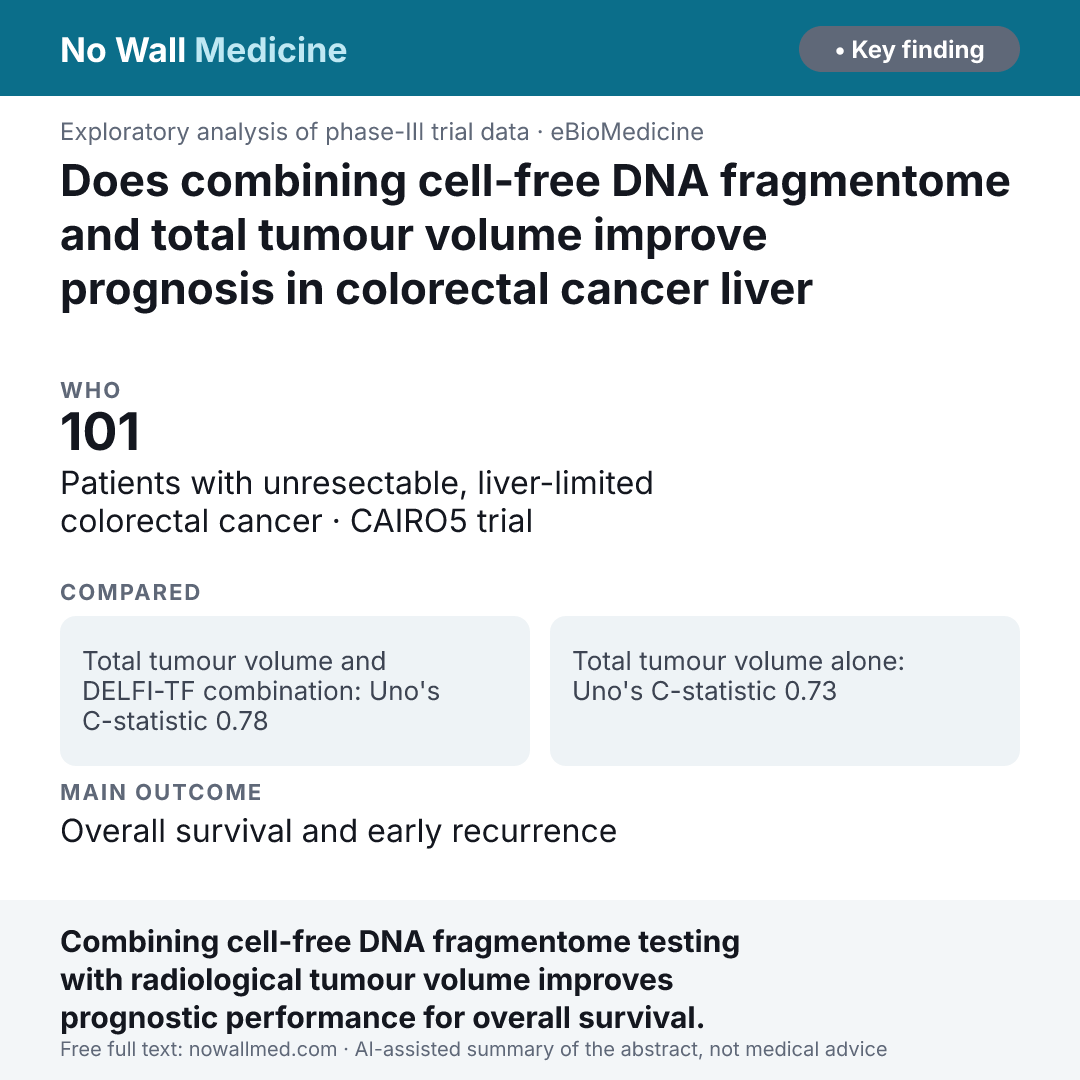
Does combining cell-free DNA fragmentome and total tumour volume improve prognosis in colorectal cancer liver metastases?
Who
101
Patients with unresectable, liver-limited colorectal cancer · CAIRO5 trial
Compared
Total tumour volume and DELFI-TF combination: Uno's C-statistic 0.78
Total tumour volume alone: Uno's C-statistic 0.73
Main outcome
Overall survival and early recurrence
Result: Uno's C-statistic 0.78 vs 0.73 (P = 0.036)
Bottom line: Combining cell-free DNA fragmentome testing with radiological tumour volume improves prognostic performance for overall survival.
Limitation: This was an exploratory study requiring further validation.
Funded by: German Research Foundation, Heidelberg Medical Faculty, Dutch Cancer Society, and others
eBioMedicine · 2025-12-16 · Save PNG
Same trial (NCT02162563)
Papers we list that report this registered trial, oldest first. Read a secondary analysis alongside the main results.
- Secondary analysis No clear difference
Long-term survival outcomes for different chemotherapy regimens in patients with colorectal cancer liver metastases JAMA Oncol 2024-11 - Secondary analysis Key finding
This paper eBioMedicine 2025-12
Clinical question: Does combining cell-free DNA fragmentome and total tumour volume improve prognosis in colorectal cancer liver metastases?
Why it matters: Radiological assessment alone provides an imprecise estimate of underlying tumor biology or treatment response in patients with unresectable colorectal cancer liver metastases.
Key points
- Researchers studied 101 patients with unresectable colorectal cancer liver metastases using plasma samples and computed tomography scans.
- Combining the DNA fragmentome score with total tumor volume improved prognostic performance with a Uno's C-statistic of 0.78 compared to 0.73.
- Baseline and on-treatment changes in the DNA fragmentome score predicted early recurrence after local therapy.
Headline and key points written with AI from the paper’s abstract, with every number checked against it. Read the paper before relying on them.
Was this summary helpful?
Subject terms
Headline, design, result, key points, caveat and citation as plain text.
Cite this article
Crnovrsanin N, Zeeuw JM, Ali M, et al. Combining cell-free DNA fragmentomes and total tumour volume improves prognostication and tumour response evaluation in patients with colorectal cancer liver metastases. EBioMedicine. 2026;123:106081. doi:10.1016/j.ebiom.2025.106081
Spotted a mistake? Suggest a correction