Combining nerve ablation and cognitive behavioral therapy shows potential for chronic low back pain
Combining procedural and behavioral treatments for chronic low back pain: A pilot feasibility randomized controlled trial
2 x 2 factorial randomized controlled trialMixed results
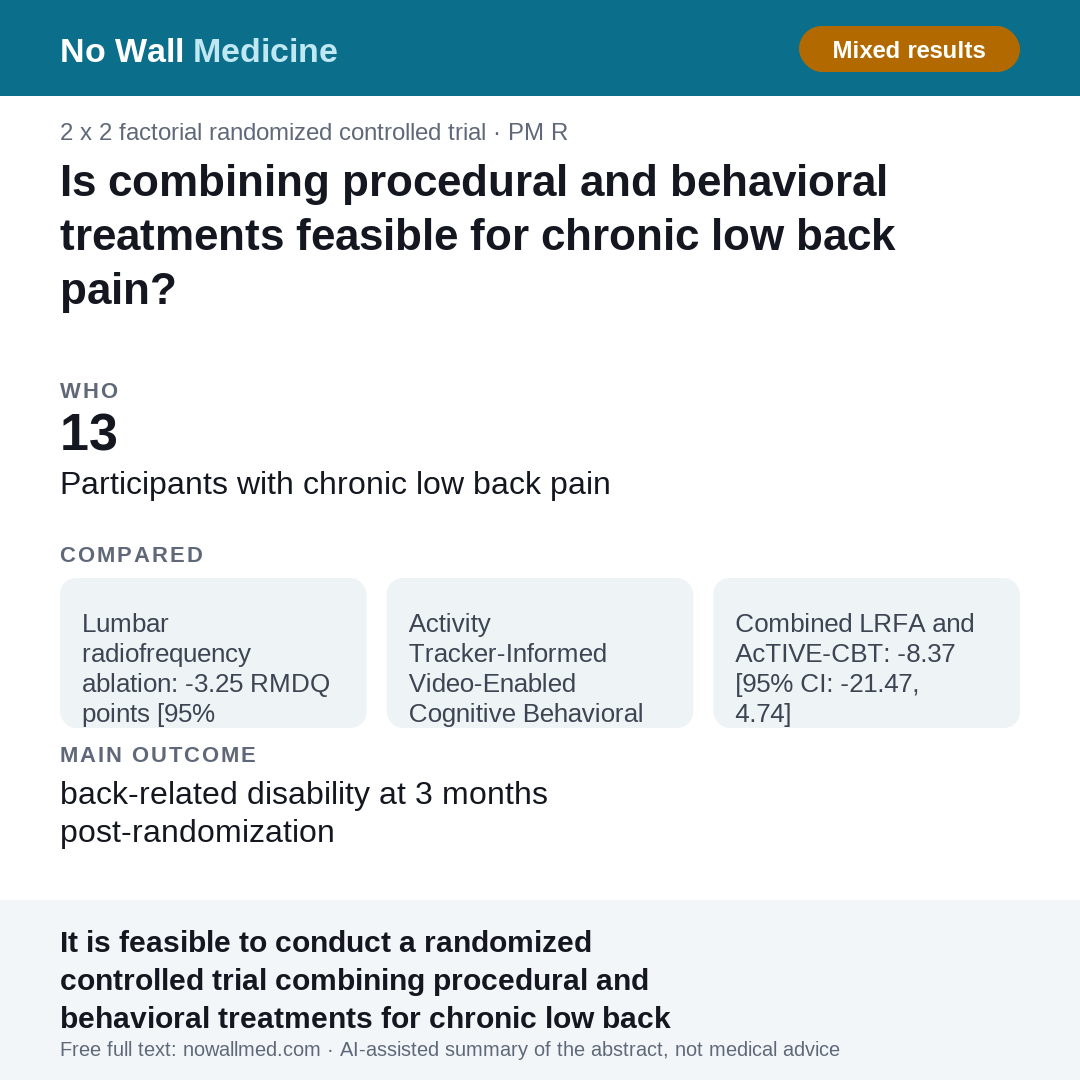
Is combining procedural and behavioral treatments feasible for chronic low back pain?
Who
13
Participants with chronic low back pain
Compared
Lumbar radiofrequency ablation: -3.25 RMDQ points [95% confidence interval [CI], -10.18 to 3.67]
Activity Tracker-Informed Video-Enabled Cognitive Behavioral Therapy: -6.29 [95% CI, -10.97 to -1.60]
Combined LRFA and AcTIVE-CBT: -8.37 [95% CI: -21.47, 4.74]
Main outcome
back-related disability at 3 months post-randomization
Bottom line: It is feasible to conduct a randomized controlled trial combining procedural and behavioral treatments for chronic low back pain.
PM R · 2025-02-04Download image
Clinical question: Is combining procedural and behavioral treatments feasible for chronic low back pain?
Why it matters: Individual treatments for chronic low back pain often have small effects, and it is unknown if combining procedural and behavioral treatments produces larger effects.
Key points
- Researchers studied 13 participants in a trial comparing lumbar radiofrequency ablation, which uses heat to disrupt nerve signals, and a video-based cognitive behavioral therapy program.
- The cognitive behavioral therapy program showed a significant, large-magnitude effect on disability scores compared to education, with a difference of -6.29 (95% CI, -10.97 to -1.60).
- The combination of both treatments and the nerve ablation alone showed beneficial effects, but these results were not statistically significant.
Headline and key points written with AI from the paper’s abstract, with every number checked against it. Read the paper before relying on them.
Topics
Cite this article
Tanus AD, Nishio I, Williams R, Friedly J, Soares B, Anderson D. Combining procedural and behavioral treatments for chronic low back pain: A pilot feasibility randomized controlled trial. PM R. 2025. doi:10.1002/pmrj.13323
Spotted a mistake? Suggest a correction
Top studies every Monday
The week’s key trials and guidelines in your specialties, by email. Free.
Get the weekly digest