Bicarbonate adaptation linked to strong ion difference in respiratory disorders
Combining the Physical-Chemical Approach with Standard Base Excess to Understand the Compensation of Respiratory Acid-Base Derangements: An Individual Participant Meta-analysis Approach to Data from Multiple Canine and Human Experiments
Individual participant data meta-analysisMixed results
How do strong ion difference and standard base excess relate to bicarbonate adaptation?
Who
Canine and human subjects from multiple experiments · Multiple canine and human experiments
Compared
Acute respiratory derangement: β-coefficient, -0.02 (95% CI, -0.11 to 0.07)
Chronic respiratory derangement: β-coefficient, 1.04 (95% CI, 0.84 to 1.24)
Main outcome
Bicarbonate concentration association with strong ion difference and standard base excess
Result: β-coefficient, 1.2 (95% CI, 1.2 to 1.3)
Bottom line: Bicarbonate adaptation relates to strong ion difference, but acute changes are not mirrored by standard base excess.
Anesthesiology · 2023-08-24Download image
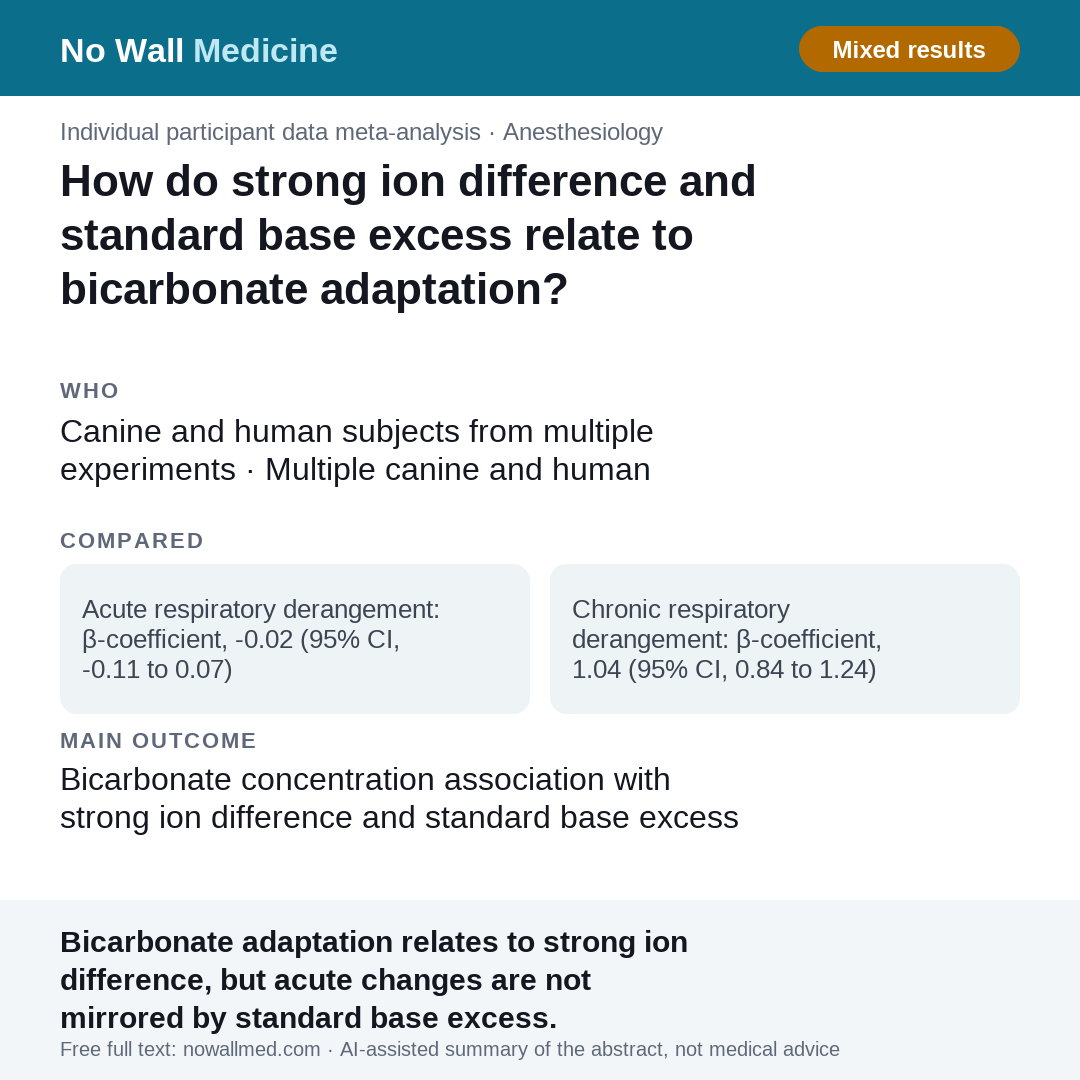
Clinical question: How do strong ion difference and standard base excess relate to bicarbonate adaptation?
Why it matters: The relationship between bicarbonate and strong ion difference in respiratory acid-base derangements was unclear
Key points
- Eleven studies with canine and human data were analyzed.
- Bicarbonate changes were linearly associated with strong ion difference variation.
- Sodium and chloride variations drove strong ion difference changes in acute and chronic settings.
Headline and key points written with AI from the paper’s abstract, with every number checked against it. Read the paper before relying on them.
Was this summary helpful?
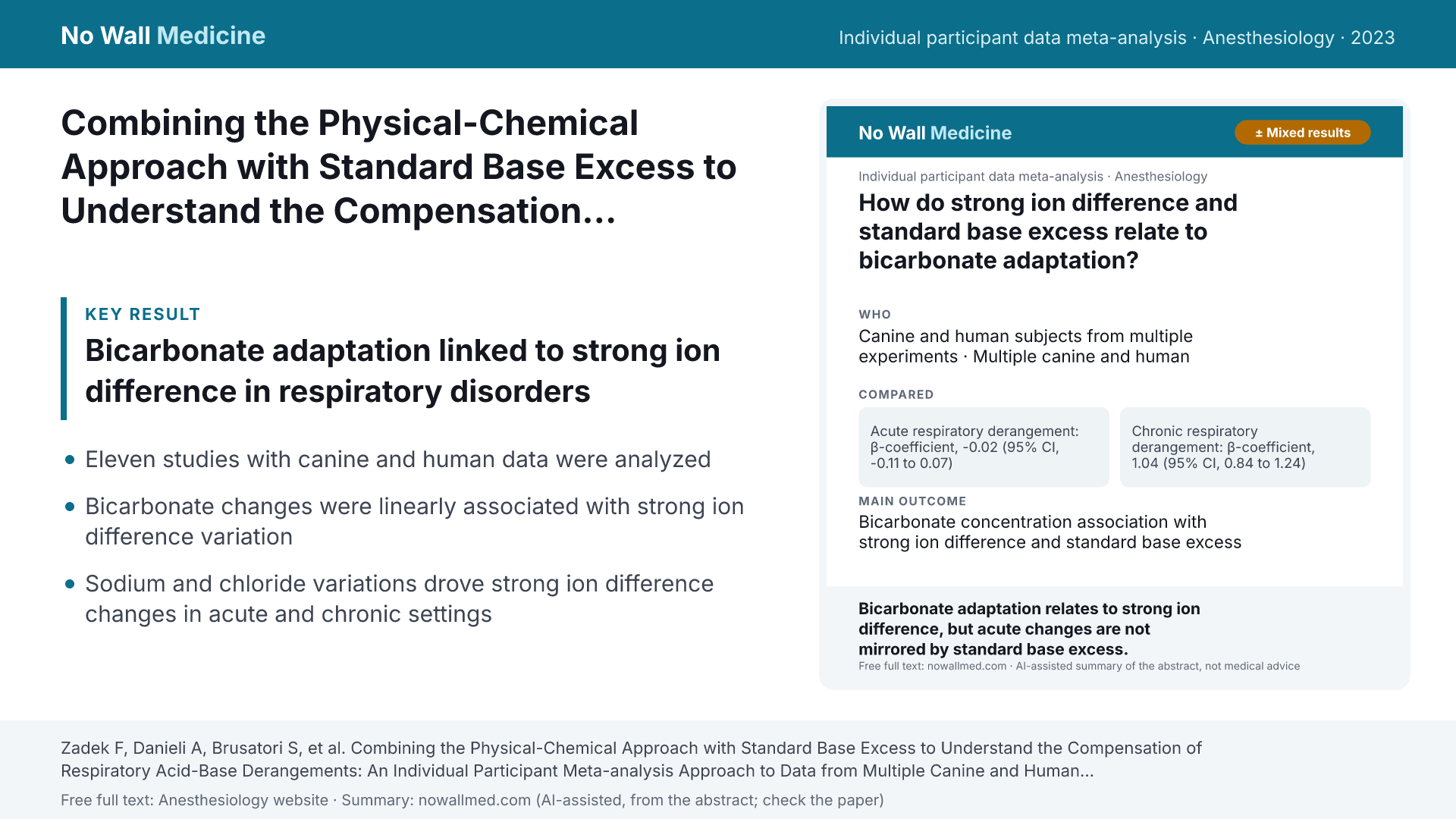
Subject terms
Cite this article
Zadek F, Danieli A, Brusatori S, et al. Combining the Physical-Chemical Approach with Standard Base Excess to Understand the Compensation of Respiratory Acid-Base Derangements: An Individual Participant Meta-analysis Approach to Data from Multiple Canine and Human Experiments. Anesthesiology. 2023. doi:10.1097/ALN.0000000000004751
Spotted a mistake? Suggest a correction