Common and distinct cortical thickness alterations in youth with autism spectrum disorder and attention-deficit/hyperactivity disorder
Comparative meta-analysis of vertex-based studiesMixed results
What are the common and distinct cortical thickness alterations in youth with autism and ADHD?
Who
Youth under 18 years with autism spectrum disorder or ADHD
Compared
Autism spectrum disorder: increased CTh in bilateral superior frontal gyrus, left middle temporal gyrus, and right superior parietal lobule and decreased CTh in right temporoparietal junction
Attention-deficit/hyperactivity disorder: decreased CTh in bilateral precentral gyri, right postcentral gyrus, and right temporoparietal junction
Main outcome
Cortical thickness alterations
Bottom line: Autism and ADHD share reduced temporoparietal junction thickness, but show distinct cortical thickness patterns in different attention networks.
BMC Med · 2024-03-04Download image
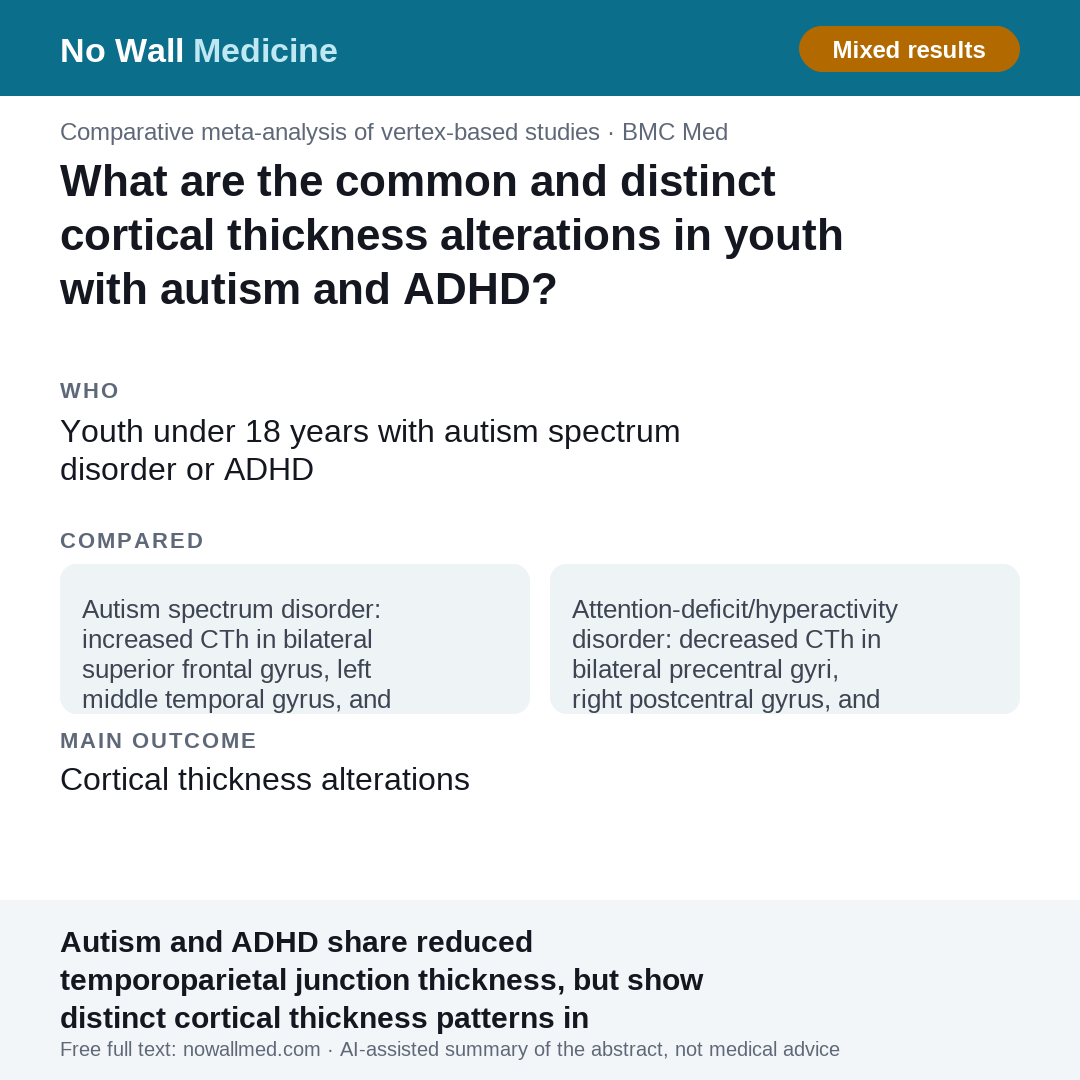
Clinical question: What are the common and distinct cortical thickness alterations in youth with autism and ADHD?
Abstract
Background
Autism spectrum disorder (ASD) and attention-deficit/hyperactivity disorder (ADHD) are neurodevelopmental disorders with overlapping behavioral features and genetic etiology. While brain cortical thickness (CTh) alterations have been reported in ASD and ADHD separately, the degree to which ASD and ADHD are associated with common and distinct patterns of CTh changes is unclear. Methods
We searched PubMed, Web of Science, Embase, and Science Direct from inception to 8 December 2023 and included studies of cortical thickness comparing youth (age less than 18) with ASD or ADHD with typically developing controls (TDC). We conducted a comparative meta-analysis of vertex-based studies to identify common and distinct CTh alterations in ASD and ADHD. Results
Twelve ASD datasets involving 458 individuals with ASD and 10 ADHD datasets involving 383 individuals with ADHD were included in the analysis. Compared to TDC, ASD showed increased CTh in bilateral superior frontal gyrus, left middle temporal gyrus, and right superior parietal lobule (SPL) and decreased CTh in right temporoparietal junction (TPJ). ADHD showed decreased CTh in bilateral precentral gyri, right postcentral gyrus, and right TPJ relative to TDC. Conjunction analysis showed both disorders shared reduced TPJ CTh located in default mode network (DMN). Comparative analyses indicated ASD had greater CTh in right SPL and TPJ located in dorsal attention network and thinner CTh in right TPJ located in ventral attention network than ADHD. Conclusions
These results suggest shared thinner TPJ located in DMN is an overlapping neurobiological feature of ASD and ADHD. This alteration together with SPL alterations might be related to altered biological motion processing in ASD, while abnormalities in sensorimotor systems may contribute to behavioral control problems in ADHD. The disorder-specific thinner TPJ located in disparate attention networks provides novel insight into distinct symptoms of attentional deficits associated with the two neurodevelopmental disorders. Trial registration
PROSPERO CRD42022370620. Registered on November 9, 2022.
Subject terms
Cite this article
You W, Li Q, Chen L, He N, Li Y, Long F. Common and distinct cortical thickness alterations in youth with autism spectrum disorder and attention-deficit/hyperactivity disorder. BMC Med. 2024. doi:10.1186/s12916-024-03313-2
Spotted a mistake? Suggest a correction
Top studies every Monday
The week’s key trials and guidelines in your specialties, plus any topics you follow. By email, free.
Get the weekly digest