Meta-analysis shows disrupted brain connectivity patterns in the reward circuit of substance use disorder patients
Common neural patterns of substance use disorder: a seed-based resting-state functional connectivity meta-analysis
Meta-analysis of 53 studiesMixed results
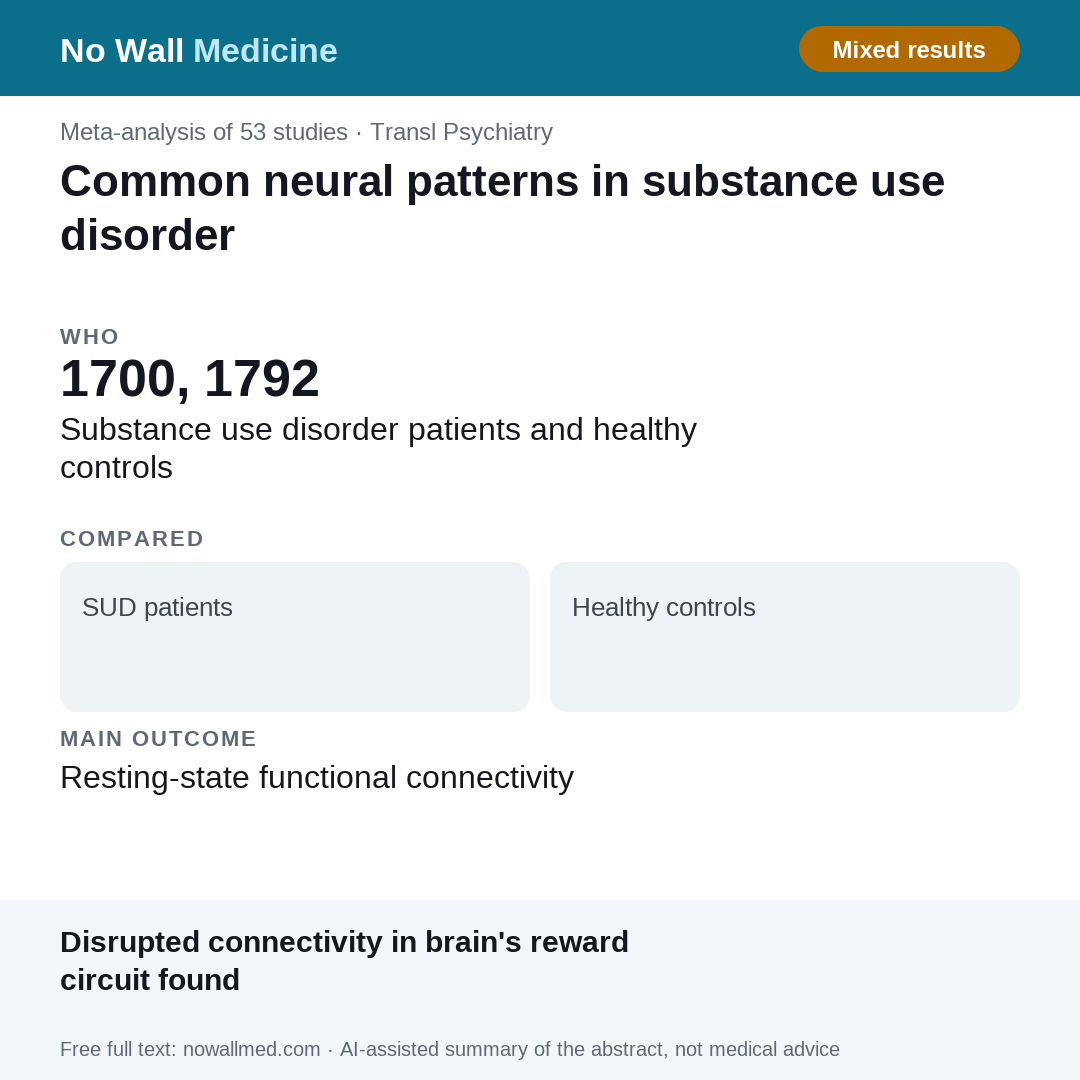
Common neural patterns in substance use disorder
Who
1700, 1792
Substance use disorder patients and healthy controls
Compared
SUD patients
Healthy controls
Main outcome
Resting-state functional connectivity
Bottom line: Disrupted connectivity in brain's reward circuit found
Transl Psychiatry · 2025-06-04Download image
Why it matters: Previous studies on brain connectivity in substance use disorder have shown inconsistent results due to differences in substances and stages of addiction.
Key points
- Researchers analyzed 53 studies involving 1700 patients with substance use disorder and 1792 healthy controls using resting-state functional magnetic resonance imaging.
- Patients showed significant dysfunctions in the cortical-striatal-thalamic-cortical circuit, including increased connectivity in the anterior cingulate cortex and decreased connectivity in the thalamus.
- Reduced connectivity between the striatum and the median cingulate gyrus was significantly negatively correlated with total BIS-11 impulsivity scores.
Headline and key points written with AI from the paper’s abstract, with every number checked against it. Read the paper before relying on them.
Was this summary helpful?
Subject terms
Cite this article
Zhang X, Zhang H, Shao Y, Li Y, Zhang F, Zhang H. Common neural patterns of substance use disorder: a seed-based resting-state functional connectivity meta-analysis. Transl Psychiatry. 2025. doi:10.1038/s41398-025-03396-2
Spotted a mistake? Suggest a correction
Top studies every Monday
The week’s key trials and guidelines in your specialties, plus any topics you follow. By email, free.
Get the weekly digest