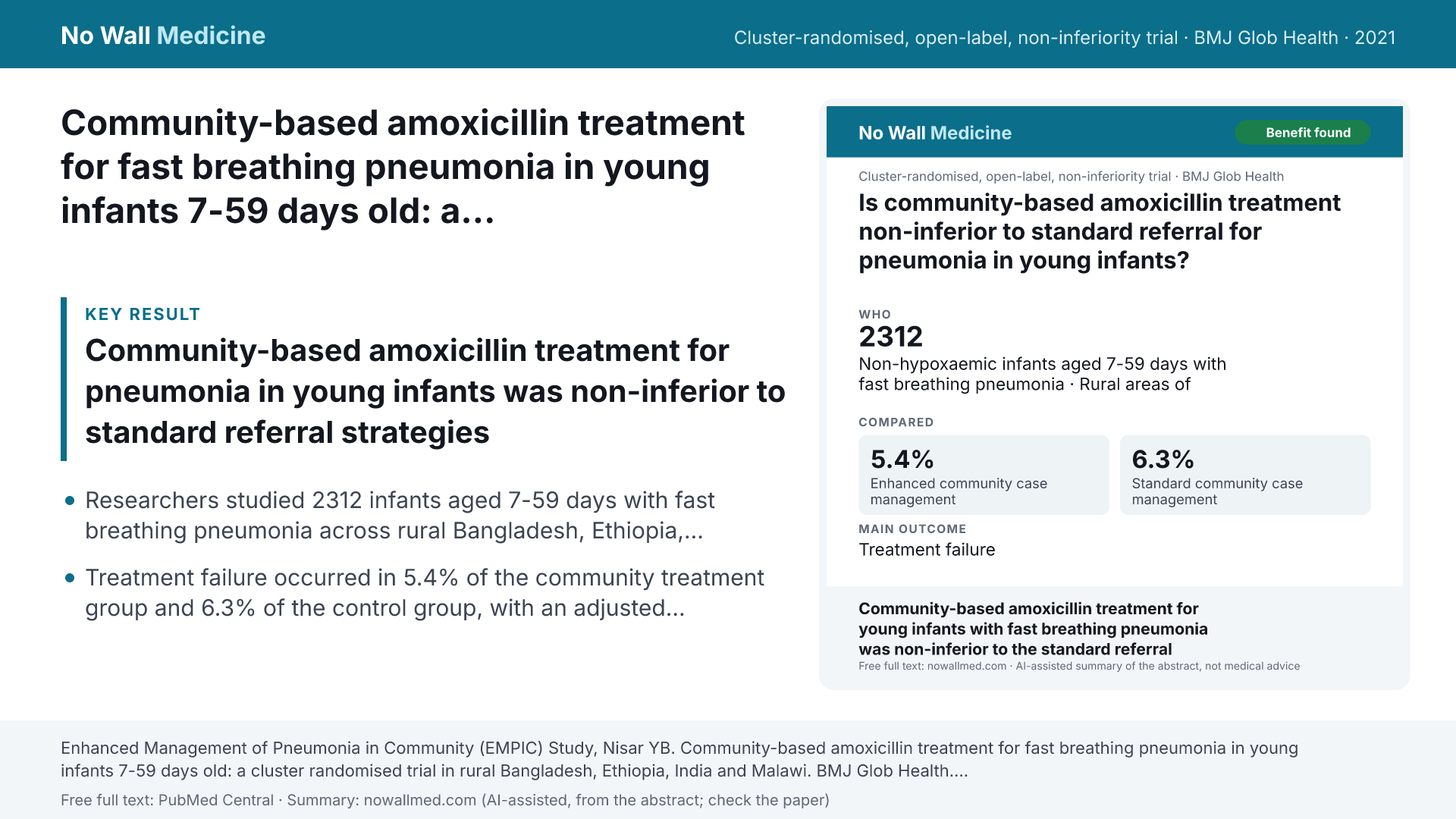
Community-based amoxicillin treatment for pneumonia in young infants was non-inferior to standard referral strategies
Community-based amoxicillin treatment for fast breathing pneumonia in young infants 7-59 days old: a cluster randomised trial in rural Bangladesh, Ethiopia, India and Malawi
Cluster-randomised, open-label, non-inferiority trialBenefit found
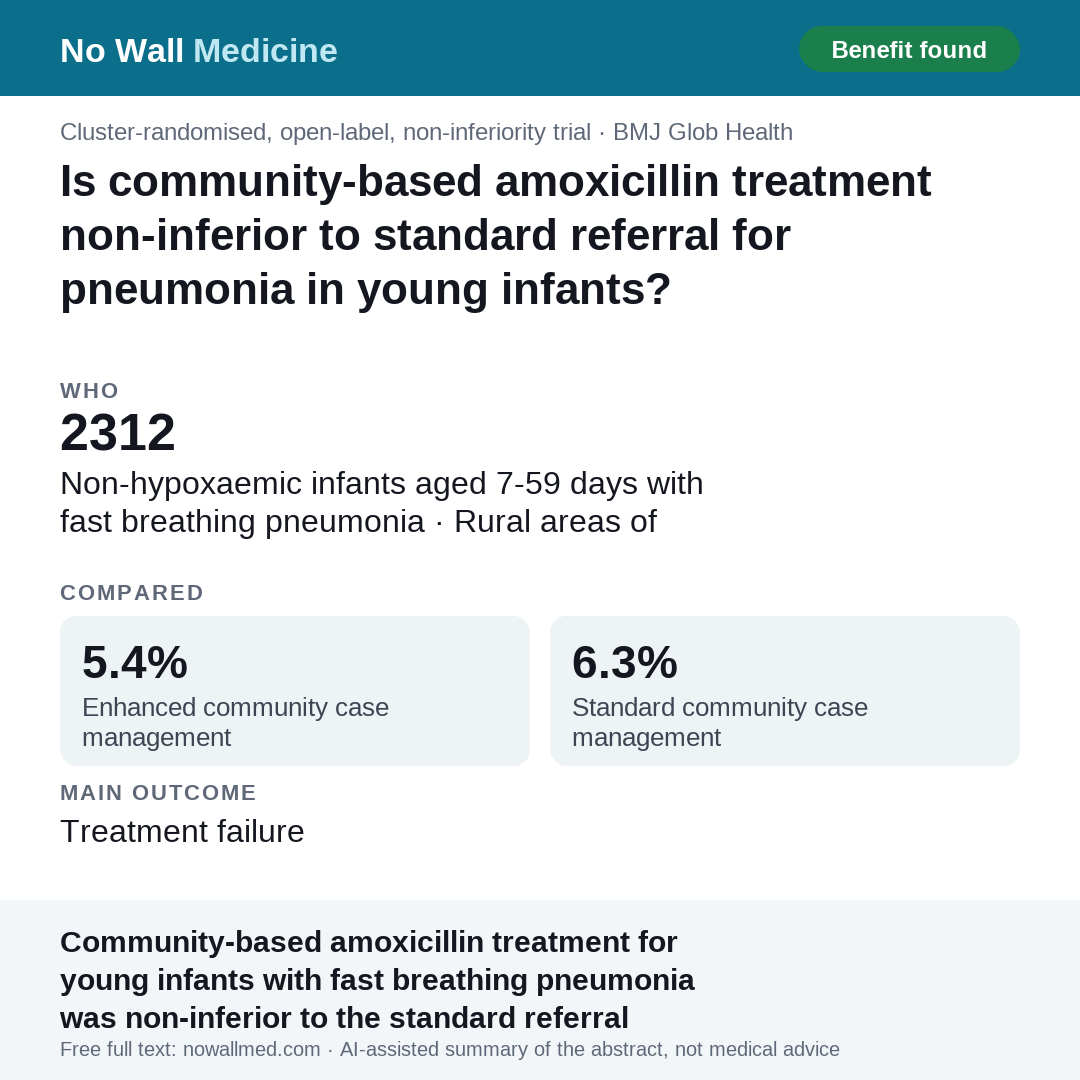
Is community-based amoxicillin treatment non-inferior to standard referral for pneumonia in young infants?
Who
2312
Non-hypoxaemic infants aged 7-59 days with fast breathing pneumonia · Rural areas of Bangladesh, Ethiopia, India and Malawi
Compared
5.4%Enhanced community case management (63/1155)
6.3%Standard community case management (73/1157)
Main outcome
Treatment failure
Result: risk difference -1.0% (95% CI -3.0% to 1.1%)
Bottom line: Community-based amoxicillin treatment for young infants with fast breathing pneumonia was non-inferior to the standard referral strategy.
BMJ Glob Health · 2021-08-21Download image
Clinical question: Is community-based amoxicillin treatment non-inferior to standard referral for pneumonia in young infants?
Why it matters: Current guidelines do not allow community-level health workers to treat young infants with fast breathing pneumonia, who are typically referred to health facilities.
Key points
- Researchers studied 2312 infants aged 7-59 days with fast breathing pneumonia across rural Bangladesh, Ethiopia, India, and Malawi.
- Treatment failure occurred in 5.4% of the community treatment group and 6.3% of the control group, with an adjusted risk difference of -1.0%.
- Community-level health workers in the intervention group performed all recommended steps of pulse oximetry assessment, which measures blood oxygen levels, in 94% of patients.
Headline and key points written with AI from the paper’s abstract, with every number checked against it. Read the paper before relying on them.
Was this summary helpful?
Abstract
Introduction
Young infants 7-59 days old with fast breathing pneumonia presented to a primary level health facility receive a 7-day course of amoxicillin as per the WHO guideline. However, community-level health workers (CLHW) are not allowed to treat these infants. This trial evaluated the community level treatment of non-hypoxaemic young infants with fast breathing pneumonia by CLHWs. Methods
This cluster-randomised, open-label, non-inferiority trial was conducted in rural areas of Bangladesh, Ethiopia, India and Malawi. We randomly allocated clusters (first-level health facility) 1:1, stratified by the population size, to an intervention group (enhanced community case management) or control group (standard community case management). Infants aged 7-59 days with a respiratory rate of ≥60 breaths/min and oxygen saturation (SpO2) ≥90% were enrolled. In the intervention clusters, these infants were treated with a 7-day course of oral amoxicillin (according to WHO weight bands) and were regularly followed up by CLHWs. In the control clusters, CLHWs continued the standard management (assess and refer after pre-referral antibiotic dose) and followed up according to the national programme guideline. The primary outcome of treatment failure was assessed in both groups by independent outcome assessors on days 6 and 14 after enrolment. Secondary outcomes (accuracy and impact of pulse oximetry) were also assessed. Results
Between September 2016 and December 2018, we enrolled 2334 infants (1168 in intervention and 1166 in control clusters) from 208 clusters (104 intervention and 104 control). Of 2334, 22 infants with fast breathing were excluded from analysis, leaving 2312 (1155 in intervention clusters and 1157 in control clusters) for intention-to-treat analysis. The proportion of treatment failure was 5.4% (63/1155) in intervention and 6.3% (73/1157) in the control clusters, including two deaths (0.2%) in each group. The adjusted risk difference for treatment failure between the two groups was -1.0% (95% CI -3.0% to 1.1%). The secondary outcome showed that CLHWs in the intervention clusters performed all recommended steps of pulse oximetry assessment in 94% (1050/1115) of enrolled patients. Conclusions
The 7-day amoxicillin treatment for 7-59 days old non-hypoxaemic infants with fast breathing pneumonia by CLHWs was non-inferior to the currently recommended referral strategy. Trial registration numbers
CTRI/2017/02/007761 and ACTRN12617000857303.
Abstract reproduced under the article’s CC BY licence.
Subject terms
Headline, design, result, key points, caveat and citation as plain text.
Cite this article
Enhanced Management of Pneumonia in Community (EMPIC) Study, Nisar YB. Community-based amoxicillin treatment for fast breathing pneumonia in young infants 7-59 days old: a cluster randomised trial in rural Bangladesh, Ethiopia, India and Malawi. BMJ Glob Health. 2021;6(8). doi:10.1136/bmjgh-2021-006578
Spotted a mistake? Suggest a correction