Individualised care planning and regular reviews may help older people sustain independence at home
Community based complex interventions to sustain independence in older people: systematic review and network meta-analysis
Systematic review and network meta-analysisBenefit found
Do community interventions sustain independence in older people
Who
74946
older people living at home, mean age sixty-five years or more
Compared
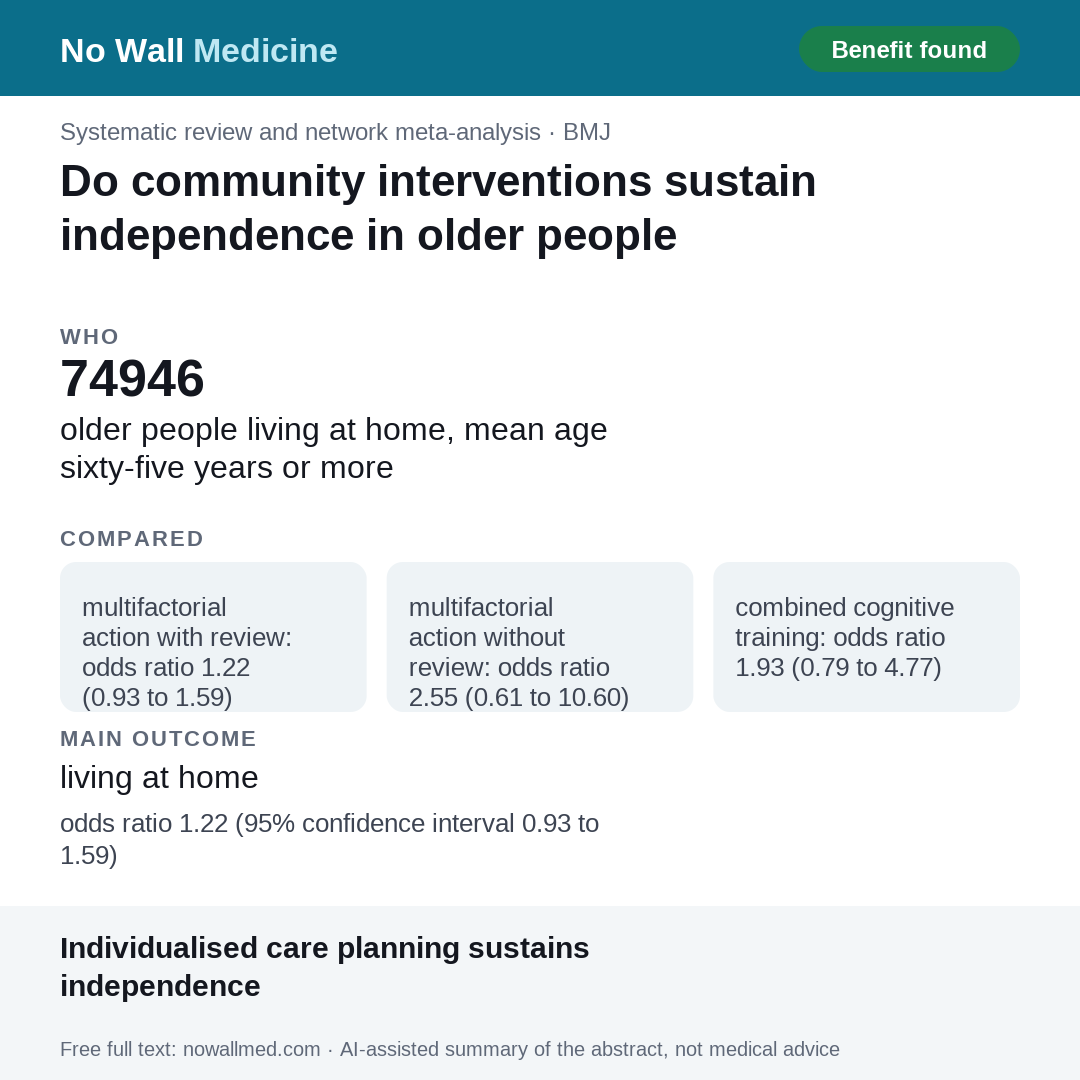
multifactorial action with review: odds ratio 1.22 (0.93 to 1.59)
multifactorial action without review: odds ratio 2.55 (0.61 to 10.60)
combined cognitive training: odds ratio 1.93 (0.79 to 4.77)
Main outcome
living at home
Result: odds ratio 1.22 (95% confidence interval 0.93 to 1.59)
Bottom line: Individualised care planning sustains independence
Limitation: high risk of bias and imprecise estimates
BMJ · 2024-03-21Download image
Why it matters: Evidence is needed to determine which combinations of community-based interventions are most effective at helping older people maintain their independence.
Key points
- Researchers analyzed 129 studies involving 74,946 participants to evaluate community-based complex interventions for older people living at home.
- Multifactorial action from individualised care planning, including medication review and regular follow-ups, was associated with higher odds of living at home (odds ratio 1.22, 95% confidence interval 0.93 to 1.59).
- For homecare recipients, adding individualised care planning and regular medication reviews was associated with better outcomes (0.60, 0.32 to 0.88).
Limitation the authors note: High risk of bias and imprecise estimates meant that most evidence was low or very low certainty.
Headline and key points written with AI from the paper’s abstract, with every number checked against it. Read the paper before relying on them.
Abstract
Objective
To synthesise evidence of the effectiveness of community based complex interventions, grouped according to their intervention components, to sustain independence for older people. Design
Systematic review and network meta-analysis. Data sources
Medline, Embase, CINAHL, PsycINFO, CENTRAL, clinicaltrials.gov, and International Clinical Trials Registry Platform from inception to 9 August 2021 and reference lists of included studies. Eligibility criteria
Randomised controlled trials or cluster randomised controlled trials with ≥24 weeks' follow-up studying community based complex interventions for sustaining independence in older people (mean age ≥65 years) living at home, with usual care, placebo, or another complex intervention as comparators. Main outcomes
Living at home, activities of daily living (personal/instrumental), care home placement, and service/economic outcomes at 12 months. Data synthesis
Interventions were grouped according to a specifically developed typology. Random effects network meta-analysis estimated comparative effects; Cochrane's revised tool (RoB 2) structured risk of bias assessment. Grading of recommendations assessment, development and evaluation (GRADE) network meta-analysis structured certainty assessment. Results
The review included 129 studies (74 946 participants). Nineteen intervention components, including "multifactorial action from individualised care planning" (a process of multidomain assessment and management leading to tailored actions), were identified in 63 combinations. For living at home, compared with no intervention/placebo, evidence favoured multifactorial action from individualised care planning including medication review and regular follow-ups (routine review) (odds ratio 1.22, 95% confidence interval 0.93 to 1.59; moderate certainty); multifactorial action from individualised care planning including medication review without regular follow-ups (2.55, 0.61 to 10.60; low certainty); combined cognitive training, medication review, nutritional support, and exercise (1.93, 0.79 to 4.77; low certainty); and combined activities of daily living training, nutritional support, and exercise (1.79, 0.67 to 4.76; low certainty). Risk screening or the addition of education and self-management strategies to multifactorial action from individualised care planning and routine review with medication review may reduce odds of living at home. For instrumental activities of daily living, evidence favoured multifactorial action from individualised care planning and routine review with medication review (standardised mean difference 0.11, 95% confidence interval 0.00 to 0.21; moderate certainty). Two interventions may reduce instrumental activities of daily living: combined activities of daily living training, aids, and exercise; and combined activities of daily living training, aids, education, exercise, and multifactorial action from individualised care planning and routine review with medication review and self-management strategies. For personal activities of daily living, evidence favoured combined exercise, multifactorial action from individualised care planning, and routine review with medication review and self-management strategies (0.16, -0.51 to 0.82; low certainty). For homecare recipients, evidence favoured addition of multifactorial action from individualised care planning and routine review with medication review (0.60, 0.32 to 0.88; low certainty). High risk of bias and imprecise estimates meant that most evidence was low or very low certainty. Few studies contributed to each comparison, impeding evaluation of inconsistency and frailty. Conclusions
The intervention most likely to sustain independence is individualised care planning including medicines optimisation and regular follow-up reviews resulting in multifactorial action. Homecare recipients may particularly benefit from this intervention. Unexpectedly, some combinations may reduce independence. Further research is needed to investigate which combinations of interventions work best for different participants and contexts. Registration
PROSPERO CRD42019162195.
Abstract reproduced under the article’s CC BY licence.
Topics
Cite this article
Crocker TF, Ensor J, Lam N, Jordão M, Bajpai R, Bond M. Community based complex interventions to sustain independence in older people: systematic review and network meta-analysis. BMJ. 2024. doi:10.1136/bmj-2023-077764
Spotted a mistake? Suggest a correction