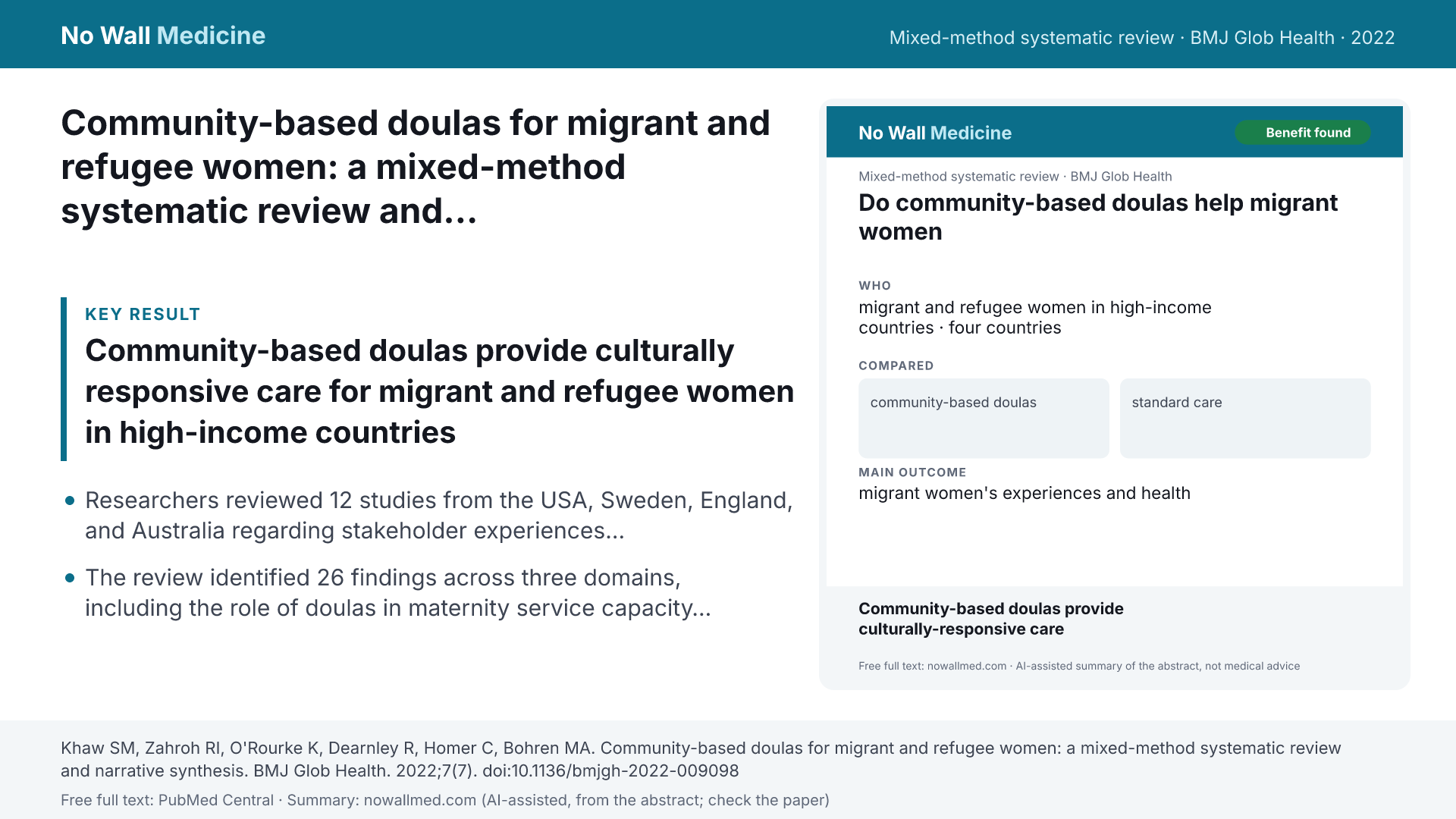
Community-based doulas provide culturally responsive care for migrant and refugee women in high-income countries
Community-based doulas for migrant and refugee women: a mixed-method systematic review and narrative synthesis
Mixed-method systematic reviewBenefit found
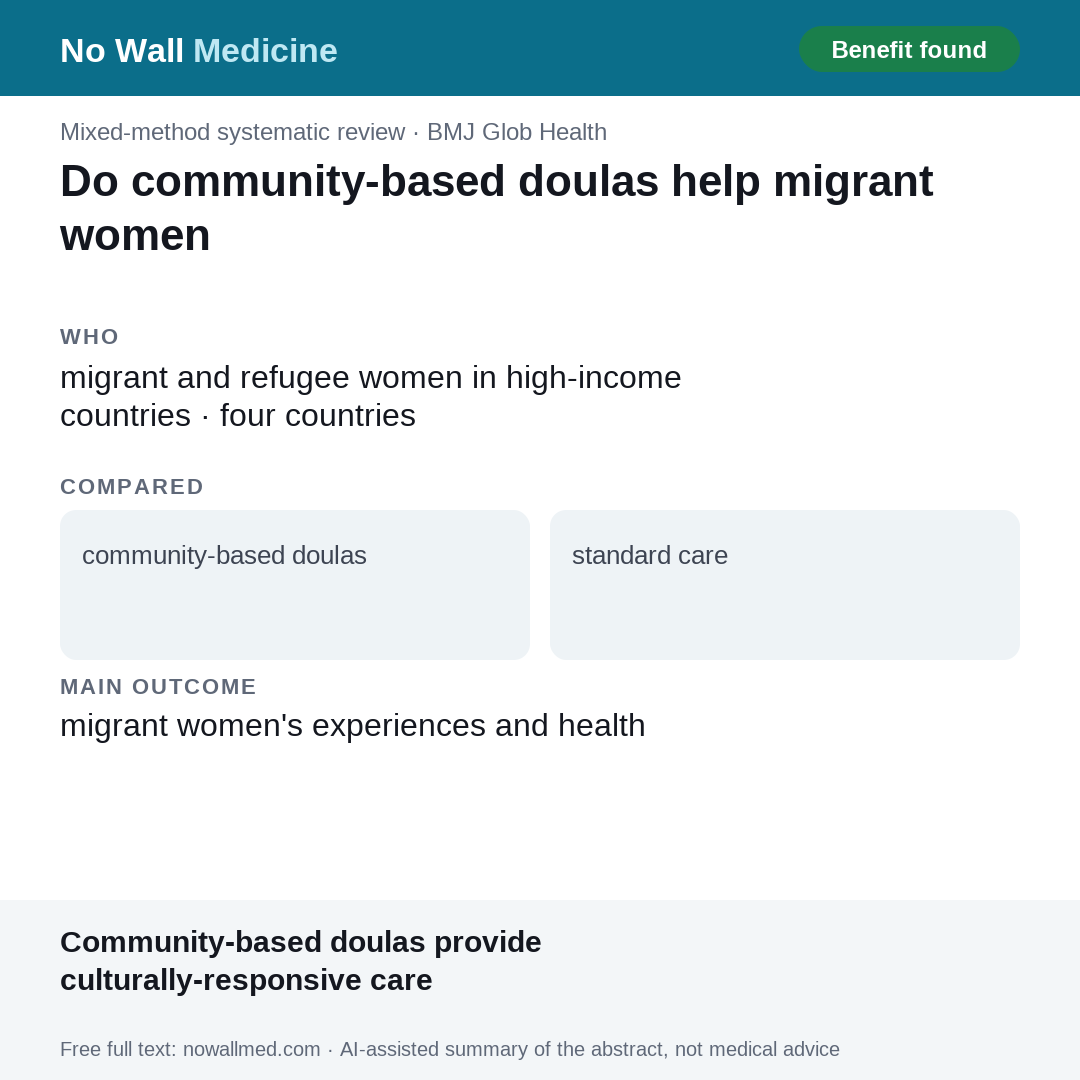
Do community-based doulas help migrant women
Who
migrant and refugee women in high-income countries · four countries
Compared
community-based doulas
standard care
Main outcome
migrant women's experiences and health
Bottom line: Community-based doulas provide culturally-responsive care
BMJ Glob Health · 2022-07-28Download image
Why it matters: It was unknown how stakeholders perceive community-based doula programs and what factors affect the implementation and sustainability of these programs for migrant and refugee women.
Key points
- Researchers reviewed 12 studies from the USA, Sweden, England, and Australia regarding stakeholder experiences with community-based doula programs.
- The review identified 26 findings across three domains, including the role of doulas in maternity service capacity and their impact on women's health.
- Findings suggest these programs can offer culturally responsive care to migrant and refugee women during labor and birth.
Headline and key points written with AI from the paper’s abstract, with every number checked against it. Read the paper before relying on them.
Was this summary helpful?
Abstract
Background
Community-based doulas share the same cultural, linguistic, ethnic backgrounds or social experiences as the women they support. Community-based doulas may be able to bridge gaps for migrant and refugee women in maternity settings in high-income countries (HICs). The aim of this review was to explore key stakeholders' perceptions and experiences of community-based doula programmes for migrant and refugee women during labour and birth in HICs, and identify factors affecting implementation and sustainability of such programmes. Methods
We conducted a mixed-method systematic review, searching MEDLINE, CINAHL, Web of Science, Embase and grey literature databases from inception to 20th January 2022. Primary qualitative, quantitative and mixed-methods studies focusing on stakeholders' perspectives and experiences of community-based doula support during labour and birth in any HIC and any type of health facility were eligible for inclusion. We used a narrative synthesis approach to analysis and GRADE-CERQual approach to assess confidence in qualitative findings. Results
Twelve included studies were from four countries (USA, Sweden, England and Australia). There were 26 findings categorised under three domains: (1) community-based doulas' role in increasing capacity of existing maternity services; (2) impact on migrant and refugee women's experiences and health; and (3) factors associated with implementing and sustaining a community-based doula programme. Conclusion
Community-based doula programmes can provide culturally-responsive care to migrant and refugee women in HICs. These findings can inform community-based doula organisations, maternity healthcare services and policymakers. Further exploration of the factors that impact programme implementation, sustainability, strategic partnership potential and possible wider-reaching benefits is needed.
Abstract reproduced under the article’s CC BY NC licence.
Subject terms
Cite this article
Khaw SM, Zahroh RI, O'Rourke K, Dearnley R, Homer C, Bohren MA. Community-based doulas for migrant and refugee women: a mixed-method systematic review and narrative synthesis. BMJ Glob Health. 2022. doi:10.1136/bmjgh-2022-009098
Spotted a mistake? Suggest a correction