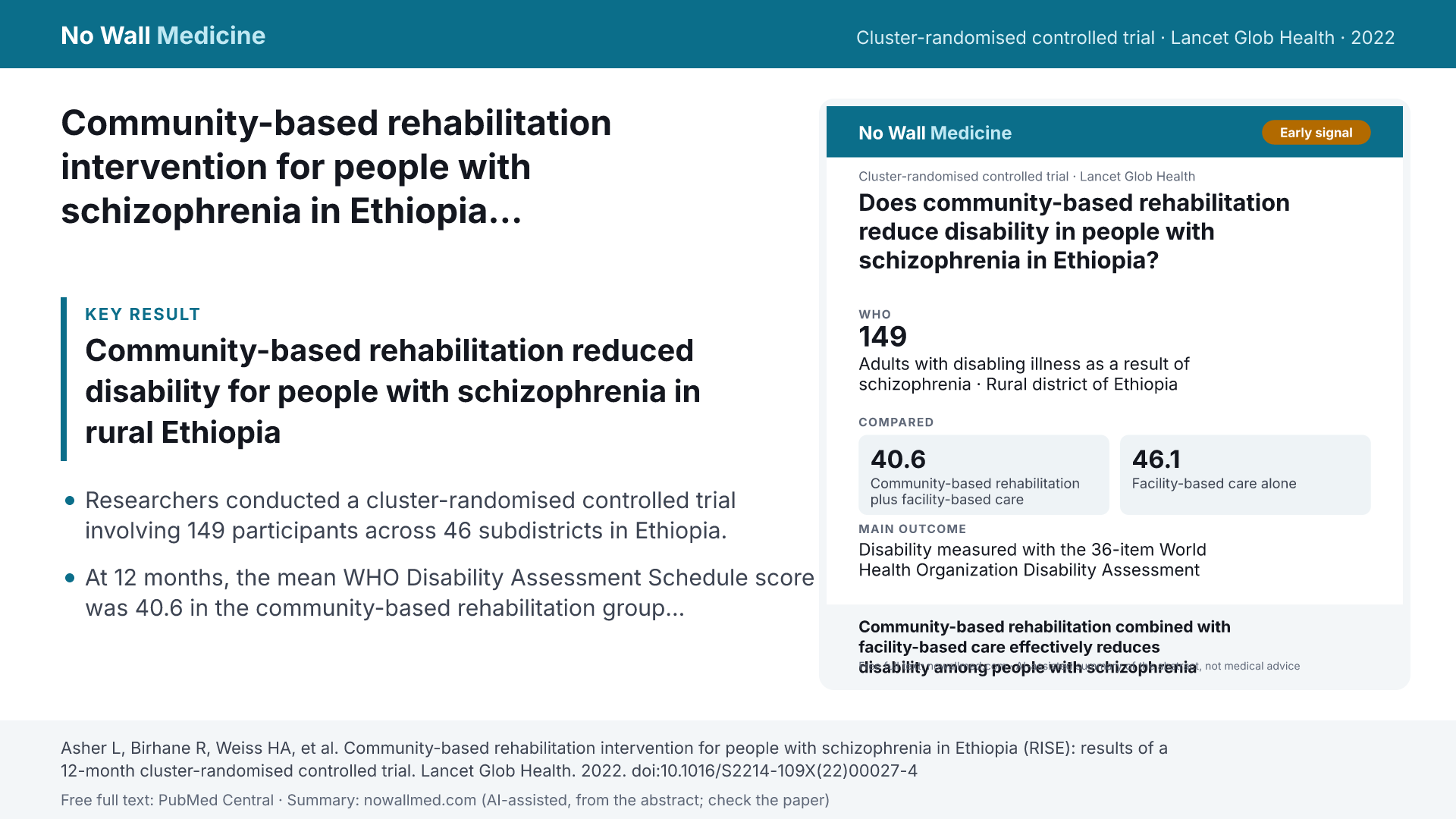
Community-based rehabilitation reduced disability for people with schizophrenia in rural Ethiopia
Community-based rehabilitation intervention for people with schizophrenia in Ethiopia (RISE): results of a 12-month cluster-randomised controlled trial
Cluster-randomised controlled trialEarly signal
Does community-based rehabilitation reduce disability in people with schizophrenia in Ethiopia?
Who
149
Adults with disabling illness as a result of schizophrenia · Rural district of Ethiopia
Compared
40.6Community-based rehabilitation plus facility-based care (22.5)
46.1Facility-based care alone (23.3)
Main outcome
Disability measured with the 36-item World Health Organization Disability Assessment Schedule score
Result: adjusted mean difference -8.13 (95% CI -15.85 to -0.40)
Bottom line: Community-based rehabilitation combined with facility-based care effectively reduces disability among people with schizophrenia in Ethiopia.
Funded by: Wellcome Trust
Lancet Glob Health · 2022-03-19Download image
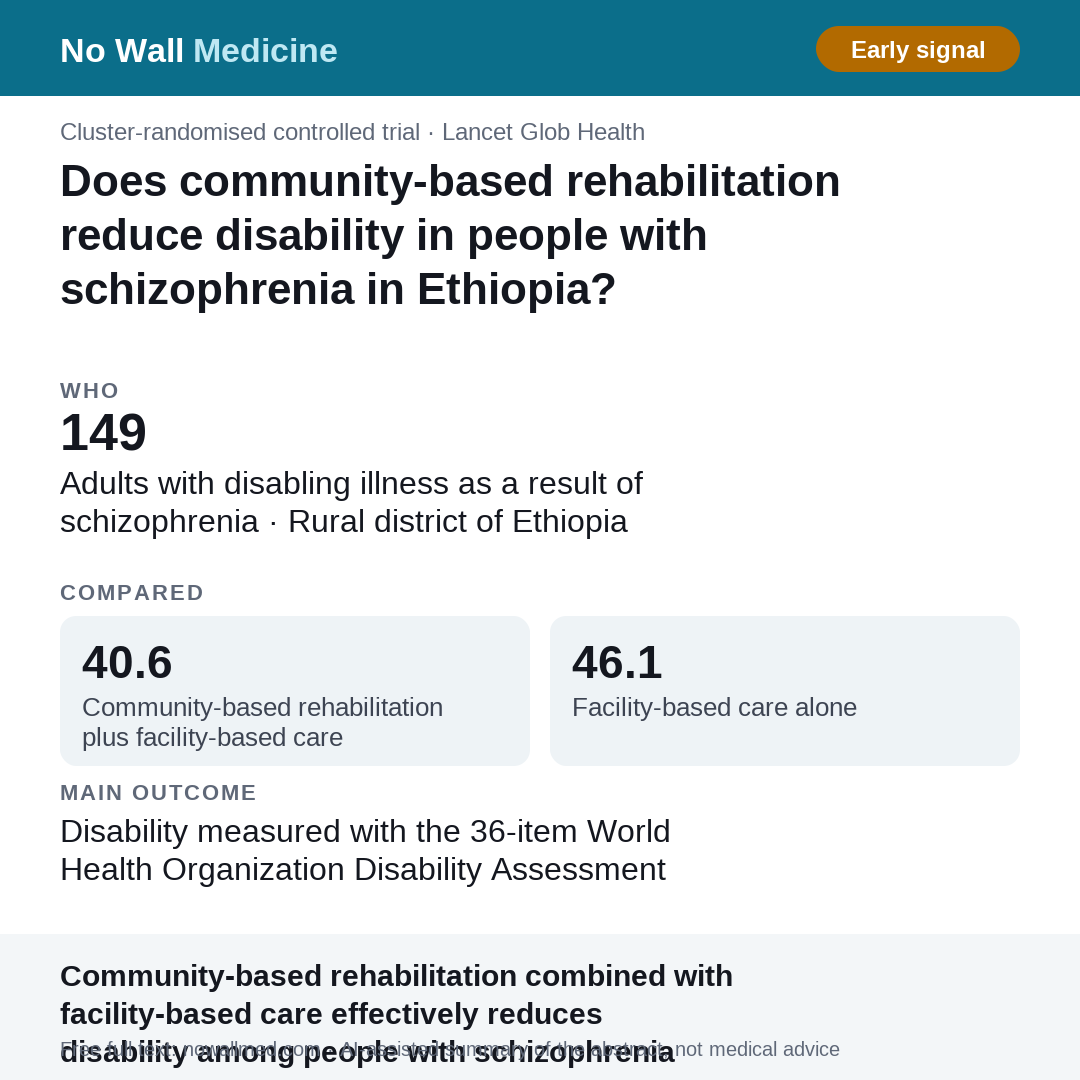
Clinical question: Does community-based rehabilitation reduce disability in people with schizophrenia in Ethiopia?
Key points
- Researchers conducted a cluster-randomised controlled trial involving 149 participants across 46 subdistricts in Ethiopia.
- At 12 months, the mean WHO Disability Assessment Schedule score was 40.6 in the community-based rehabilitation group compared to 46.1 in the facility-based care group.
- Serious adverse events, including death, suicide attempts, and hospitalisation, occurred in 5% of the intervention group and 10% of the control group.
Headline and key points written with AI from the paper’s abstract, with every number checked against it. Read the paper before relying on them.
Was this summary helpful?
Abstract
Background
Community-based rehabilitation (CBR) is recommended to address the social and clinical needs of people with schizophrenia in resource-poor settings. We evaluated the effectiveness of CBR at reducing disability at 12 months in people with schizophrenia who had disabling illness after having had the opportunity to access facility-based care for 6 months METHODS: This cluster-randomised controlled trial was conducted in a rural district of Ethiopia. Eligible clusters were subdistricts in Sodo district that had not participated in the pilot study. Available subdistricts were randomised (in a 1:1 ratio) to either the intervention group (CBR plus facility-based care) or to the control group (facility-based care alone). An optimisation procedure (accounting for the subdistrict mean WHO Disability Assessment Schedule (WHODAS) score and the potential number of participants per subdistrict) was applied for each of the eight health facilities in the district. An independent statistician, masked to the intervention or control label, used a computer programme to randomly choose the allocation sequence from the set of optimal ones. We recruited adults with disabling illness as a result of schizophrenia. The subdistricts were eligible for inclusion if they included participants that met the eligibility criteria. Researchers recruiting and assessing participants were masked to allocation status. Facility-based care was a task-shared model of mental health care integrated within primary care. CBR was delivered by lay workers over a 12-month period, comprising of home visits (psychoeducation, adherence support, family intervention, and crisis management) and community mobilisation. The primary outcome was disability, measured with the proxy-rated 36-item WHODAS score at 12 months. The subdistricts that had primary outcome data available were included in the primary analysis. This study is registered with ClinicalTrials.gov, NCT02160249. Findings
Enrolment took place between Sept 16, 2015 and Mar 11, 2016. 54 subdistricts were randomised (27 to the CBR plus facility-based care group and 27 to the facility-based care group). After exclusion of subdistricts without eligible participants, we enrolled 79 participants (66% men and 34% women) from 24 subdistricts assigned to CBR plus facility-based care and 87 participants (59% men and 41% women) from 24 subdistricts assigned to facility-based care only. The primary analysis included 149 (90%) participants in 46 subdistricts (73 participants in 22 subdistricts in the CBR plus facility-based care group and 76 participants in 24 subdistricts in the facility-based care group). At 12 months, the mean WHODAS scores were 46·1 (SD 23·3) in the facility-based care group and 40·6 (22·5) in the CBR plus facility-based care group, indicating a favourable intervention effect (adjusted mean difference -8·13 [95% CI -15·85 to -0·40]; p=0·039; effect size 0·35). Four (5%) CBR plus facility-based care group participants and nine (10%) facility-based care group participants had one or more serious adverse events (death, suicide attempt, and hospitalisation). Interpretation
CBR delivered by lay workers combined with task-shared facility-based care, was effective in reducing disability among people with schizophrenia. The RISE study CBR model is particularly relevant to low-income countries with few mental health specialists. Funding
Wellcome Trust.
Abstract reproduced under the article’s CC BY licence.
Subject terms
Headline, design, result, key points, caveat and citation as plain text.
Cite this article
Asher L, Birhane R, Weiss HA, et al. Community-based rehabilitation intervention for people with schizophrenia in Ethiopia (RISE): results of a 12-month cluster-randomised controlled trial. Lancet Glob Health. 2022. doi:10.1016/S2214-109X(22)00027-4
Spotted a mistake? Suggest a correction