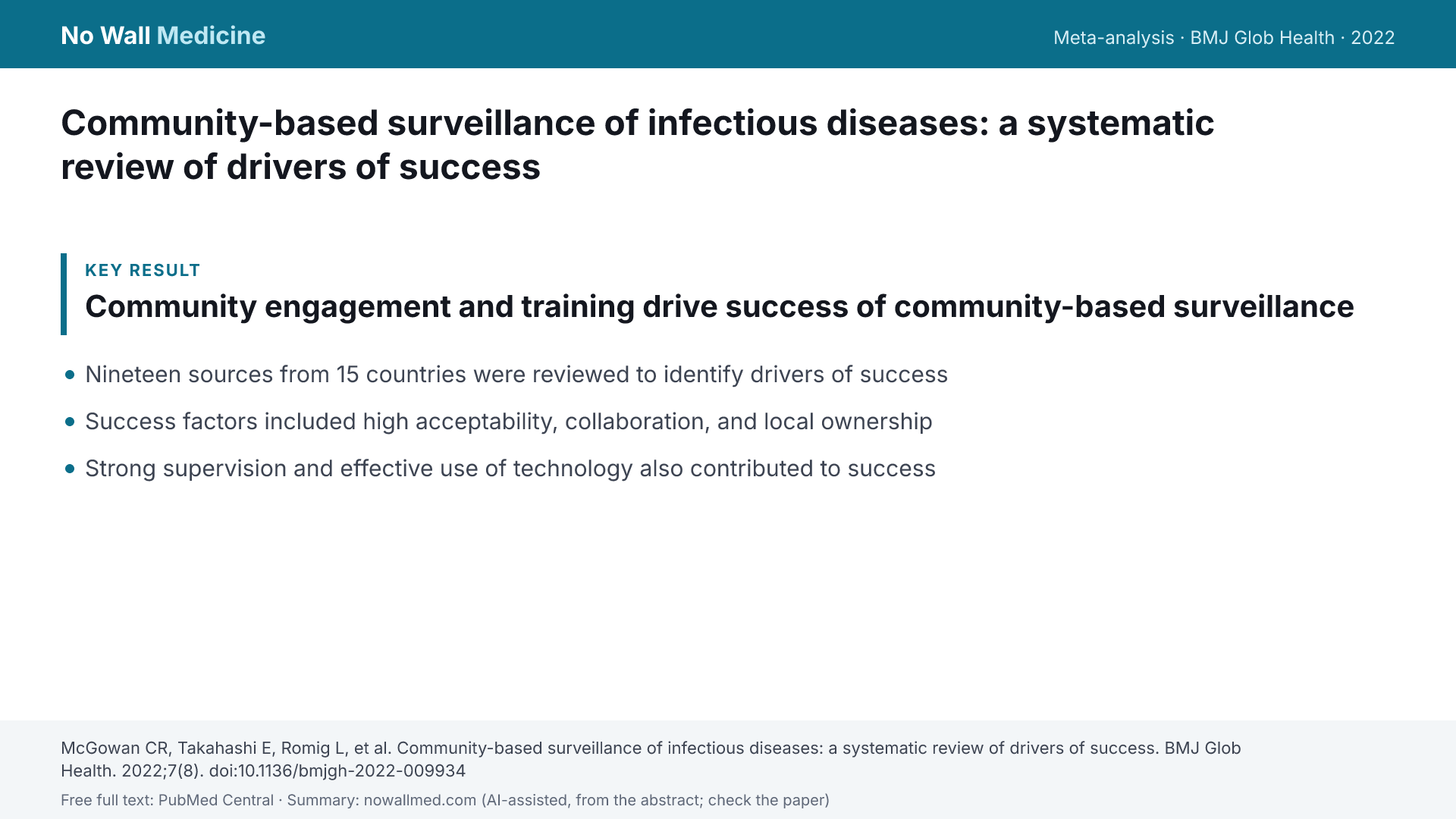
Community engagement and training drive success of community-based surveillance
Community-based surveillance of infectious diseases: a systematic review of drivers of success
Why it matters: The WHO had identified evidence gaps around community-centred approaches to health emergencies
Key points
- Nineteen sources from 15 countries were reviewed to identify drivers of success.
- Success factors included high acceptability, collaboration, and local ownership.
- Strong supervision and effective use of technology also contributed to success.
Headline and key points written with AI from the paper’s abstract, with every number checked against it. Read the paper before relying on them.
Was this summary helpful?
Abstract
Introduction
Community-based surveillance may improve early detection and response to disease outbreaks by leveraging the capacity of community members to carry out surveillance activities within their communities. In 2021, the WHO published a report detailing the evidence gaps and research priorities around community-centred approaches to health emergencies. In response, we carried out a systematic review and narrative synthesis of the evidence describing the drivers of success of community-based surveillance systems. Methods
We included grey literature and peer-reviewed sources presenting empirical findings of the drivers of success of community-based surveillance systems for the detection and reporting of infectious disease-related events. We searched for peer-reviewed literature via MEDLINE, EMBASE, Global Health, SCOPUS and ReliefWeb. We carried out grey literature searches using Google Search and DuckDuckGo. We used an evaluation quality checklist to assess quality. Results
Nineteen sources (17 peer-reviewed and 2 grey literature) met our inclusion criteria. Included sources reported on community-based surveillance for the detection and reporting of a variety of diseases in 15 countries (including three conflict settings). The drivers of success were grouped based on factors relating to: (1) surveillance workers, (2) the community, (3) case detection and reporting, (4) and integration. Discussion
The drivers of success were found to map closely to principles of participatory community engagement with success factors reflecting high levels of acceptability, collaboration, communication, local ownership, and trust. Other factors included: strong supervision and training, a strong sense of responsibility for community health, effective engagement of community informants, close proximity of surveillance workers to communities, the use of simple and adaptable case definitions, quality assurance, effective use of technology, and the use of data for real-time decision-making. Our findings highlight strategies for improving the design and implementation of community-based surveillance. We suggest that investment in participatory community engagement more broadly may be a key surveillance preparedness activity. Prospero registration number
CRD42022303971.
Abstract reproduced under the article’s CC BY NC licence.
Subject terms
Cite this article
McGowan CR, Takahashi E, Romig L, et al. Community-based surveillance of infectious diseases: a systematic review of drivers of success. BMJ Glob Health. 2022. doi:10.1136/bmjgh-2022-009934
Spotted a mistake? Suggest a correction