Cardiac resynchronization therapy reduces mortality and hospitalizations regardless of the number of comorbidities
Comorbidities and clinical response to cardiac resynchronization therapy: Patient-level meta-analysis from eight clinical trials
Patient-level meta-analysis of eight randomized trialsBenefit found
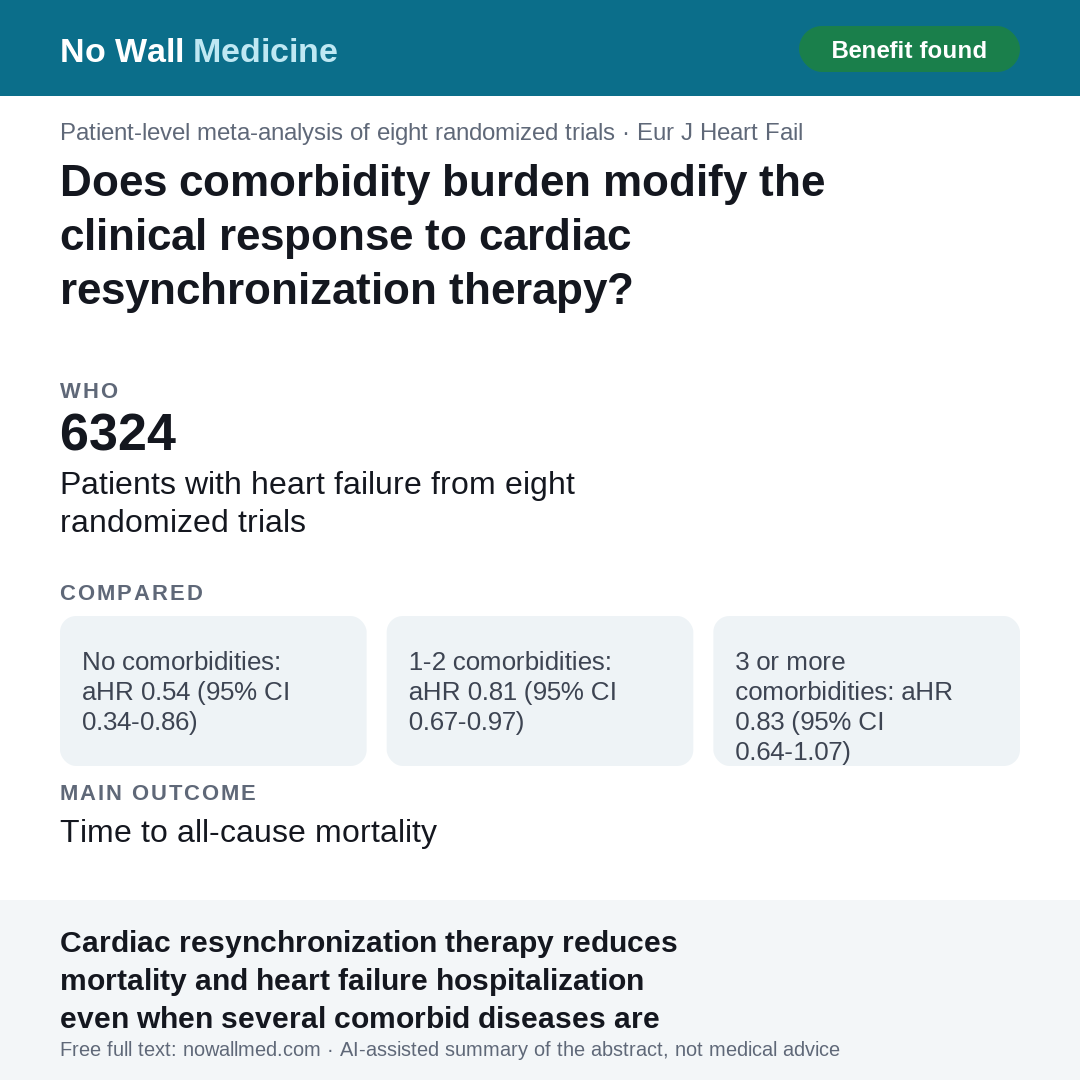
Does comorbidity burden modify the clinical response to cardiac resynchronization therapy?
Who
6324
Patients with heart failure from eight randomized trials
Compared
No comorbidities: aHR 0.54 (95% CI 0.34-0.86)
1-2 comorbidities: aHR 0.81 (95% CI 0.67-0.97)
3 or more comorbidities: aHR 0.83 (95% CI 0.64-1.07)
Main outcome
Time to all-cause mortality
Result: adjusted hazard ratio 0.79 (95% credible interval 0.68-0.93)
Bottom line: Cardiac resynchronization therapy reduces mortality and heart failure hospitalization even when several comorbid diseases are present.
Eur J Heart Fail · 2023-09-15Download image
Clinical question: Does comorbidity burden modify the clinical response to cardiac resynchronization therapy?
Why it matters: It was unknown if the number of additional medical conditions a patient has modifies the clinical response to cardiac resynchronization therapy.
Key points
- Researchers pooled data from 6324 patients across eight randomized trials to compare cardiac resynchronization therapy, a device treatment for heart failure, against no treatment.
- For all-cause mortality, the adjusted hazard ratio for cardiac resynchronization therapy was 0.79 in the overall cohort, including those with 0, 1-2, or ≥3 comorbidities.
- The therapy was associated with an adjusted hazard ratio of 0.74 for the combined outcome of heart failure hospitalization or all-cause mortality across the entire group.
Headline and key points written with AI from the paper’s abstract, with every number checked against it. Read the paper before relying on them.
Was this summary helpful?
Subject terms
Cite this article
Fudim M, Dalgaard F, Friedman DJ, Abraham WT, Cleland JGF, Curtis AB. Comorbidities and clinical response to cardiac resynchronization therapy: Patient-level meta-analysis from eight clinical trials. Eur J Heart Fail. 2023. doi:10.1002/ejhf.3029
Spotted a mistake? Suggest a correction
Top studies every Monday
The week’s key trials and guidelines in your specialties, plus any topics you follow. By email, free.
Get the weekly digest