Empowerment-based educational videos improved pain management confidence and reduced fear of movement in knee osteoarthritis
Comparative effect of two educational videos on self-efficacy and kinesiophobia in people with knee osteoarthritis: an online randomised controlled trial
Two-arm randomised controlled trialBenefit found
Do empowerment-based educational videos improve self-efficacy and kinesiophobia in knee osteoarthritis?
Who
589
People aged 45 years or older with knee pain · online survey
Compared
Empowerment and participatory discourse video
Disease and impairment discourse video
Main outcome
Self-efficacy for managing pain and kinesiophobia
Result: mean difference 0.4 (95%CI 0.2, 0.6) for self-efficacy and 1.6 (95%CI 1.1, 2.0) for kinesiophobia
Bottom line: Empowerment-based educational videos improved pain self-efficacy and reduced kinesiophobia more than disease-focused videos.
Osteoarthritis Cartilage · 2022-06-22Download image
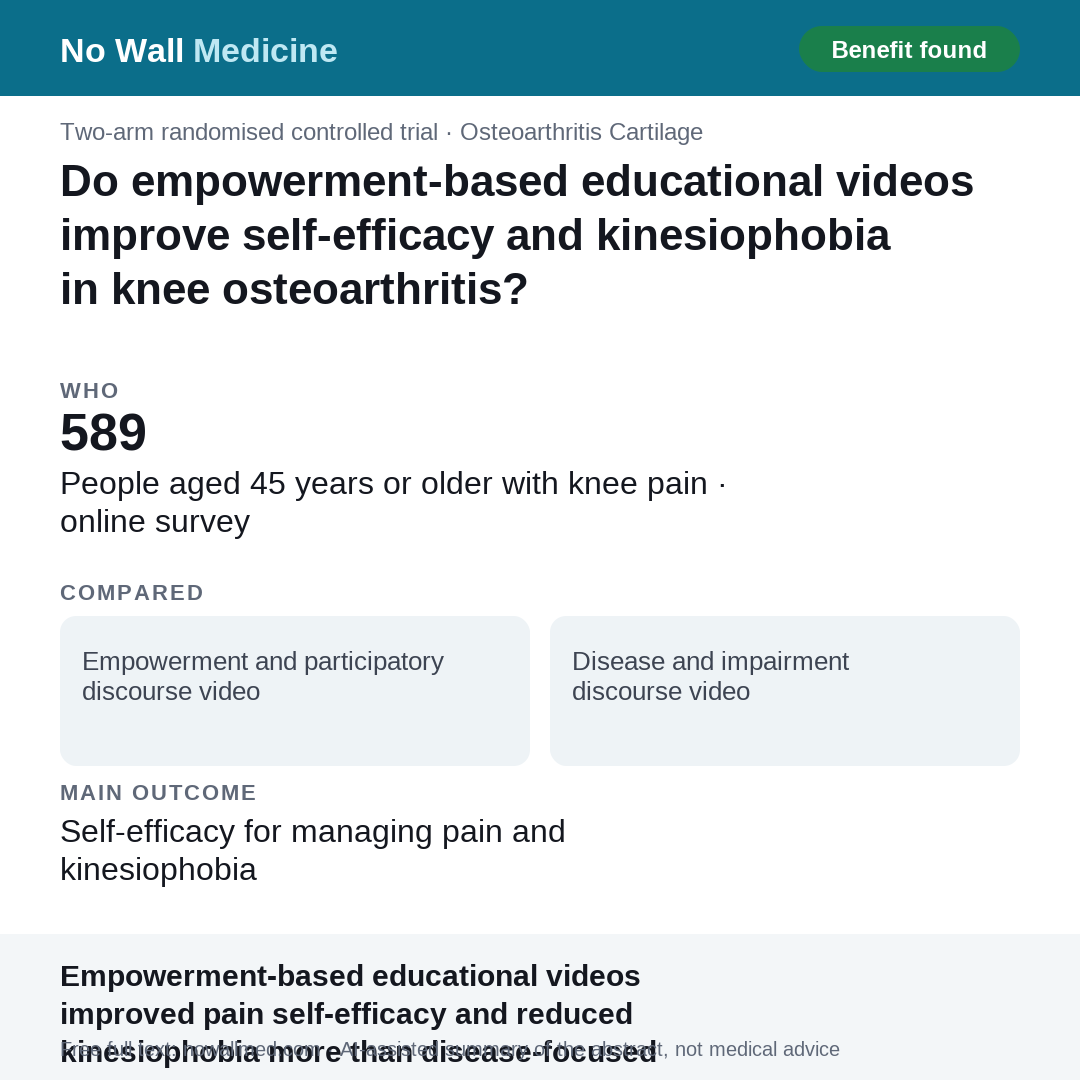
Clinical question: Do empowerment-based educational videos improve self-efficacy and kinesiophobia in knee osteoarthritis?
Why it matters: It was unknown whether educational videos focused on empowerment and activity participation are more effective than those focused on disease and impairment for managing knee osteoarthritis.
Key points
- Researchers conducted a randomized controlled trial with 589 participants aged 45 years or older with knee pain to compare two different types of educational videos.
- The group watching the empowerment-focused video showed a mean difference of 0.4 [95%CI 0.2, 0.6] units in pain self-efficacy and a 1.6 [1.1, 2.0] unit reduction in kinesiophobia, or fear of movement.
- The empowerment group also showed greater improvements in secondary outcomes such as knowledge and motivation, though hopefulness remained high in both groups.
Headline and key points written with AI from the paper’s abstract, with every number checked against it. Read the paper before relying on them.
Was this summary helpful?
Subject terms
Cite this article
Egerton T, Bennell KL, McManus F, Lamb KE, Hinman RS. Comparative effect of two educational videos on self-efficacy and kinesiophobia in people with knee osteoarthritis: an online randomised controlled trial. Osteoarthritis Cartilage. 2022. doi:10.1016/j.joca.2022.05.010
Spotted a mistake? Suggest a correction
Top studies every Monday
The week’s key trials and guidelines in your specialties, plus any topics you follow. By email, free.
Get the weekly digest