Multicomponent rehabilitation was most effective and acceptable for improving social participation in older adults
Comparative effectiveness and acceptability of non-pharmacological interventions on improving social participation among older adults: a Bayesian network meta-analysis of randomised controlled trials
Bayesian network meta-analysis of randomised controlled trialsBenefit found
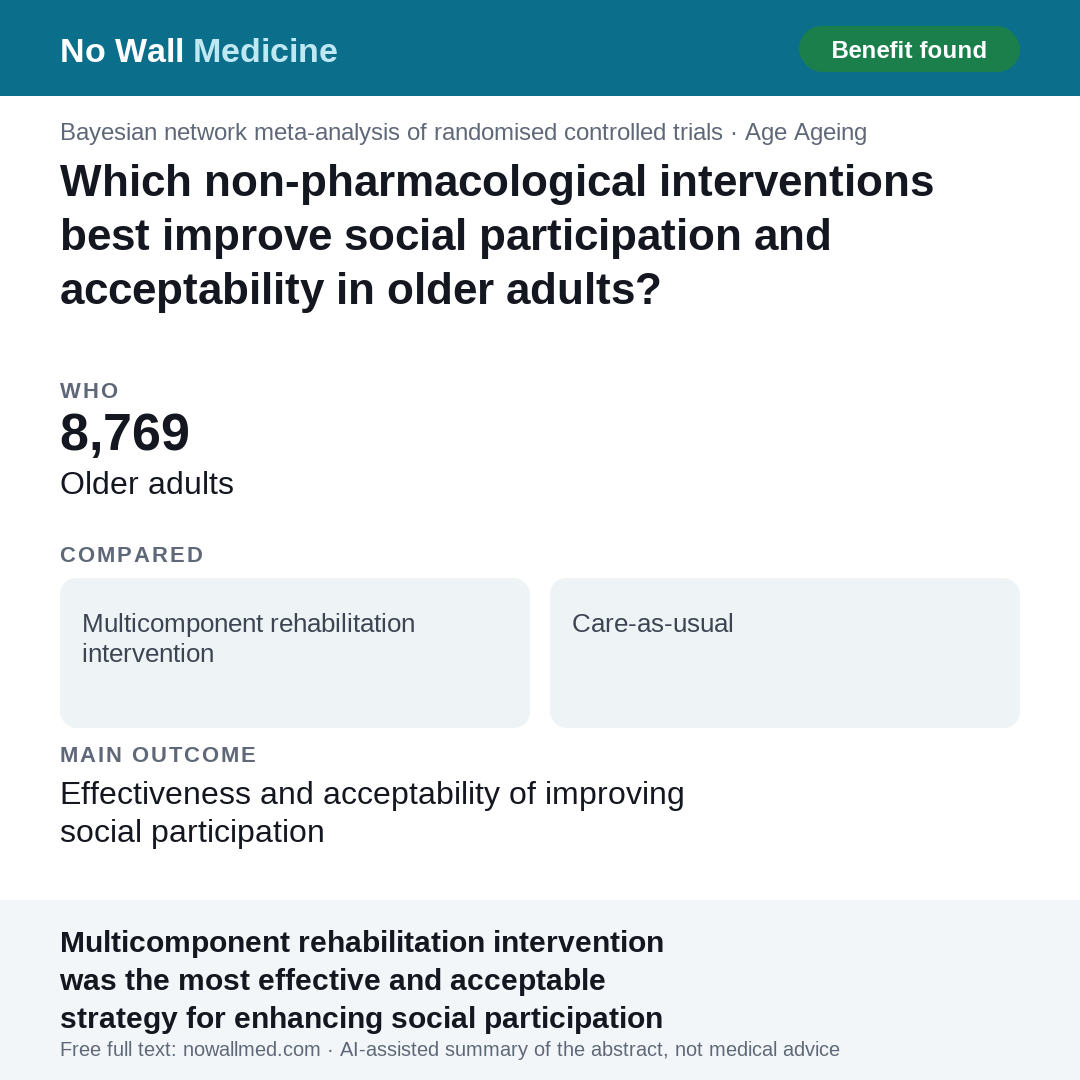
Which non-pharmacological interventions best improve social participation and acceptability in older adults?
Who
8,769
Older adults
Compared
Multicomponent rehabilitation intervention
Care-as-usual
Main outcome
Effectiveness and acceptability of improving social participation
Result: Standardized Mean Differences ranged from 0.32 to 0.77
Bottom line: Multicomponent rehabilitation intervention was the most effective and acceptable strategy for enhancing social participation among older adults.
Limitation: Most comparisons were rated as moderate to low for the certainty of evidence.
Age Ageing · 2025-07-30Download image
Clinical question: Which non-pharmacological interventions best improve social participation and acceptability in older adults?
Why it matters: Current evidence is inconclusive regarding which non-pharmacological interventions are most effective and widely acceptable for improving social participation among older adults.
Key points
- Researchers analyzed 54 randomized controlled trials involving 8,769 participants to compare nine non-drug interventions for social participation.
- Multicomponent rehabilitation, health education, and social interaction interventions showed positive effects compared to care-as-usual with standardized mean differences between 0.32 and 0.77.
- Home environment adaptation, psychological interventions, and social interaction interventions were less acceptable than comprehensive exercise interventions, with odds ratios from 3.86 to 5.28.
Headline and key points written with AI from the paper’s abstract, with every number checked against it. Read the paper before relying on them.
Topics
Cite this article
Yi M, Chen S, Chao J, Ma Y, Li X, Zhang H. Comparative effectiveness and acceptability of non-pharmacological interventions on improving social participation among older adults: a Bayesian network meta-analysis of randomised controlled trials. Age Ageing. 2025. doi:10.1093/ageing/afaf193
Spotted a mistake? Suggest a correction
Top studies every Monday
The week’s key trials and guidelines in your specialties, plus any topics you follow. By email, free.
Get the weekly digest