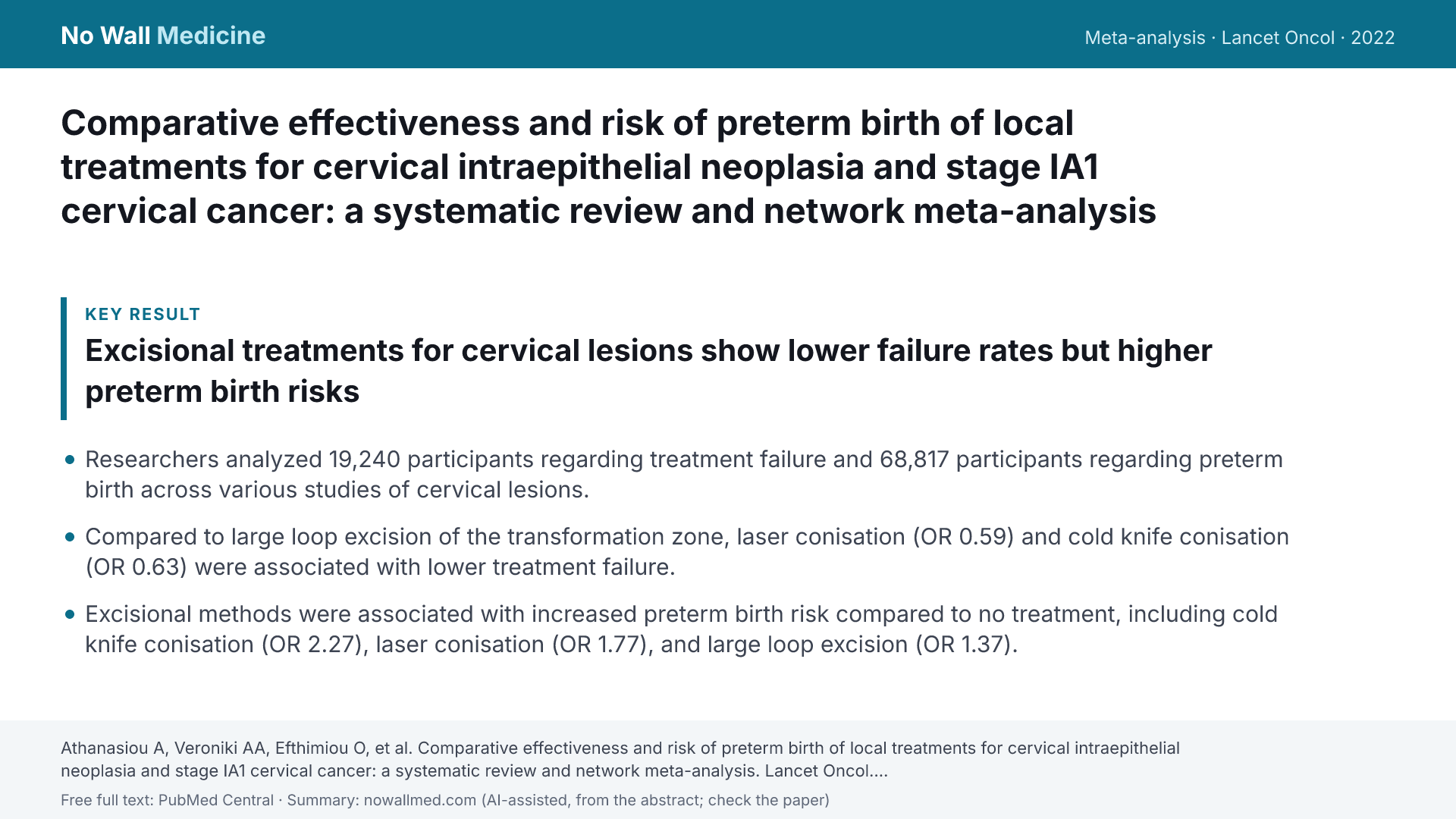
Excisional treatments for cervical lesions show lower failure rates but higher preterm birth risks
Comparative effectiveness and risk of preterm birth of local treatments for cervical intraepithelial neoplasia and stage IA1 cervical cancer: a systematic review and network meta-analysis
Systematic review and network meta-analysisMixed results
What are the risks of treatment failure and preterm birth for cervical intraepithelial neoplasia treatments?
Who
68817
Women with cervical intraepithelial neoplasia, glandular intraepithelial neoplasia, or stage IA1 cervical cancer
Compared
Large loop excision of the transformation zone
Laser conisation
Cold knife conisation
Laser ablation
Main outcome
Treatment failure and preterm birth
Bottom line: Excisional techniques reduce treatment failure but increase preterm birth risk, while ablative methods have higher failure rates but lower preterm birth risk.
Limitation: Evidence was based mostly on observational studies and the credibility of many comparisons was low.
Funded by: National Institute for Health and Care Research
Lancet Oncol · 2022-07-11Download image
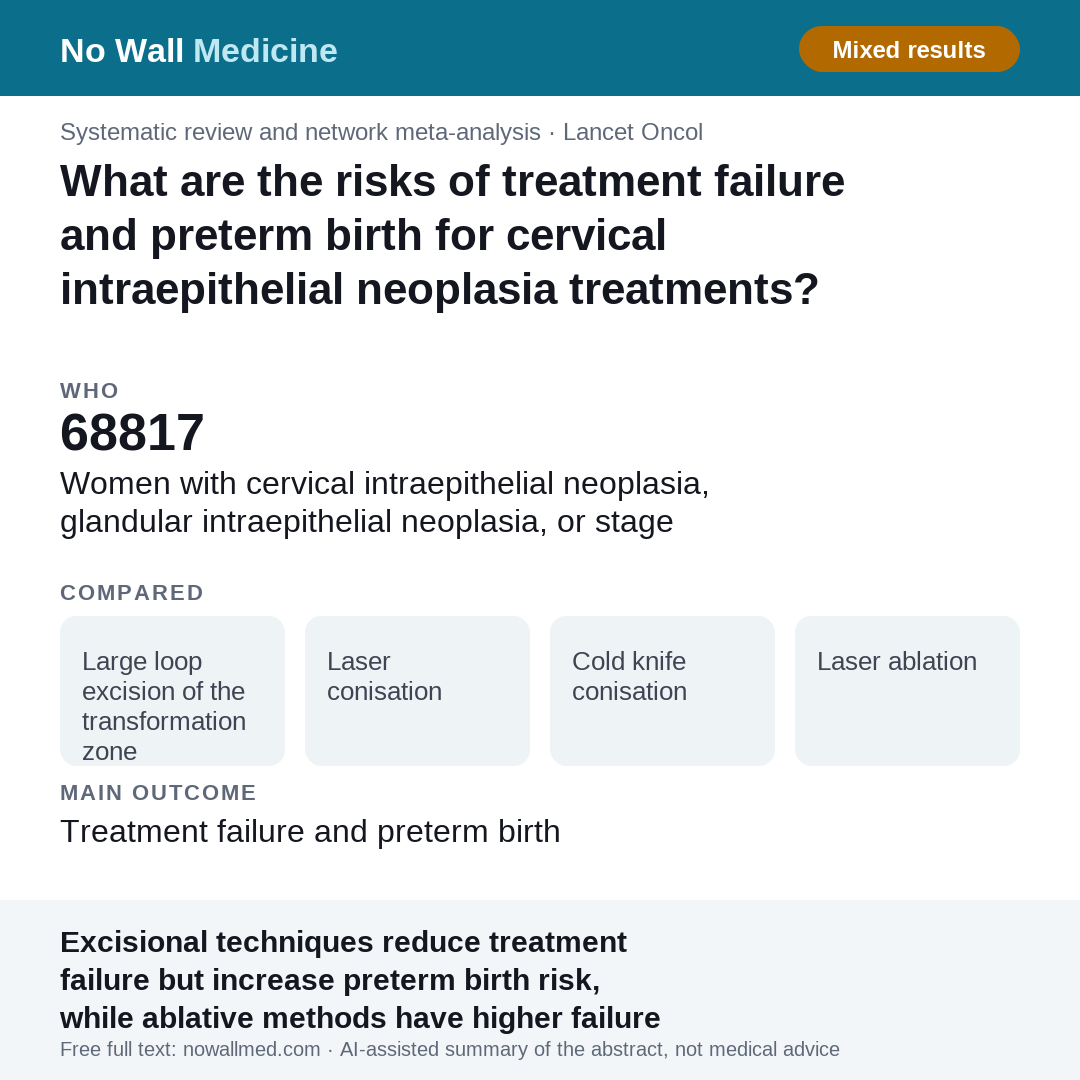
Clinical question: What are the risks of treatment failure and preterm birth for cervical intraepithelial neoplasia treatments?
Why it matters: The trade-off between the effectiveness of cervical lesion treatments and the risk of preterm birth remains unclear.
Key points
- Researchers analyzed 19,240 participants regarding treatment failure and 68,817 participants regarding preterm birth across various studies of cervical lesions.
- Compared to large loop excision of the transformation zone, laser conisation (OR 0.59) and cold knife conisation (OR 0.63) were associated with lower treatment failure.
- Excisional methods were associated with increased preterm birth risk compared to no treatment, including cold knife conisation (OR 2.27), laser conisation (OR 1.77), and large loop excision (OR 1.37).
Limitation the authors note: The evidence was based mostly on observational studies with inherent risks of bias, and the credibility of many comparisons was low.
Headline and key points written with AI from the paper’s abstract, with every number checked against it. Read the paper before relying on them.
Was this summary helpful?
Abstract
Background
The trade-off between comparative effectiveness and reproductive morbidity of different treatment methods for cervical intraepithelial neoplasia (CIN) remains unclear. We aimed to determine the risks of treatment failure and preterm birth associated with various treatment techniques. Methods
In this systematic review and network meta-analysis, we searched MEDLINE, Embase, and the Cochrane Central Register of Controlled Trials database for randomised and non-randomised studies reporting on oncological or reproductive outcomes after CIN treatments from database inception until March 9, 2022, without language restrictions. We included studies of women with CIN, glandular intraepithelial neoplasia, or stage IA1 cervical cancer treated with excision (cold knife conisation [CKC], laser conisation, and large loop excision of the transformation zone [LLETZ]) or ablation (radical diathermy, laser ablation, cold coagulation, and cryotherapy). We excluded women treated with hysterectomy. The primary outcomes were any treatment failure (defined as any abnormal histology or cytology) and preterm birth (<37 weeks of gestation). The network for preterm birth also included women with untreated CIN (untreated colposcopy group). The main reference group was LLETZ for treatment failure and the untreated colposcopy group for preterm birth. For randomised controlled trials, we extracted group-level summary data, and for observational studies, we extracted relative treatment effect estimates adjusted for potential confounders, when available, and we did random-effects network meta-analyses to obtain odds ratios (ORs) with 95% CIs. We assessed within-study and across-study risk of bias using Cochrane tools. This systematic review is registered with PROSPERO, CRD42018115495 and CRD42018115508. Findings
7880 potential citations were identified for the outcome of treatment failure and 4107 for the outcome of preterm birth. After screening and removal of duplicates, the network for treatment failure included 19 240 participants across 71 studies (25 randomised) and the network for preterm birth included 68 817 participants across 29 studies (two randomised). Compared with LLETZ, risk of treatment failure was reduced for other excisional methods (laser conisation: OR 0·59 [95% CI 0·44-0·79] and CKC: 0·63 [0·50-0·81]) and increased for laser ablation (1·69 [1·27-2·24]) and cryotherapy (1·84 [1·33-2·56]). No differences were found for the comparison of cold coagulation versus LLETZ (1·09 [0·68-1·74]) but direct data were based on two small studies only. Compared with the untreated colposcopy group, risk of preterm birth was increased for all excisional techniques (CKC: 2·27 [1·70-3·02]; laser conisation: 1·77 [1·29-2·43]; and LLETZ: 1·37 [1·16-1·62]), whereas no differences were found for ablative methods (laser ablation: 1·05 [0·78-1·41]; cryotherapy: 1·01 [0·35-2·92]; and cold coagulation: 0·67 [0·02-29·15]). The evidence was based mostly on observational studies with their inherent risks of bias, and the credibility of many comparisons was low. Interpretation
More radical excisional techniques reduce the risk of treatment failure but increase the risk of subsequent preterm birth. Although there is uncertainty, ablative treatments probably do not increase risk of preterm birth, but are associated with higher failure rates than excisional techniques. Although we found LLETZ to have balanced effectiveness and reproductive morbidity, treatment choice should rely on a woman's age, size and location of lesion, and future family planning. Funding
National Institute for Health and Care Research: Research for Patient Benefit.
Abstract reproduced under the article’s CC BY licence.
Subject terms
Cite this article
Athanasiou A, Veroniki AA, Efthimiou O, et al. Comparative effectiveness and risk of preterm birth of local treatments for cervical intraepithelial neoplasia and stage IA1 cervical cancer: a systematic review and network meta-analysis. Lancet Oncol. 2022. doi:10.1016/S1470-2045(22)00334-5
Spotted a mistake? Suggest a correction